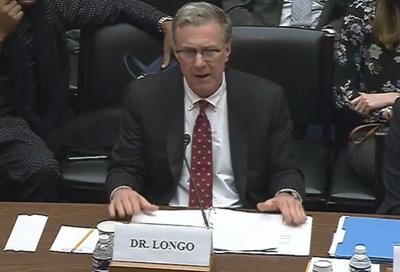


William Longo testifies before a congressional committee on asbestos and talc
TRENTON, N.J. - The experts who made talc litigation possible are on trial as a federal judge in New Jersey will decide whether their opinions are supported by real science or tailored to fit the story plaintiff lawyers want to tell jurors.
Expert opinions blaming cosmetic talc like Baby Powder for causing cancer “are grounded in results-oriented methods and are at odds with the U.S. scientific and medical consensus,” Johnson & Johnson said in a recent court filing. The stakes are high, as similar mass torts have fallen apart when judges tossed experts’ testimony after finding they couldn’t prove Zantac causes cancer or Tylenol causes autism.
Facing more than 67,000 lawsuits that allege talcum powder is tainted with asbestos, J&J has asked the judge overseeing multidistrict litigation to disqualify key witnesses, including William Longo, an expert who claims to find stray asbestos fibers in decades-old bottles of Johnson’s Baby Powder.
If they have Longo’s testimony in hand, plaintiff lawyers can then present medical experts who testify the asbestos fibers somehow migrated into the bodies of women to cause ovarian cancer. Johnson & Johnson is challenging those experts’ testimony as well, arguing they can’t explain how Baby Powder dusted on a woman’s lower body can work its way up through the genital tract and Fallopian tubes to the ovaries.
Despite these objections, a special master has recommended the judge overseeing multidistrict talc litigation allow jurors to hear the disputed evidence and decide for themselves whether the experts are right. In a Jan. 20 opinion, retired judge Freda L. Wolfson rejected most of J&J’s challenges even under stringent standards of evidence that require judges to act as “gatekeepers” and rigorously examine the methods and factual conclusions of expert witnesses. The MDL judge, Michael Shipp, will make the final call.
Judge Wolfson’s latest report largely repeats her 2020 opinion, before the federal rules on scientific evidence were tightened, to conclude there is no scientific consensus on talc and therefore “the question of whose experts are correct is a question for the jury.”
Johnson & Johnson says lay jurors aren’t qualified to figure out whether plaintiff experts are getting the science right. Most of the evidence supporting the plaintiff opinions comes from case-control studies, where researchers ask subjects who have already been diagnosed with a disease to say whether they used products suspected of causing it. Critics say such studies are prone to “recall bias” where subjects “remember” using the product they think made them sick.
There are larger problems, J&J says. The largest study, named after the principal author O’Brien, looked at 253,000 women and concluded in 2020 there was no statistically significant link between talc use and ovarian cancer. The authors revised the study in 2004, however, “imputing exposure” in cases where they didn’t have data or the study participants died, and found a 40% higher ovarian cancer risk in moderate users of talc.
Other plaintiff experts have written their own studies based in part upon the risk levels reported in O’Brien, J&J says, “creating an echo chamber for weak science that depends more on the volume of references than the quality of the data or the soundness of the methodology.”
Judge Wolfson also credited the experts’ use of the Bradford Hill methodology, a multipart test for the reliability of a scientific conclusion. The special master gave a pass to the most important part of that test, however, which is whether there is evidence of a dose-response relationship between talc and cancer. Nearly everyone already has billions of asbestos fibers in their bodies from ambient exposure, yet plaintiff experts haven’t shown the additional asbestos they say is in talc is enough to cause cancer, J&J says.
“Plaintiffs’ experts should not be allowed to tell a jury that a causal relationship between talc use and ovarian cancer exists when they concede that the `single most important factor’ in the Bradford Hill analysis does not support them,” J&J said in its objection to Judge Wolfson’s findings.
The American Tort Reform Association called this the “Junk Science Playbook” in a recent report. Plaintiff lawyers hire experts to produce evidence to support their cases, and those experts publish studies in pay-to-publish journals that lack rigorous peer review.
“Quasi-academic organizations, litigation-support laboratories, and agenda-driven nonprofits produce studies that conflict with mainstream science,” ATRA says.
Johnson & Johnson has aggressively been pushing back, winning court rulings against experts it says fabricated evidence. Last week, a federal judge in New Jersey allowed J&J’s trade libel suit to proceed against Dr. Jacqueline Moline, a frequent plaintiff expert who wrote a study claiming 33 cancer patients had “no known alternative exposure” to asbestos other than talc. It turns out at least 11 of the subjects had claimed other exposures in litigation, three of whom used Dr. Moline as an expert.
A court in Virginia also allowed a lawsuit against Dr. Theresa Emory over similar claims of fabricated study results.
Judge Wolfson still must hand down a recommendation on Longo, an expert who uses X-ray microscopy to detect what he says are asbestos fibers in talc. She held hearings in January and February on Longo’s methods, which J&J says are an amalgam of different regulatory standards that allow him to confuse jurors about what constitutes asbestos.
Longo once dismissed the idea of asbestos in talc as an “urban legend,” but then switched after lawyers hired him in talc cases. He has also switched methods, once bragging he’s “a TEM guy,” for transmission electron microscopy, but later changing to polarized light microscopy. Johnson & Johnson argues judges must consider such dramatic changes in methodology when assessing whether an expert’s opinions are reliable.
While Judge Shipp mulls the special master’s recommendations on expert witnesses, plaintiffs face another problem. The judge has been asked to disqualify Beasley Allen after a state appellate court in New Jersey removed the firm from talc cases for strategizing with a former lawyer for J&J. Beasley Allen is locked in a fight with its former partner in talc lawsuits, the Smith Law Firm, which recently filed the complaint of a disgruntled Beasley Allen client in federal court to bolster calls for its removal from the MDL.