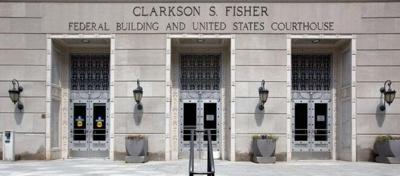


Clarkson S. Fisher U.S. Courthouse in Trenton, N.J.
TRENTON, N.J. - The law firm Beasley Allen’s control over thousands of talc lawsuits is in jeopardy, as a disgruntled client has hired one of its former business partners to push for disqualification.
The move follows a similar effort in New Jersey state courts, where appellate judges recently removed Beasley Allen from more than 3,000 cases for working with a lawyer who previously represented Johnson & Johnson, a defendant in these cases. The litigation alleges J&J’s talcum powder contained asbestos and caused ovarian cancer.
Now, plaintiff Aletha Wilson says Beasley Allen tried to trick her into signing a retroactive power of attorney giving the firm the power to vote against a $9 billion bankruptcy plan Johnson & Johnson once floated to settle talc litigation against it.
Beasley Allen voted against the bankruptcy plan on behalf of some 11,500 clients, claiming they were better off negotiating a settlement or suing in court. Allen says she stood to gain money under the bankruptcy plan but nothing if she sued in court, since plaintiff experts back claims Baby Powder can cause ovarian cancer, but not uterine cancer.
“I feel like (Beasley Allen) was trying to trick me into signing this Power of Attorney to cover up the fact that BA voted on behalf of clients, such as myself, without my consent and against my best interest,” Allen said in a declaration filed Feb. 18 in New Jersey federal court, where tens of thousands of cases are consolidated and Beasley Allen is lead counsel.
Smith’s allegations were filed by attorney Robert Allen Smith, whose firm formed a joint venture in 2014 with Beasley Allen to pursue talc lawsuits. The arrangement soured after a couple of years and Smith broke into open opposition with Beasley Allen over the J&J bankruptcy plan, which Smith supported and Beasley Allen opposed. Smith has accused Beasley Allen of violating its duties to clients by voting against the bankruptcy plan so it could try to earn larger fees in court.
Beasley Allen is suing Smith in federal court in Alabama, meanwhile, claiming Smith began “secretly undercutting” it in settlement talks because Smith is desperate to repay some $240 million to litigation funders. Smith is suing Ellington Financial, ICG Investments, Stifel Financial and other lenders in Mississippi, accusing them of a “loan to own” scheme to force the law firm into default and seize its talc fees.
The lenders’ “motivation was pure greed, realizing the billions of dollars at stake in the talc litigation,” Smith says in that lawsuit.
The New Jersey state Appellate Division took the unusual step of finding Beasley Allen violated professionalism rules when it strategized with James Conlan on a mass settlement of talc claims. The ruling disqualifies Beasley Allen from 3,600 cases in New Jersey state court.
Conlan was a former partner at Faegre Drinker Biddle & Reath who defended J&J in talc litigation. He left the firm to start Legacy Liability Solutions, where he attempted to buy the company’s talc liabilities and opposed the company’s ultimately unsuccessful plan to settle all cases in bankruptcy court.
Aletha Wilson says she was betrayed by Beasley Allen and attorney Andy Birchfield, who has testified that cases over some cancers have no value in court because they aren’t backed by science. Despite that, J&J included those cases in its settlement plan in bankruptcy court, but since it was defeated those claims might be worthless.
“Beasley Allen described the Power of Attorney as an innocuous prophylactic measure ‘just in case’ Johnson & Johnson makes ‘a future bankruptcy attempt,’” Wilson says.
“However, the Power of Attorney contains language intended to retroactively authorize Beasley Allen to vote on behalf of Wilson against her interests in opposition to the Red River Talc LLC bankruptcy plan which had already been ruled upon.
“Given the obvious legal and ethical problems that a retroactive power of attorney presents, Beasley Allen drafted its Power of Attorney to appear to ‘affirm’ and ‘confirm’ existing authorities, rather than to create new ones.”
Juries have ruled for and against J&J in ovarian cancer cases, and some plaintiffs have been awarded huge amounts.
For example, two women won $40 million in December in Los Angeles. The largest-ever was $4.69 billion in 2018 that was later reduced to $2.1 billion, and late last year a Maryland jury awarded $1.5 billion.