
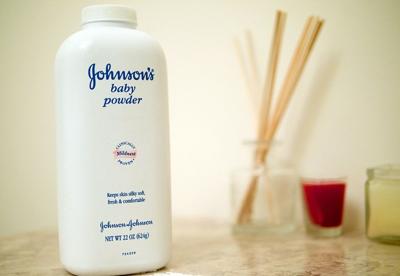


Johnson & Johnson Baby Powder no longer contains talc powder.
LOS ANGELES - A Los Angeles County jury has ordered pharmaceutical and personal care product maker Johnson & Johnson to pay a combined $40 million to two women who claim they contracted ovarian cancer from trace amounts of asbestos allegedly contained in talc used at the time in baby powder.
Johnson & Johnson said the verdict came about in a trial marked by "legal errors" based on claims with "no scientific validity." A company spokesperson noted J&J has prevailed in 16 of the 17 trials involving talc-related ovarian cancer claims. The spokesperson said J&J would immediately appeal the verdict and they "expect to prevail as we typically do with aberrant adverse verdicts."
The verdict came at the conclusion of the first in a series of so-called bellwether trials set up by the L.A. court to test the validity of the claims underlying hundreds of lawsuits filed in California state courts seeking potentially massive payouts from J&J.
In the new verdict, jurors awarded $18 million to plaintiff Monica Kent and $22 million to Deborah Schultz. The damages were awarded entirely as compensatory damages. No punitive damages - or payouts ordered to punish a company for allegedly egregious conduct - were tacked on to the verdicts.
The trial had begun in mid-November and wrapped up Dec. 15.
Tens of thousands of lawsuits have been lodged in courts in California and across the U.S. against J&J, all claiming that plaintiffs or their family members contracted cancer after allegedly being exposed to trace amounts of asbestos allegedly contained within talc used in baby powder manufactured and sold for decades by J&J.
More than 50,000 cases have been particularly centralized in federal court in New Jersey, with about 800 others centralized in L.A. County Superior Court.
In court, J&J has assailed the cancer link claims as essentially "junk science."
To date, most of the claims to go to trial have asserted asbestos in baby powder caused a deadly lung cancer known as mesothelioma.
Those lawsuits largely followed the 2019 publication of a study by Dr. Jacqueline Moline, of Northwell Health, which claimed exposure to talcum powder alone could cause mesothelioma.
However, J&J has sued Moline, claiming she knowingly included falsehoods in her study, including allegedly knowing that more than half of the subjects of her study had been exposed to asbestos through other products or had claimed such exposure in legal actions filed against other manufacturers alleging their products had caused them to contract mesothelioma.
Similarly, J&J has argued the alleged link between talc in baby powder and other forms of cancer isn't backed up by science.
The cases, however, have proceeded to trial in courts in various court systems in recent years.
To help determine the strength of the cases, judges and lawyers for both sides identified certain cases to take to trial, as so-called "bellwether" cases.
The most recent L.A. verdict came at the conclusion of the first such case in the consolidated proceedings in Los Angeles state court.
At the same time, J&J has sought to use the bankruptcy process to absorb the potential cost of the liability through a spinoff company. That attempt was blocked by a federal bankruptcy judge in Texas earlier this spring.
Opposition to the bid was led by the plaintiffs' law firm of Beasley Allen, which is serving as co-lead counsel in the consolidated proceedings in New Jersey and L.A., and as such, is poised to potentially reap a big fee award from any settlement.
Lawyers from Beasley Allen also represented the plaintiffs in the most recent ovarian cancer trial in Los Angeles.
In a statement emailed to The Record following the trial, Beasley Allen attorney Andy Birchfield said: “These jurors heard and saw that Johnson & Johnson withheld crucial information, manipulated scientific research, and misled regulators for decades. These brave women trusted J&J with their health and safety, only to be betrayed by a company that knew about the dangers but kept the truth hidden. The jurors saw the truth, and the verdict speaks the truth about the seriousness of their injuries.”
Birchfield's colleague, Leigh O’Dell, who also serves as co-lead of the Multi-District Litigation Plaintiffs' Steering Committee, said: “This verdict sends an unmistakable message that no amount of legal maneuvering or corporate intimidation will prevent juries from holding J&J accountable."
J&J, however, said the trial was riddled with errors, and the company believed it will ultimately defeat the verdict.
"Today’s result is irreconcilable with the decades of independent scientific evaluations confirming that talc is safe, does not contain asbestos, and does not cause cancer," said Erik Haas, J&J's Worldwide Vice President of Litigation. “These talc lawsuits clog courts and impose extraordinary costs on the judicial system with contrived ‘scientific’ debates that should be presented to and decided by the scientific agencies authorized by Congress to evaluate such questions. This why the Company continues to expose the plaintiff’s bar and their so-called experts through affirmative litigation.”