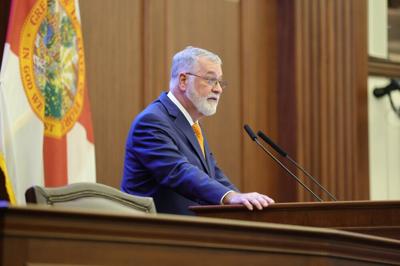



Florida Senate President Ben Albritton warned that the passage of a new congressional map may be followed by lawsuits.
Florida lawmakers are scheduled to begin a four-day special session on Monday to consider the redrawing of congressional districts, a process that could unleash a flurry of litigation if a new congressional map is approved.
In January, Gov. Ron DeSantis issued a proclamation saying the session would take place this week, but that time frame was postponed. The governor called on the Legislature to consider a new mid-decade congressional map that would more accurately reflect the state’s population growth and possible redistricting guidance from the U.S. Supreme Court.
But the high court’s anticipated opinion in Louisiana v. Callais, which could weaken provisions of the federal Voting Rights Act, has yet to be issued. And the special session has been recast to include two other topics: proposed legislation to better safeguard children from the advance of artificial intelligence and “medical freedom” reforms, including a K-12 exemption from vaccine requirements.
The redistricting effort also comes in the wake of President Trump urging red states to favor the election of GOP Congress members in mid-term elections in the fall. Redistricting critics, however, have pointed out that the Florida Constitution contains provisions that bar state lawmakers from reconfiguring electoral districts if the intent is to favor one political party or incumbent.
So far, the Governor’s Office has not issued a new congressional map, but DeSantis’ press secretary, Molly Best, hinted that such a proposal may be in the works. In response to a query about a new congressional map, Best emailed, “Stay tuned!”
Neither the Florida Democratic Party nor the House Speaker’s Office responded to requests for comment about the special session, but Senate President Ben Albritton issued a memo on April 15 saying that the upper house is not drafting a map for the special session.
“It is our expectation that pursuant to the proclamation issued by the governor and consistent with the process undertaken during the 2022 Special Session on Congressional Reapportionment, a proposal will be transmitted from the Governor’s Office to the Senate for our consideration,” Albritton stated.
He also warned senators to maintain records of their communications during the session since they might be compelled to produce such records or testify under oath in future legal proceedings.
“As a reminder, senators should be aware that in prior cycles, significant litigation has followed passage of new maps,” Albritton said, adding that the Florida Supreme Court has placed limits on legislative privilege as it relates to redistricting.
Lawmakers’ conversations with outside parties seeking to influence lawmakers to pass congressional maps that favor or disfavor a particular political party or incumbent could be brought up during future legal proceedings, according to the memorandum.
The DeSantis proclamation indicates that lawmakers may not only need to draw up a new congressional map but appropriate additional funding for the anticipated litigation to follow.
The political arguments for redistricting have also evolved in the wake of Trump’s waning poll ratings and recent Democratic Party successes in Florida special elections. An April 12 paper by Alex Alvarado, executive director of the St. Augustine-based Civic Data & Research Institute, concludes that a plan to aggressively maximize the GOP congressional seat count in Florida could backfire.
“... Any attempt to generate additional Republican-leaning seats necessarily requires diluting existing Republican vote margins across a larger geographic footprint,” Alvarado said. “... Modeling suggests that aggressive redistricting would increase competitive seats from four to seven while producing zero net gain in Republican seats.”