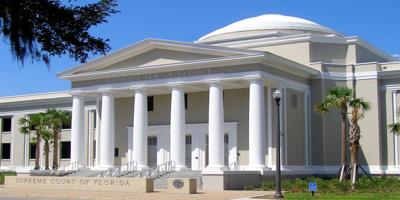


Florida Supreme Court
The Florida Supreme Court has agreed to hear a case about the constitutionality of a state statute allowing Florida’s nonprofit insurer of last resort to require claims be decided before a state agency that adjudicates administrative disputes.
The high court accepted jurisdiction in the case of Citizens Property Insurance Corp. v. Victoria Quintana et al. on Sept. 17. State-run Citizens is petitioning the court to overturn an 11th Judicial Circuit decision that found the arbitration requirement created the appearance of impropriety since it involved the insurer’s “bedfellow agency,” the Florida Department of Administrative Hearings (DOAH).
A 2023 state law gave Citizens the authority to require policyholders to resolve their insurance claims through binding arbitration before DOAH. Citizens is now the only insurer in Florida permitted to mandate that its claims be resolved through the DOAH arbitration process, according to an analysis prepared by the state House of Representatives.
Since the law’s enactment, several legal actions have challenged the mandatory arbitration process based on arguments that it deprives policyholders of due process, access to civil courts and jury trials. But Citizens argues that the arbitration process is more efficient and less time-consuming for all parties.
“The DOAH arbitration process has been transparently settling government and agency disputes in Florida for more than 50 years,” Citizens spokesman Michael Peltier said in an email to the Florida Record. “This issue has been working its way through the courts for some time, and we look forward to making our arguments before the Florida Supreme Court regarding the constitutionality of the program.”
According to the Legislature’s analysis of an unsuccessful bill filed this year to give policyholders a veto power over using the DOAH arbitration process, the average resolution time for insurance claims before DOAH is 93 days, compared to 618 days in the state court system.
In addition, about eight in 10 such claims are resolved through a voluntary settlement, the analysis reported, but nearly half of those cases involved policyholders accepting a “nominal” amount of $500 or less.
The Miami judge who sided with plaintiff Quintana against Citizens in May found that the insurer’s relationship with its “sister agency” in the executive branch created an impression that falls short of judicial impartiality.
“The symbiotic relationship between Citizens and DOAH serves only to add to the appearance of impropriety,” 11th Circuit Judge Milton Hirsch said in his opinion. “Citizens provides DOAH with much of its work, and with much of its revenue for that work. Manus manum lavat … One hand washes the other. Must Floridians not think the same here?
The Legislature’s analysis indicated that in December of 2024, Citizens agreed to pay DOAH $19.3 million to fund the arbitration of its insurance claims through the end of next year. That level of funding allows DOAH’s administrative law judges to review 320 claims per month from 2025 through 2027, the analysis says.
Hirsch indicated that amending the arbitration process could resolve plaintiffs’ objections to the Citizens policy.
“The circumstances of the present case do not allow for participation by the plaintiffs in the choice of arbitrators, which if allowed might ameliorate due-process concerns,” he said. “The circumstances of the present case do not provide for independent arbitrators, unaligned with the executive branch of Florida government, which if provided for might ameliorate due-process concerns.”
The Supreme Court said initial briefs in the case will be filed in October and November, with oral arguments to be set at a later date.