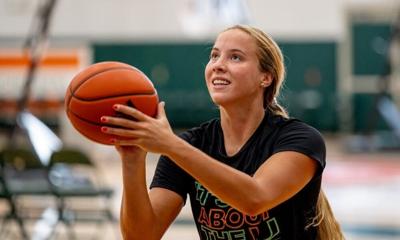


Ally Stedman
MIAMI – A former University of Miami basketball player alleges in a lawsuit filed this month that the NCAA, in denying her request to compete for a fifth season, is not committed to prioritizing athletes’ welfare and mental health.
Plaintiff Ally Stedman, who previously competed for The U’s women’s basketball team and most recently the University of Central Florida women’s basketball team, filed her lawsuit November 4 in the U.S. District Court for the Southern District of Florida, Miami Division.
Stedman also argues defendant National Collegiate Athletic Association’s redshirt rules violate antitrust laws, and the NCAA’s denial restrains her name, image, and likeness earnings.
“The 2025–2026 basketball season is scheduled to begin imminently on November 3, 2025, and without prompt judicial intervention, Plaintiff will be deprived of the opportunity to compete in what should be her final season of eligibility,” her 31-page complaint states. “With no remaining administrative mechanism for review or relief, judicial intervention is now the only means to prevent the permanent and irreparable deprivation of Plaintiff’s eligibility.
“This deprivation would not only cause irreparable harm by foreclosing her last chance to participate in Division I competition while mentally healthy and supported, but would also permanently eliminate her remaining NIL earning potential.”
In its 2021 ruling, the U.S. Supreme Court characterized the NCAA as a “sprawling enterprise” that generates billions in revenue each year.
Justice Brett Kavanaugh described the NCAA as such in his concurring opinion in National Collegiate Athletic Association v. Alston. He said the NCAA’s previous restrictions on athlete compensation were a clear violation of antitrust laws and that it was not above the law.
NCAA v. Alston paved the way for college athletes to receive compensation for use of their names, images, and likenesses, or NIL. A unanimous Supreme Court ruled the NCAA’s rules violated antitrust law.
Stedman began her career at Pepperdine University, where she served as a starting guard for two seasons, 2021-2023. Following an injury more than halfway through her sophomore season and a coaching change, she entered the NCAA transfer portal.
She was heavily recruited by numerous Division 1 coaches, in particular The U’s Katie Meier.
Stedman claims Meier convinced her to transfer for the 2023-24 academic year “under the guise of numerous unfulfilled promises.”
In her complaint, she alleges Meier began engaging in “confrontational and unprofessional behavior” soon after arriving on campus.
The coach allegedly “made it clear” that Stedman would not be receiving the “extensive minutes” she was promised during her recruitment. Stedman also claims she was humiliated in front of coaches and teammates.
As a result, she experienced “persistent” insomnia, social withdrawal, and depressive fatigue that made it difficult to attend class or complete team obligations, Stedman claims.
She eventually sought treatment with Dr. Eric Goldstein, director of sports psychology and mental health at The U. Goldstein, Stedman alleges, documented “a progressive deterioration in her mental health” and diagnosed her with major depressive disorder and anxiety.
In November 2023, after nearly three months of treatment – and well in advance of the 30 percent contest marker to acquire a medical redshirt under NCAA guidelines, Stedman notes – Goldstein raised the possibility of Stedman redshirting the remainder of the season. He stated in text messages he did not see why Meier would deny Stedman’s request, according to the filing.
Stedman formally requested to be redshirted Nov. 24, 2023.
Meier dismissed Goldstein’s recommendation and allegedly told Stedman she needed to “toughen up, buttercup.” She claimed “the team needed her” and “she was an important part of the roster.”
According to Stedman’s complaint, Meier demanded she continue on with the team, “adding injury to Plaintiff’s fragile mental state and continuing to aggravate her lingering physical injuries.”
Stedman was forced to appear in 22 more games. Her playing time was extremely limited.
“Plaintiff’s forced, yet severely limited, participation further aggravated her diagnosed condition and directly contravened the NCAA’s own Mental Health Best Practices, which require deference to licensed clinicians in determining an athlete’s fitness to compete and compelling Plaintiff to lose one of her four permissible seasons of eligibility and suffering severe psychological harm,” the complaint states.
Following the 2023-24 season, Stedman informed Meier she intended to enter the NCAA transfer portal.
She transferred to UCF for the 2024-25 academic year.
After being assured her experience would “differ markedly,” Stedman was encouraged to immediately compete rather than seek a redshirt.
Stedman claims the beginning of the 2024-25 season appeared stable, but it began to mirror the “dysfunction and maltreatment” she experienced at The U.
Her family encouraged her to transfer; Stedman transferred to Utah Valley University, where she is hoping to play in one final season.
However, the NCAA has denied her waiver request, agreeing with The U’s determination that her participation in 26 games reflected “voluntary competition.”
“In doing so, the NCAA disregarded its own Bylaws, which expressly recognize incapacitating physical or mental circumstances as valid grounds for a waiver, and instead deferred to the non-medical judgment of Meier whose decision had caused the harm in the first place,” Stedman wrote in her complaint.
She argues NCAA bylaws provide that a student-athlete may qualify for a medical-hardship waiver when the athlete has participated in fewer than 30 percent of scheduled contests and becomes unable to continue due to an incapacitating injury or illness occurring before the midpoint of the season.
Her lawsuit contends that the bylaws recognize “incapacitating physical or mental circumstances” supported by medical documentation as grounds for a waiver of the five-year limit.
“In theory, these exceptions protect athletes from being penalized for unforeseen hardships,” the complaint states. “In practice, however, the NCAA’s enforcement framework has left the decision-making process open to manipulation by non-medical institutional personnel, particularly head coaches and athletic administrators whose professional incentives center on maintaining team performance, athlete control, and roster depth.
“Because the initial determination of whether an athlete should be withheld from competition often depends on a coach’s approval, athletes suffering from legitimate physical or mental incapacity are routinely pressured to continue playing rather than risk losing scholarship status, playing time, or perceived commitment to the program.”
Stedman argues the outcome is a system “that privileges competitive advantage over athlete welfare,” and permits “instructional misconduct to erode the NCAA’s own eligibility framework.”
“By failing to implement uniform medical and procedural safeguards, the NCAA enables member institutions to exercise unchecked discretion in determining whether an athlete competes, effectively converting subjective coaching decisions into eligibility outcomes with nationwide effect,” the complaint states.
“This absence of consistent process suppresses the supply of qualified athletes within the five-year eligibility market, deprives them of the opportunity to offer their athletic services, and eliminates their access to NIL and competitive financial opportunities that would otherwise exist under a fair and properly governed medical system.”
Stedman seeks a declaration that she is eligible to participate for the 2025-26 academic year and utilize her remaining season of eligibility without restriction; compensatory and punitive damages; attorneys’ fees; and prejudgment and post-judgment interest.
Miami-based ChaseLawyers is representing Stedman in the action.