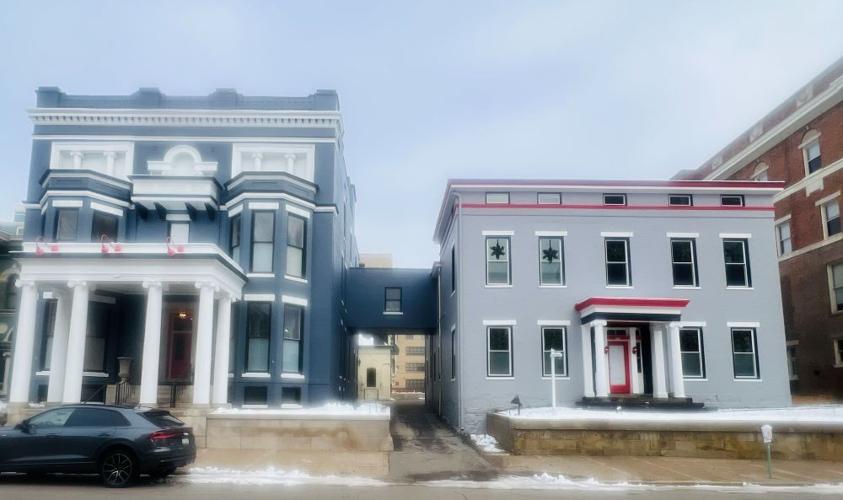



Toriseva Law recently opened its new office in downtown Wheeling.
WHEELING – Three Wheeling businesses, including a law firm, have filed a lawsuit against the owners of another law firm over a 200-year-old agreement regarding a downtown alleyway.

Toriseva
The three plaintiffs – the law firm of Phillips Gardill Kaiser & Altmeyer, construction company Shaeffer & Madama and investment firm Fort Henry Capital – filed their complaint December 3 in Ohio Circuit Court against Teresa Toriseva and Josh Miller, owners of Toriseva Law.
All of the parties are owners of downtown Wheeling properties in what is known as Square Number 15. Toriseva and Miller purchased 1308 and 1314 Chapline Street in 2023 to use as a new location for Toriseva Law. The alley runs between the two Toriseva Law buildings.
Square 15 is intersected by a 10-foot-wide alley from Eoff Street to Chapline Street. It runs adjacent to the northern border of the plaintiffs’ properties and the northern border of the defendants’ Southern Parcel as well as adjacent to the southern border of the defendants’ Northern Parcel.
“Said alley has existed for nearly 200 years and was created and established by agreement between Noah Zane, Thomas Paull and Andrew Scott dated August 6, 1829,” the complaint states. “Additionally, the existence of said alley was confirmed in 1865 by deed dated September 15, 1865. …
“Plaintiffs and their predecessors in title have enjoyed the unobstructed, open, continuous, exclusive, adverse and notorious use of the alley for over 200 years. The alley has and continues to be maintained by plaintiffs and is used regularly for both vehicular and pedestrian traffic by plaintiffs, the general public and, at times, has been utilized by emergency vehicles.”
On November 8, the plaintiffs say the defendants placed 30-inch-high concrete jersey barriers on the east boundary of their Southern Parcel extending from the southeast corner of the parcel to the southeast corner of their Northern Parcel.
The plaintiffs say the barriers are “intentionally and maliciously blocking the alley from vehicular and pedestrian traffic, thereby disrupting and preventing the use of the alley enjoyed and shared by the plaintiffs, their predecessors in title and the general public for nearly 200 years and further jeopardizing the safety of the entire neighborhood.”
On November 10, the plaintiff law firm sent a letter to the defendants requesting they partially remove the barricade to allow vehicular and pedestrian access through the alley. Four days later, those parties met to discuss the situation. But Phillips Gardill Kaiser & Altmeyer say the defendants have refused to remove the barriers.
The plaintiffs say the installation of the barriers is a “clear violation” of the recorded easement and 1829 agreement. They say the barriers have created health and safety issues to all neighbors. They also say the plaintiffs and the general public will suffer irreparable harm if it isn’t remedied.
“Defendants’ continued refusal to remove the concrete barriers and continued obstruction of plaintiffs’ use of the alley constitutes an intentional, bad faith and vexatious denial of plaintiffs’ clearly existing civil rights,” the complaint states.
When they purchased the property, Toriseva said she and Miller relied on a title search from a reputable experienced attorney who found no encumbrances. She said they also have a current commercial survey showing no alley.
“This complaint touches on the legal issues the court will grapple with but barely scratches the surface of what’s actually going on with this downtown Wheeling city block,” Toriseva told The West Virginia Record. “There are more critical facts, disputes, necessary parties, counterclaims and third-party claims, all of which we will put before the court when we answer within our 30-day window.
“The specific dispute as to the alley centers on a 200-year-old handwritten paragraph from the Commonwealth of Virginia before West Virginia statehood and is further complicated by a title cleaned by government sale/transfer of the Phillips Gardill property from 1980 to 1990.”
The two buildings that house Toriseva Law previously were Kepner Funeral Home. The building at 1314 Chapline Street is known as the Thomas Paull House, which was built in the 1830s. The building at 1308 Chapline Street is known as the Lynda Speidel House, which was built in the 1880s.
“Built during the 1830s, this stately home is a reminder of the time when the 1300 block of Chapline Street was an elegant neighborhood,” an online description of the Thomas Paull House states. “This simple two-and-a-half story brick building displays Federal symmetry and some modest Greek Revival detailing. …
“A good sense of the presumed original appearance of the Fort Henry Club can be inferred from the facade of this mansion next door. Its five-bay facade has windows trimmed with plain Greek Revival lintels, while a small Ionic portico protects the central entrance. Knee, or frieze-band, windows in the frieze above light the top story.”
“The paired, two-story polygonal bays remain from the 1880s house, but the Ionic portico between them was added later,” an online summary of the Lynda Speidel House states. “The third floor, also added later, has fenestration, an entablature, and a parapet similar to those of the L.S. Good House. The original structure and later alterations blend more harmoniously here than is often the case.”
The plaintiffs seek a declaratory judgment confirming the 1829 agreement is valid and grants them a legally enforceable right to use the alley, an order and preliminary injunction requiring the defendants to remove all obstructions from the alley, an order permanently enjoining the defendants from restricting vehicular and pedestrian traffic in the alley, an order restoring the alley to its previous physical condition and state of use as well as an order finding the defendants’ actions were intentional, wrongful, malicious, vexatious and in bath faith.
They also seek court costs and attorney fees.
The plaintiffs also have arranged to tender $10,000 in bond to compensate the defendants for any conceivable financial damage. The bond, dated December 3, is signed by James C. Gardill, Dennis M. Madama and David H. McKinley from Fort Henry Capital, which he owns with his father and former U.S. Representative David B. McKinley.
The plaintiffs are being represented by Bob Fitzsimmons and Rocky Fitzsimmons of Fitzsimmons Law Firm in Wheeling. The case has been assigned to Circuit Judge Jason Cuomo.
Ohio Circuit Court case number 25-C-231