

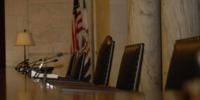


The chambers of the West Virginia Supreme Court of Appeals
CHARLESTON – The state Supreme Court has granted a motion to stay in the case focusing on religious exemptions to school vaccination requirements.
The December 2 order means the enforcement of Raleigh Circuit Judge Michael Froble’s November 26 ruling that would have allowed students to attend school with a religious exemption is temporarily suspended.
Froble had enjoined the West Virginia and Raleigh County boards of education from enforcing the mandatory vaccine requirements on students seeking the exemption.
The stay applies as the Supreme Court reviews the case.
“Upon consideration and review, the Court is of the opinion to, and does, grant the petitioners’ motion to stay,” the justices wrote. “Enforcement of the circuit court’s November 26, 2025, ‘Findings of Fact, Conclusions of Law, and Order Granting Permanent Injunction and Declaratory Relief’ and any further proceedings in circuit court are stayed pending resolution of this petition for a writ of prohibition.”
Froble’s ruling said the school boards shouldn’t prevent children from enrolling in school, attending school or participating in extracurricular sports because of their vaccination status.
The state Board of Education immediately reinstated its earlier directive to county school boards to not accept religious exemptions.
“This directive will be in effect until the Supreme Court issues further guidance. Our priority is to ensure compliance with W. Va. Code §16-3-4 and safeguard the health and well-being of all students across West Virginia.”
The hot-button issue has been tied up in courts across the state for months, and the impact of the ruling changes how the state’s long-standing compulsory vaccination law can be enforced in regards to public health, religious freedom and authority of state agencies.
Nearly 600 families across the state have received religious exemptions to the vaccination laws. Froble’s 74-page ruling also granted declaratory relief to the families.
“Legislative intent is not absolute nor controlling in interpreting a statute or determining its application; at most, it is a factor,” Froble wrote.
He also said there is “no difference between a religious exemption and a philosophical exemption under the law.”
“The court believes that the compulsory vaccination law is not valid without a religious exemption; that statute itself is not constitutional and is invalid without a religious exception,” Froble wrote.
In October, Froble certified the case as a class action for those families and others that might seek exemptions in the future. Last month, the state and Raleigh County school boards filed a writ with the state Supreme Court saying Froble exceeded his authority in granting class status.
The state school board already has filed an intent to appeal the case to the state Supreme Court. It has a December 12 deadline for that. The families seeking religious exemptions to be able to opt out of school vaccinations have until January 26 to file their response. Any response to that by the school boards would have until February 16 to do so.
The state’s vaccination law requires students entering school for the first time to show proof of immunization against diphtheria, pertussis, tetanus, polio, measles, mumps, rubella, varicella and hepatitis B unless properly medically exempted.
West Virginia previously has been one of only five states that do not allow religious exemptions for vaccines, but Gov. Patrick Morrisey issued an executive order in January requiring the state to accept such exemptions, linking EPRA with the vaccine law that was written in 1937 and doesn’t explicitly include religious exemptions. The Morrisey administration then directed families to apply for exemptions through the state health department, but West Virginia school systems have not accepted them.
The state Legislature voted down a bill this spring that would have written the religious exemption into state law, and the state Board of Education continues to tell county school boards to accept only medical exemptions as previously done.
EPRA allows citizens to sue if they think their religious beliefs are being suppressed, but it also includes other factors, such as if a compelling state interest exists. The school boards say the law applies to individuals but not groups, such as the class in a potential class action lawsuit.
In last week’s ruling, Froble said the vaccination policies “substantially burdened plaintiffs’ religious exercise by forcing them to choose between vaccination and public education.” He ordered the school boards to allow children with religious or philosophical exemptions to “enroll in school, attend school or participate in extracurricular sports” regardless of their vaccination status.
West Virginia Supreme Court of Appeals case number 25-740 (Raleigh Circuit Court case number 25-C-230)