


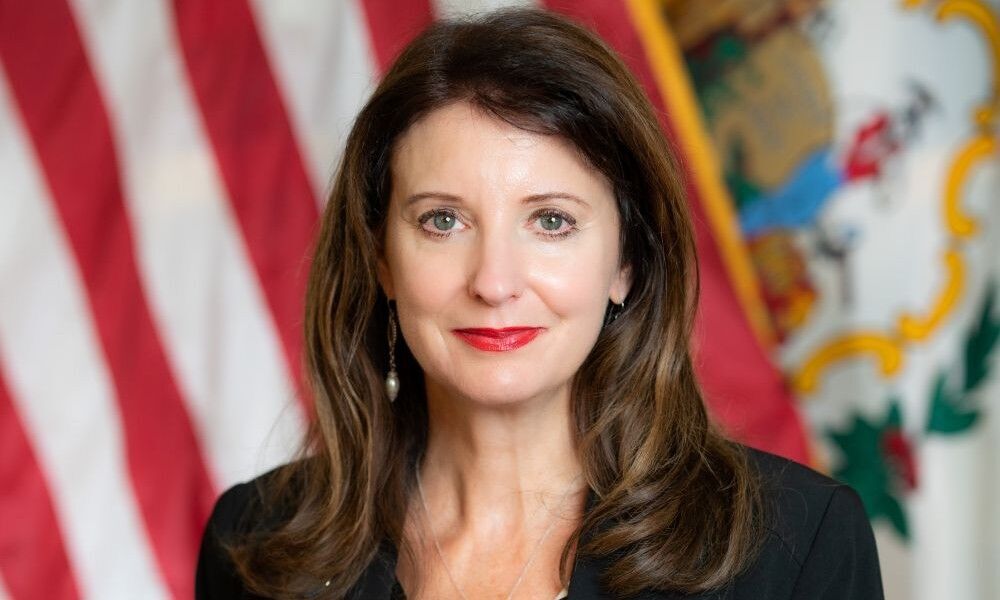
West Virginia Inspector General Ann Urling
CHARLESTON – A longtime state government health official says he was wrongfully terminated and a victim of retaliation by Inspector General Ann Urling.
Christopher G. Nelson filed his complaint January 23 in Kanawha Circuit Court against Urling, in her capacity as Inspector General for the Departments of Health, Human Services and Health Facilities, and the West Virginia Office of Inspector General.
Nelson was the director of the Investigations and Fraud Management (IFM) division of the Office of Inspector General when he was fired by Urling in July. Nelson has worked for the state since 1993 in a variety of capacities with the Department of Health and Human Resources and the OIG. He also served as interim Director of the West Virginia Office of Health Licensure and Certification, and he was interim Inspector General.
The OIG is a state agency created to combat and eliminate fraud, waste and abuse from both within and outside the Department of Health, Department of Human Services and Department of Health Facilities.
Nelson’s complaint notes he was recognized by the federal Department of Agriculture for his agency’s efforts to deter and detect fraud within the Supplemental Nutrition Assistance Program, particularly focusing on individuals who sell their SNAP benefits, also known as food stamp trafficking.
In February 2024, former Gov. Jim Justice appointed Urling to serve as interim Inspector General, replacing Nelson in that position. Urling, who had been Justice’s chief of staff, became the permanent Inspector General a few months later.
The complaint says Urling had little or no experience with the state and federal programs associated with the job of Inspector General while Nelson did because of “extensive years of experience.”
The complaint says Urling had various meetings and communications with Nelson, who often shared his experiences and explained the proper procedures that had to be followed based upon the applicable state and federal rules and statutes.
“While plaintiff (Nelson) was trying to be helpful, through time it was apparent that defendant Urling did not appreciate some of the comments and concerns raised and, consequently, their working relationship became strained,” the complaint states. “The genesis of this animosity appeared to begin in March 2024 when defendant Urling called plaintiff into her office to discuss the investigation into the tragic event which had occurred in a state facility.
“Defendant Urling was frantic, pacing around her office, and stated, ‘I have got to provide cover for my Governor.’ … According to defendant Urling, Governor Justice was upset about the articles addressing this tragic event and wanted to show that some action was being taken.”
During a meeting the next day that included Justice, Urling and others, Nelson said he couldn’t share some information because of federal requirements. He says he “immediately observed hostile dissatisfaction” from Urling.
Nelson says he raised multiple concerns to Urling about wrongdoing and waste, and he says in the complaint he made it clear to Urling and others that he considered some of her actions, orders or comments to be unethical or criminal.
Among those concerns, according to the complaint, were Urling targeting a state official for investigation for retaliatory motives.
Urling asked Nelson to target what she referred to as “that smug bitch” Janie Cole, Commissioner for the Bureau for Family Assistance (BFA), because of Urling’s ongoing animosity with Cole and Human Services Secretary Alex Mayer. Urling asked Nelson at low hanging fruit he could investigate involving Cole and the BFA to “take the fight to her.”
Nelson says he told Urling he would not conduct such an improper investigation, according to the complaint.
In May 2025, Nelson says he had a video meeting with BFA Deputy Commissioner Kent Nowviskie, who told him twice in that meeting that Urling insisted Nelson target and investigate Cole. Nelson also said OIG Deputy Director Andrew Petitt had been in two meetings in which Urling asked to target and investigate Cole.
Nelson’s complaint also targets Urling’s purchasing and procurement irregularities. He says he and Nowviskie discussed the purchase of a case management system for IFM and BFA obtained with a USDA grant.
“Urling had set up several meetings with SAS to allow SAS to custom build a case management system for the IFM division, an advantage she had not extended to any other vendors,” the complaint states. “Urling had been out to dinner with SAS representatives while this appropriation was in process.”
In May 2025, Nelson says he met with DHHR Purchasing Director Bill Rosen to express his concerns about the process.
“Rosen told plaintiff it was bad business, but not illegal at that time and that as long as the proper bidding and purchasing procedures were followed, there would not be a problem,” the complaint states. “Plaintiff later learned that defendant Urling was going to attempt to do a direct award, and he advised Mr. Rosen of this fact.
Also that month, Nelson says there was a meeting including Urling, Mayer and Tom P. McCaffery, Gov. Patrick Morrisey’s chief of staff. He says Urling had asked Petitt for information “to defend herself against Secretary Mayer.”
He says Urling said the meeting was about the grant for the case management system.
Nelson also says he was asked by Daron Light, deputy general counsel for the OIG, asked him for information concerning a pending investigation because he was responding to a FOIA request for a newspaper reporter. Nelson told him the information was not subject to FOIA and that IFM investigations cannot be disclosed publicly.
He says this conversation triggered a meeting between Nelson, Urling and OIG attorney Berkeley Bentley. During the meeting, Nelson says Urling referred to him as “a friction point.”
Nelson says OIG General Counsel Jessica Whitmore violated law when she told a reporter the name of an entity being investigated by IFM. He says the good faith information he provided in that meeting was ignored and that it also resulted in Urling criticizing him.
He also says Urling authorized the “costly removal” of landlines needed for the Public Assistance Reporting Information System, an information sharing system, operated by the U.S. Department of Health and Human Services, Administration for Children and Families (ACF), allowing states and federal agencies to verify public assistance client circumstances.
Nelson said the system has helped the state save more than $29 million in waste. He says Urling ordered an employee to remove landline phones in a cost-saving move without discussing it with Nelson or “recognizing the impact such removal would have on PARIS.”
The landlines later were restored based on Nelson’s comments, according to the complaint. Nelson
The complaint also says Urling jeopardized the privacy of income tax and other private personal identification information.
Soon after she became interim Inspector General, Urling had some office remodeling done that involved the IFM division. She wanted to have the door to the IFM part of the office removed, according to the complaint.
“Investigations conducted by the IFM division often involve obtaining income tax returns and other private personal identification information, which the IFM division is required by law to protect and maintain as confidential,” the complaint states. “The IFM division is required to keep the records in a locked room where only certain authorized employees have access. …
“During the construction, workers were able to move in and out of the offices, including the IFM office where confidential documents were maintained. Of particular concern to plaintiff was the restricted access locked door outside of the area where this sensitive and confidential material was stored.”
Nelson says he told Urling removing the door would violate privacy concerns mandated by law. The door did remain in place.
The complaint also addresses Urling’s alleged unethical and/or criminal actions reported to the Committee on Special Investigations.
In a May 2025 email, Nelson said he had received complaints that Urling “maximized, minimized, manipulated, and flat-out lied about facts in order to obtain a favorable reception and approximately $7,000,000 or so in additional funding” during various Senate committee hearings. The email was sent to Jesse Bailes of the Committee on Special Investigations.
The following month, Nelson says he met with Bailes and CSI Director Rick Eplin to discuss the testimony Urling had given to various Senate Committees. Nelson says he also discuss “many of the other concerns previously expressed to defendant Urling and others.”
In May 2025, Urling told Nelson she wanted a meeting with him. Present were Nelson, Urling, Petitt and Director of Operations Shannon Wallace. Nelson expressed his concerns about various actions by Urling. The following day, he emailed McCaffery saying Urling had asked him and Petitt to do “two things which I believe are at best unethical and at worst criminal. Both involve the Department of Human Services.”
Nelson said McCaffery never responded.
He said he sent another lengthy email to Urling and McCaffery the same day addressing issues raised during the previous day’s meeting.
“I have advised you numerous times that the door and the others’ access to it was a problem,” the email states. “Your response has repeatedly been, ‘Well, that’s just two locked doors, isn’t it?’…
“Subsequent to that email, Berkeley Bentley and I had another discussion about the door and why access should be restricted. I’m unaware of any action either of you may have taken regarding that discussion.
“I have brought numerous concerns to your attention, in writing, which appear to have been ignored. At the very least, I am unable to find a response in writing. Mr. Dempsey’s actions brought about concerns which do not have months, and months, and months to wait on a response from you, as so many other issues have.
“If your implication is that you would need more than a few hours to determine an answer to that issue, I believe the documentation you have had months of time to deliberate, discuss, and decide on the issue. …
“As I also stated yesterday, if you choose to further disregard my experience and judgment after serving over 31 years with the State, and 28 or so within the Office of Inspector General, that I would be left with no choice but to take my concerns to another party who would perhaps listen to me. I am CC’ing Governor Morrisey’s Chief of Staff, Tom McCaffery on this response.”
Two days later, Nelson says he received a hand-delivered letter from Urling issuing a formal written reprimand concerning his “unacceptable, unprofessional, and insubordinate conduct.” It says he was insubordinate in the May 12, 2025, meeting and “did not display the professional conduct as expected of a director, or that of a former interim Inspector General.”
“During this meeting your actions were perceived as blustering and threatening,” Urling’s letter states. “You were pointing your finger, raising your voice and acting aggressively, as if you were about to jump out of your chair towards me. Prior to walking out of my office, you verbally threatened me, stating that this would be the last time you would bring these issues to me and “if I walk out this door, there is going to be a lawsuit. …
“On May 14, 2025, you CC’d the Governor’s Chief of Staff on an email about various and disparate issues, rather than following the appropriate chain of communication – which we have discussed several times. I consider this action to be another instance of insubordination.”
Nelson says it is not clear how Defendant became aware of this email to McCaffery.
“If your misconduct and hostility is the result of medical and/or personal problems, I suggest you may want to contact the physician, practitioner, or counseling service of your choice,” Urling wrote in her letter.
Nelson filed a grievance June 6 with the West Virginia Public Employees Grievance Board challenging the formal written reprimand, saying it was retaliatory in nature because of his ongoing concerns about fraud, waste, abuse and misconduct in the OIG.
“It is my belief that this reprimand was a pretext to continue to harass, bully, and intimidate me for voicing such concerns,” his grievance states. “This matter and several others, in my opinion, are demonstrative of an on-going hostile work environment for myself, and what I believe to be spread throughout divisions of the Office of Inspector General.”
Also in May, Nelson says the IFM completed a hospitality request to use funds for an employee appreciation luncheon. He says were no OIG written guidelines on the procedure for seeking funds for hospitality functions and after the breakup of the DHHR, not all forms had not been updated to reflect the new agency divisions. That means many of the forms that existed under the former DHHR continued to be used.
He says he forwarded an email from Urling to Petitt and Administrative Investigator Associate Diana Wright so “they would adhere to her instructions and clarifications in planning and executing the appreciation lunch.”
Nelson says he signed in a box labeled “Agency Head Signature” for the hospitality request for the employee appreciation luncheon, which was subsequently approved by OSA finance.
In June, Nelson says he was asked about the IFM division’s semi-annual meeting usually held during the summer months, where to hold it and when to schedule it. He says he worked with Wright and Sandra K. Bailey, who worked in IOG finance.
“Once the decision was made to attempt to hold the meeting at Blackwater Falls, plaintiff instructed Ms. Wright to get with Ms. Bailey to see if hospitality money could be used to cover the shelter costs,” the complaint states. “Plaintiff believed that the cabins, if reserved, should be normal travel charges and not hospitality funds and paid or held out of the ghost account, instead.”
Wright later brought Nelson a form with a charge for a shelter at Blackwater Falls State Park for him to sign, according to the complaint.
“Plaintiff explicitly asked her whether this was one of the forms plaintiff signed, or that the Inspector General signed,” the complaint states. “Wright responded she thought that this form required plaintiff’s signature.”
After more discussion with Wright, Nelson says he signed the “routine” document based upon “history and information.”
“The signing of these two routine documents needed to obtain hospitality funds, both of which were reviewed by the OSA and approved, prompted fefendant Urling on July 10, 2025, to send an email to plaintiff entitled ‘Notice of Predetermination,’’ the complaint states. “Urling referenced the routine form seeking hospitality funds signed by plaintiff. …
“The Inspector General is the head of the agency and/or appointing authority. You then had your employee submit this request to the OSA Finance team for authorization. Your employee directed the OIG/OHFLAC ASA to process payment for the reserved shelter and lodging reservations at a State Park, all without my authorization.
“I believe this action to be a form of indirect insubordination, and a disruption of the normal operations of the agency.”
Urling’s email also referenced an office incident.
“Directors have been informed, on multiple occasions, that units should not be left unattended during business hours, unless there is an unforeseen emergency,” Urling wrote. “On Tuesday, July 8, 2025, you reported that the IFM unit was closing shop for the day, and no one would be back there after 2:00 p.m. This again is a disruption of the normal operations of the agency, as well as a form of direct insubordination.”
Nelson says he told Urling he thought he had complied with policy regarding the document. And he says Urling never told him or other directors that offices never could be unattended.
“In fact, plaintiff made it clear that on July 8, 2025, when he was out of the office in the afternoon taking annual leave to address a medical issue, he made it clear that he would be available by telephone if anyone needed to contact someone in the IFM office,” the complaint states. “A few hours later, plaintiff’s employment was terminated in a telephone call from defendant Urling.”
Nelson says the decision to terminate him was “a mere pretext designed to cover up their retaliation for the multiple good faith reports of wrongdoing and waste plaintiff communicated to defendant Urling and other appropriate authorities as well as defendants’ retaliation for the grievance plaintiff filed on June 6, 2025.”
He accuses the defendants of violating the state Whistleblower Act and wrongful discharge in violation of public policy prohibiting retaliation against public employee for filing a grievance.
Nelson says he has suffered emotional distress, embarrassment, harm to his reputation, annoyance, inconvenience and humiliation.
Nelson seeks compensatory damages, punitive damages, full reinstatement to his position as IFM director, back wages, full reinstatement of fringe benefits and seniority, economic and non-economic damages, court costs, attorney fees and other relief.
Nelson is being represented by Lonnie Simmons of DiPiero Simmons McGinley & Bastress in Charleston. The case has been assigned to Circuit Judge Stephanie Abraham.
Urling, who unsuccessfully ran for state Treasurer in 2016, did not return multiple messages seeking comment.
Kanawha Circuit Court case number 26-C-100