

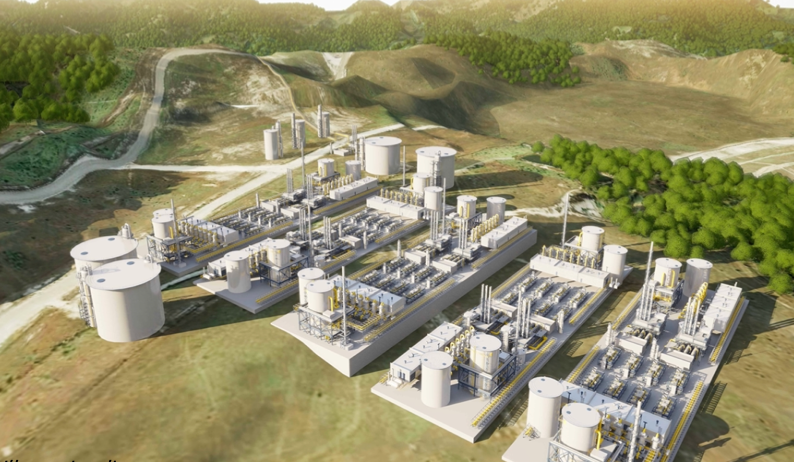
An illustration shows the proposed Adams Fork Energy project near the Mingo-Logan county line.
HUNTINGTON – Ten West Virginia residents have filed a federal lawsuit claiming planned southern West Virginia data centers will harm the area.
The plaintiffs filed their complaint December 3 against TransGas Development Systems, the U.S. Army Corps of Engineers Huntington District, the U.S. Fish & Wildlife Service and the Federal Energy Regulation Commission. TransGas is the project developer proposing the 117-engine power plant and ammonia facility with associated data centers near Wharnecliffe and the Mingo-Logan. engines that together constitute a fossil-fuel electric
They say the Adams Fork Energy project would violate the Endangered Species Act, the Clean Water Act, the National Environmental Policy Act and the Natural Gas Act.

New
“I look forward to judicial review of the allegations of the people in the Gilbert area raising concerns about this data center project,” attorney Steve New told The West Virginia Record. “Given the stress and strain on electricity and water, these issues are of paramount importance and need strict administrative and judicial review.”
The plaintiffs – Danny Hatfield, Martha Browning, Bonnie Breeding Runyon, Sheila Miller, Chris Cohenour, Tina Cohenour, Jared Calloway, Stewart Johnson, Joshua Vance and Bill Gilkerson – live, recreate, work or conduct environmental observation within the affected watershed areas near the project. They also say federal natural gas pipeline approvals, and required local land-use authorization have not been satisfied.
“Aesthetic, recreational, ecological and scientific interests will be harmed by unlawful construction, stream impacts, increased air emissions, habitat degradation and the loss or impairment of endangered species,” the complaint states. “TransGas proposes to construct a large gas-powered ammonia plant, powered by 117 massive dual-fuel natural gas/diesel engines that together constitute a fossil-fuel electric generating facility.
“The project’s ammonia plant will be powered by two large natural-gas-fired power plants, which together function as a self-contained ‘micro-grid’ that generates its own electricity rather than using the public utility grid.”
The complaint says each of the 117 engines have a design capacity of more than 28,000 horsepower, which is more powerful than engines used in most freight trains. The West Virginia Department of Environmental Protection issued the construction permit for the engines in October, and the permit approves the plans for the construction of an industrial-scale power plant sold as a data center, including on-site fuel combustion, exhaust stacks, and continuous emission from a dedicated micro-grid.
“The permit approves over 200 tons per year of regulated pollutants, making the project legally a ‘major source’ of air pollution under the Clean Air Act,” the complaint states. “The ammonia plant in the project consists of 117 giant combustion engines (of which 114 engines will operate at any one time) that burn gas and diesel 24 hours a day, 7 days a week.
“The permit includes no hourly limits on the emissions described in the permit. The sheer magnitude of these annual emissions implies that the engines will burn gas and diesel 24/7.”
TransGas obtained state-level construction permits and publicly presented two project locations at the September 18 WVDEP meeting.
The complaint also says the Guyandotte Crayfish is on the endangered species list, and the Big Sandy Crayfish is on the threatened list. Both are native to and prevalent – the Gilbert area, along the Tug Fork and Guyandotte watersheds and their tributaries, Gilbert Creek and Ben Creek. In addition, the endangered Grey Bat and Northern long-eared bat roost in forests, caves, and mines in Mingo, Logan and Boone counties.
“Unless enjoined, TransGas will continue advancing its planning, design and pre- construction commitments that irreversibly narrow the federal agencies’ options under the ESA, NEPA, and Clean Water Act, thereby causing the precise procedural and environmental harm these statutes are designed to prevent,” the complaint states.
The plaintiffs ask the court to issue a temporary restraining order immediately prohibiting TransGas from proceeding with any ground-disturbing or project-advancing activities related to the Adams Fork Energy Project until a hearing can be held on plaintiff's request for a preliminary injunction. They also ask the court to declare that the federal defendants’ failure to initiate required ESA consultation, NEPA review, CWA permitting and NGA pipeline review is unlawful under those statutes and the Administrative Procedure Act.
They also seek a permanent injunction prohibiting TransGas from proceeding with the Adams Fork Energy Project prohibiting TransGas from proceeding with the Adams Fork Energy Project unless and until all federal agencies have completed legally required ESA consultation, NEPA review, CWA permitting and NGA pipeline review.
They are being represented by New of Stephen P. New & Associates in Beckley.
U.S. District Court for the Southern District of West Virginia case number 3:25-cv-714