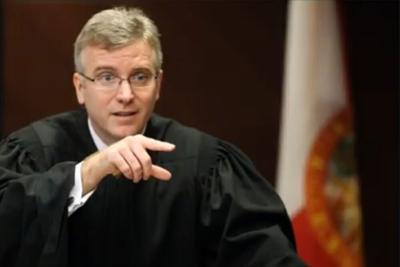



Judge Mark Walker rejected a bid by Florida officials to disqualify him from hearing a lawsuit challenging the state’s domestic terrorism law.
A federal judge in Tallahassee has rejected a motion by Florida officials to disqualify him from a lawsuit that challenges a state law allowing groups to be designated as domestic terrorist organizations, calling the state’s arguments “nonsense.”
In a seven-page order, Judge Mark E. Walker of the Northern District of Florida denied the motion for disqualification filed by attorneys for Gov. Ron DeSantis and the executive director of the Florida Department of Law Enforcement. The Sept. 14 order rejects the Florida officials’ contention that Walker has a “deep-seated … antagonism (toward Desantis or the state of Florida) that would make fair judgment impossible.”
The judge’s order points out that the defendants’ arguments to disqualify him are not based on the current lawsuit, which was filed by the Council on American-Islamic Relations (CAIR), one of several groups DeSantis has proposed should be designated as terrorist groups under a new Florida law, House Bill 1471.
Instead, the defendants argued Walker was biased against by citing opinions he has issued in other cases involving constitutional concerns about other Florida statutes. But in his opinion, the judge said there are a “vast swath of cases” in which he sided with arguments put forth by the governor or the state of Florida.
“Defendants ignore the overwhelming majority of this court’s caseload involving the governor or the state, generally, and instead point to cherry-picked quotations taken out of context from prior decisions involving constitutional challenges to the governor’s policies or the Florida Legislature’s enactments to argue that I have some deep-seated bias against the governor and the state,” Walker said.
The plaintiffs, including CAIR-Florida Inc., called the state’s bid for disqualification meritless and said Walker has said or done nothing to indicate bias against the defendants. The plaintiffs’ attorneys went on to note that Walker had ruled in favor of defendants in the CAIR lawsut when he denied the plaintiffs’ emergency motion for a temporary restraining order.
“The fact that I communicated strong views after judging the arguments and evidence presented in some prior cases involving constitutional challenges to state law or policy, without hiding behind sterile legalese in my written orders, is no evidence of deep-seated antagonism toward any party or counsel,” Walker said in his order.
He added that the defendants’ efforts were “nothing more than rank judge-shopping.”
“Sadly, this practice has become all too common in this district,” Walker said. In a footnote in the opinion, the judge said that a related bid for judicial reassignment is now pending in the 11th Circuit Court of Appeals that involves “similar parties.”
In the current case, the plaintiffs argue that the First Amendment and the due-process clause of the 14th Amendment protect them from being punished by the state through the terrorism label. The groups engage in activities involving civil rights advocacy and Muslim empowerment and deny any link to terrorism, according to their lawsuit.
In July, DeSantis expressed the intention to designate CAIR, the Muslim Brotherhood and Antifa to a list of terrorist organizations. A DeSantis executive order instructed state and local agencies to take steps to prevent such groups from “operating or gaining a foothold in Florida.”
Earlier this month, the Florida Cabinet approved a rule allowing the Department of Law Enforcement to move ahead with the process of identifying certain Florida groups as terrorist organizations.
CAIR did not respond to a request for comment about the Walker order.