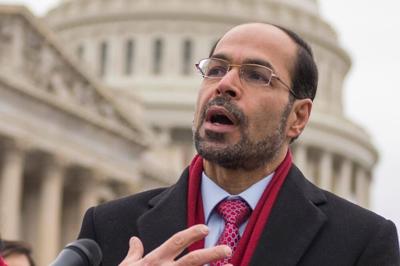


Nihad Awad is executive director of the Council on American-Islamic Relations.
A federal judge has enjoined Gov. Ron DeSantis from enforcing a 2025 executive order targeting the Council on American-Islamic Relations (CAIR), calling the governor’s designation of CAIR as a “terrorist organization” coercive and unconstitutional.
Judge Mark E. Walker of the Northern District of Florida handed down the decision on March 4, concluding that DeSantis had exceeded his authority when he issued a Dec. 8 executive order calling on government agencies to withhold support or resources from CAIR, which is the largest Muslim civil rights group in the nation.
“The First Amendment bars the governor from continuing the troubling trend of using an executive office to make a political statement at the expense of others’ constitutional rights,” Walker said. “The governor’s decree coerces third parties, under threat of losing government benefits, to disassociate from … CAIR, thereby closing avenues of expression and suppressing CAIR’s protected speech.”
The executive order designated several groups as terrorist organizations, including the Muslim Brotherhood, which DeSantis described as “a transnational network with a long history of engaging in or supporting violence, including political assassinations and terror attacks on civilians. …”
CAIR, according to the order, was founded by people connected to the Muslim Brotherhood and, in 2009, was designated an unindicted co-conspirator in a federal terrorism-financing lawsuit.
CAIR’s supporters, however, have said the executive order was never about public safety.
In its lawsuit to enjoin the governor from targeting CAIR, the group argued the order violated the First Amendment by punishing parties that seek to provide material support, assistance or advice to the civil rights organization.
In a statement provided to the Florida Record, CAIR National Executive Director Nihad Awad said the court decision blocks an illegal attack on the group.
“Amid widespread attempts by politicians to undermine our democracy, including attacks on free speech, religious freedom, immigrant rights and due process, this federal court ruling serves as a reminder that the Constitution still matters,” Awad said.
The Governor’s Office did not respond to a request for comment, but attorneys for the governor said in a March 6 notice to the court that they would appeal Walker’s decision to grant a preliminary injunction to the plaintiffs.
Walker’s ruling criticized the Florida governor for not citing justification or procedural safeguards in his executive order.
“In short, defendant has unilaterally declared via executive order that (the) plaintiff is a terrorist organization, with no substantive explanation of his authority to do so, no legislative involvement and no mechanism for judicial review,” he said.
Walker suggested that the targeting of a Muslim civil rights group was similar to past historical examples of minority groups being targeted by those in power.
“Sadly, history teaches that it is often minority religious groups who find themselves in the crosshairs,” he said. “And here, the Muslim community presents an especially easy target for (the) defendant, inasmuch as they make up less than 1% of Florida’s population.”
Walker’s decision restricts the enforcement of the governor’s order as it applies to CAIR or its Florida chapter, but it does not apply to other groups mentioned in the executive order.