
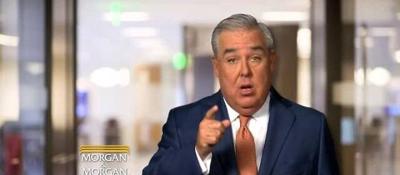


John Morgan
TALLAHASSEE, Fla. — Morgan & Morgan is asking a federal judge to block enforcement of Florida’s ban on celebrity appearances in lawyer advertising, arguing the restriction silences harmless commercials and gives regulators no clear standard for deciding who is famous enough to be off-limits.
In an October 28 memorandum supporting its request for a preliminary injunction, the Orlando-based firm said The Florida Bar has rejected proposed advertisements featuring celebrities including Shaquille O’Neal, Frankie Muniz and John Daly, warning that using them could lead to disciplinary action.
The firm wants enforcement halted while its constitutional challenge proceeds in the U.S. District Court for the Northern District of Florida.
The filing follows a lawsuit brought by Morgan & Morgan and attorney Alexander M. Clem, the firm’s CEO, according to the Florida Record’s coverage published on Legal Newsline. The suit names the Bar and three officials as defendants and seeks a declaration that the restriction is unconstitutional, a permanent injunction, attorney fees and court costs.
The latest request came after the firm unsuccessfully sought a pause in enforcement while the Bar and the Florida Supreme Court considered its proposal to repeal the restriction, according to the memorandum. The Bar’s Board of Governors met in October without acting on the suspension request, the firm said.
“Morgan & Morgan brings this motion reluctantly,” its lawyers wrote, saying the board’s inaction left the firm facing “an indefinite period of constitutional injury with no sure end in sight.”
At issue is Florida Rule of Professional Conduct 4-7.15(c), which generally prohibits lawyer advertisements containing “the voice or image of a celebrity.” The rule includes narrow exceptions for certain local broadcast personalities and testimonials by current or former clients.
The plaintiffs argue that the prohibition violates the First Amendment and is too vague to enforce consistently. They say it reaches beyond endorsements to celebrity appearances that neither recommend a lawyer nor make potentially misleading claims.
One rejected commercial depicts John Morgan, the firm’s founder, enlisting Daly to play golf on his behalf. A voice-over compares having Daly as a “designated swinger” to hiring the firm, calling each a “power move.” Daly says only “Fore!” as a golf ball ricochets off obstacles for a hole-in-one, according to the filing.
The Bar told the firm the commercial was impermissible because a celebrity appeared in it, the memorandum said.
The firm also cited a rejected billboard promoting a free youth football camp that featured Miami Hurricanes player Malachi Toney. The billboard attributed no statements to Toney, according to the filing. The original complaint said the Bar would allow it only if the firm removed its logo and other identifying material that could be treated as advertising.
The Bar’s historical rationale, as described in the memorandum, is that celebrity appearances can unduly influence prospective clients. The filing quotes a 1997 Bar task force report stating that celebrity testimonials carry an “inherent risk that a potential client will be unduly influenced by the celebrity’s fame or personality.”
Morgan & Morgan argues that the Bar’s research undercuts that position. The memorandum cites a 2011 survey that ranked celebrity endorsements as “by far the least important consideration” in choosing a lawyer. Respondents viewed celebrities as paid performers whose inclusion in advertising “elicits suspicion rather than trust,” according to the survey language quoted in the filing.
The firm also contrasts the restriction on lawyers with the use of celebrities by insurance companies, whose interests often oppose those of its clients. The memorandum points to State Farm advertisements featuring Jason Bateman and Nationwide advertisements featuring Peyton Manning.
The plaintiffs contend that separate Florida rules already prohibit false or misleading lawyer advertising and that disclosures could address potentially deceptive endorsements without banning celebrity appearances altogether. They describe Florida’s restriction as uniquely broad, noting that Pennsylvania’s celebrity advertising rule is limited to endorsements rather than any use of a celebrity’s voice or image.
A second part of the challenge focuses on the definition of “celebrity.” The rule’s commentary includes people recognizable to an advertisement’s target audience at a national, regional or local level, according to the memorandum. The plaintiffs argue that the definition can encompass local politicians, business leaders, podcasters and others without specifying how widely they must be recognized.
“Does the rule require recognition by all (or almost all) of the target audience? A majority? A significant percentage?” the lawyers wrote. “The rule doesn’t say.”
The firm cites advertising reviews involving former professional athletes as examples of inconsistent application. According to the memorandum, the Bar’s advertising committee reversed staff findings that former baseball player Jody Reed and former NBA player Chandler Parsons qualified as celebrities, but concluded that Toney was sufficiently recognizable during his first year of college football.
The restriction also affects the firm’s websites, social media and print publications, the plaintiffs said. Because online advertisements are viewable in Florida, the rule forces the firm either to withhold material or publish it while risking discipline, according to the filing.
The memorandum traces Florida’s celebrity restriction to advertising rules adopted in 1990 and cites subsequent federal decisions invalidating other restrictions on lawyer advertising. The firm argues that the celebrity provision likewise cannot survive constitutional review.
The plaintiffs are represented by Gregory Beck, Deepak Gupta and Jonathan Taylor of Gupta Wessler.
U.S. District Court for the Northern District of Florida case number 4:26-cv-405

