

TALLAHASSEE, Fla. – A Pennsylvania woman who was injured during a mass shooting at Florida State University last year has filed a federal lawsuit against ChatGPT’s parent company for its alleged role in the shooting.
Plaintiff Reese Gourley, of Gettysburg, Pennsylvania, filed her lawsuit in U.S. District Court for the Northern District of Florida, Tallahassee Division.
The named defendants include: OpenAI Foundation, OpenAI Group PBC, OpenAI GP LLC, Aestas Management Company LLC, Aestas LLC, OpenAI Holdings LLC, OAI Corporation, OpenAI Global Holdco Inc., OpenAI Global LLC, OpenAI OPCO LLC, and OpenAI LLC.
OpenAI, based in San Francisco, developed the generative AI chatbot known as ChatGPT.
“This action seeks to hold Defendants responsible for the physical, emotional, and economic injuries suffered by Plaintiff as a result of their role in assisting the Shooter in the shooting,” Gourley’s 71-page lawsuit states.
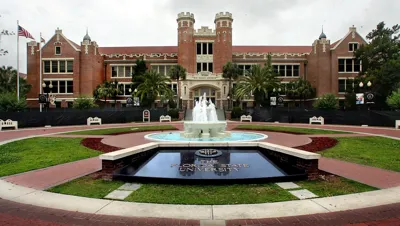
On April 17, 2025, a mass shooting occurred on the Florida State University campus in Tallahassee. Two university employees were killed and six others wounded in an attack that lasted about three minutes near and inside the college’s student union building.
The shooter, 20-year-old FSU student Phoenix Ikner, was shot in the jaw by campus police and taken into custody. He now faces the death penalty and charges of first-degree murder. His trial, initially scheduled for October, has been postponed to next year.
Court documents have revealed that Ikner used ChatGPT in the hours before the attack.
Chat logs show that Ikner asked ChatGPT what happened to mass shooters and if Florida had a maximum security prison.
“If there was a shooting at FSU, how would the country react?” Ikner asked ChatGPT, according to the logs.
ChatGPT replied by saying it “would likely follow a pattern seen with other high-profile mass shootings,” including live media coverage.
“This case arises from the Defendants’ role designing, promoting, and releasing ChatGPT, a product that actively assisted and encouraged the mass shooting carried out at Florida State University on April 17, 2025,” Gourley’s lawsuit states.
“The Shooter’s attack was carefully planned with the sycophantic assistance of his favorite chatbot – ChatGPT.”
She argues that ChatGPT failed to “adequately refuse, interrupt, de-escalate, flag, escalate, restrict, suspend, or report these high-risk interactions.”
Gourley, who was a student at FSU at the time of the shooting, contends that without the assistance and participation of ChatGPT, Ikner would have been unable to carry out the attack.
“Defendants knew that ChatGPT could produce dangerous outputs, including advice on committing crimes, self-harm, violence, and weapons use. Yet, in the days and months leading up to the shooting, the Defendants had reduced safety testing for their artificial intelligence models for the purpose of accelerating its ability to release the new models for profit,” her lawsuit states.
“Their thirst for profits and for the release of newer and more powerful models caused the Defendants to prematurely release the model utilized by the Shooter, which included sycophantic, emotionally validating, anthropomorphic, and engagement-maximizing design features, without adequate safety testing, warnings, monitoring, human review, or intervention systems.”
Gourley contends that while OpenAI purports to be governed by a non-profit entity, it sells its subscription-based ChatGPT product and derives “substantial” revenues from doing so.
“The OpenAI PBC, and other subsidiaries underneath its umbrella, are duty bound to reinvest adequate revenues in continued research and development for the benefit of the public’s safety,” her suit argues.
Gourley seeks economic damages; medical expenses; out-of-pocket costs and expenses; non-economic damages for pain and suffering, mental anguish, emotional distress, inconvenience, and disfigurement; punitive damages; costs; and interest.
She is represented by Fasig Brooks in Tallahassee.
Similar civil lawsuits have been filed against OpenAI, including one by a widow of a man killed in the mass shooting.
Vandana Joshi, whose husband Tiru Chabba was one of the two people killed, filed her lawsuit in May.
In addition, Florida Attorney General James Uthmeier launched a separate criminal investigation into OpenAI’s potential liability in April.