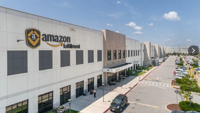





Amazon fulfillment center
Amazon has been given nearly $12 billion in subsidies such as tax breaks across the country since 2000.
And now, as the online retail giant has announced thousands of layoffs globally because of increased automation and AI advancements, experts say some local economies could be destabilized and consider it a “wake-up call” for many.
In October, Amazon announced plans to lay off more than 14,000 employees worldwide. In the Seattle area alone, there are plans to see the company cut about 2,300 jobs.
“Some may ask why we’re reducing roles when the company is performing well,” Beth Galetti, Amazon’s senior vice president of People Experience and Technology, wrote in a memo to employees about the latest layoffs. “What we need to remember is that the world is changing quickly.
“This generation of AI is the most transformative technology we’ve seen since the Internet, and it’s enabling companies to innovate much faster than ever before.”
October’s cuts follow the company’s elimination of 27,000 jobs over two waves in 2023. And, of course, the move to better use automation and AI isn’t just happening at Amazon.
But, AI-related layoffs signal a “hollowing out of middle-skilled workers,” according to Lynn Wu, a University of Pennsylvania professor of operations, information and decisions.
“Amazon is not cutting warehouse workers,” Wu told ABC News. “Robots can’t do what hands do yet. And very high-skill workers – people developing robots and building AI – are still in high demand.”
A former U.S. Department of Labor economist who now teaches public policy at Georgetown echoed Wu’s sentiments.
“This is a wake-up call,” Harry Holzer told ABC News. “And if Amazon does it, other companies might do it, too. … AI will affect a lot of different workers and businesses in ways we can’t anticipate. We have to keep monitoring it and help them adapt when changes occur.”
According to goodjobsfirst.org, Amazon has been given at least $11.6 in subsidies since 2000 through January 31, 2025. The site notes there has been greater secrecy in recent years regarding Amazon packages, saying some projects are given secret names while non-disclosure agreements and tight-lipped officials also come into play.

Tarczynska
Kasia Tarczynska, senior research analyst with Good Jobs First, says a big problem with finding information about subsidies given to Amazon is that there isn’t a lot of information readily available.
“We don’t have a lot of information,” she told Legal Newsline. “Local governments don’t like disclosing that type of information. And there also are so many other unanswered questions.
“Amazon is eliminating all of the jobs, but we don’t know if there are any clawbacks attached to the deals the company received. Are there any penalties for Amazon? Do governments have the ability to recoup any money? What is the company’s obligations to local governments? Did these local governments benefit from having Amazon? How much revenue did Amazon bring in? We don’t know.
“Plus, you have to look at the bigger picture. How many retail stores have closed because of Amazon? How did the subsidies given to Amazon affect local infrastructure projects or school systems? What were the consequences of pushing online sales?”
Each year, Good Jobs First says as much as $90 billion is given to corporations by state and local governments in the form of economic development subsidies.
“These deals are often negotiated behind closed doors, and often fail to create good-paying, permanent jobs,” the site states. “They also drain vitally needed funding from government budgets, contributing to cutbacks in public services such as schools, furthering racial and economic disparities, and shifting the tax burden onto small businesses and working families.”
Tax subsidies for Amazon facilities are large, varied and mostly offered by state and local governments through property, sales and income tax breaks tied to warehouse, data center and HQ projects. These subsidies are controversial because their job-creation benefits are uncertain compared with the public revenues and bargaining power given up by communities.
The most common incentives given to construct Amazon facilities are property tax abatements or reductions over 10–15 years for new fulfillment centers and offices; state and local income or job-creation tax credits, often conditioned on hiring and payroll targets.; sales tax exemptions on construction materials and equipment, frequently used for data centers and logistics hubs; and grants or capital subsidies to offset construction, infrastructure, and site-preparation costs.
Governments justify these subsidies as tools to attract investment, create thousands of jobs and spur local development. But economic studies and policy analysts say firm-specific subsidies to large companies such as Amazon are an inefficient and often wasteful way to create jobs. Critics also question whether the tax breaks generate benefits that exceed what communities could achieve by investing the same funds in education, infrastructure or broad-based tax relief.
Most Amazon subsidy deals are “performance-based,” meaning Amazon only receives the full value of incentives if it meets specified job, payroll, investment and occupancy benchmarks. If Amazon falls short, there are various forms of scaling back, suspension or recapture. Explicit clawbacks (recouping benefits already paid) exist in some contracts, but they are uneven and often weaker or less transparent than the subsidy amounts.
Still, watchdog groups such as Good Jobs First report that many Amazon warehouse and data center deals still lack robust, enforceable clawbacks, especially at the local level, or rely on vague “best efforts” language that makes recapture difficult. Disclosure also is often limited, so community advocates must obtain underlying contracts to verify whether true repayment obligations exist versus mere suspension of future benefits.
In a few documented cases, incentives tied to Amazon facilities have been reduced, cancelled or subject to recapture when projects were scaled back, cancelled or failed to meet conditions. But these watchdog groups say systematic, large-dollar clawbacks still are relatively rare and not always transparent.
When Amazon paused or cancelled dozens of planned warehouses in 2022, some state and local officials stated that performance-based tax credits or grants would simply not be paid because job and investment thresholds would not be reached, effectively acting as a built‑in clawback on promised incentives.
Watchdog reviews of subsidy programs used by Amazon show that many state laws allow recapture of already-claimed credits if a company later falls below required employment or investment levels, and there are reported instances of credits being reduced or disallowed for underperformance, though specific Amazon dollar amounts are often undisclosed in public summaries.
Good Jobs First’s tracking finds that while most major subsidy programs now have some penalty or recapture mechanism, only a minority publicly report when they actually claw back money from firms such as Amazon, making it hard to quantify how often it happens.
Many Amazon deals rely on “no performance, no benefit” structures rather than explicit repayment, so the most common outcome when targets are missed is cancellation of future incentives rather than a high-profile demand to pay back past subsidies.
A 2023 study found that government return on investment for Amazon subsidies is dismal. It said government spend about $44,000 per job created, and the average wage of those jobs ($32,000) is far less than that amount.

Brannon
Simply put, if the goal is to create jobs, handing out tax breaks to Amazon is poor policy,” study co-author Ike Brannon wrote for Forbes in 2023.
Brannon, a senior fellow at the Jack Kemp Foundation and president of Capital Policy Analytics, wrote the study with University of Wisconsin-Whitewater economist Matt Winden. It said Amazon’s new fulfillment centers have created relatively few additional local jobs compared with communities that did not get a new Amazon facility — and at a very high cost to taxpayers.
The study found that each $1 million subsidy to Amazon created about 23 jobs, which is about 12% of the jobs Amazon claimed to create.
We find that each $1 million subsidy to Amazon created about 23 jobs, which is just 12% of the jobs Amazon and its proponents claimed to create.
“Local taxpayers are effectively paying all the wages of Amazon workers in the first year (and more) with relatively little to show for it,” Brannon wrote in a New York Post piece that same year. “Communities are unlikely to recoup the cost of these subsidies because the low-paid jobs Amazon creates in fulfillment centers pay little in state and local income taxes, and the sales taxes their spending generates will be a fraction of the cost of creating the job.”
The study says governments are unlikely to recoup the cost of the subsides because the jobs created pay little state and local income taxes, and the sales taxes generated by their spending is a fraction of the cost of creating the job.
“These subsidies didn’t create many jobs because most of these new facilities are located in communities where unemployment is already low,” Brannon wrote for the Washington Business Journal. “Amazon builds warehouses and distribution centers in thriving areas with high demand for their products.
“The subsidy simply shifted jobs from other employers to Amazon, exacerbating the already tight labor markets.”