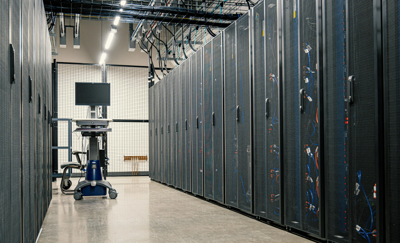



Rows of server racks and computer equipment inside a modern data center.
BATON ROUGE – Two advocacy groups are asking a state court to overturn Louisiana utility regulators’ decision blocking access to Meta’s records on electricity demand and economic benefits as Entergy Louisiana seeks approval for more than $14 billion in power infrastructure for the company’s expanding data center.
The Alliance for Affordable Energy and the Union of Concerned Scientists, represented by Earthjustice, filed the appeal in the 19th Judicial District Court in Baton Rouge. They contend the Louisiana Public Service Commission failed to explain why it overturned its chief administrative law judge’s order requiring Meta to produce the documents.
The groups want the court to reinstate the subpoena, halt activity associated with Entergy’s application and require regulators to reopen the evidentiary record to consider information obtained from Meta. They are seeking expedited review before a commission decision scheduled for Dec. 16, according to the petition.
“The Court cannot determine the reason the Commission vacated the subpoena because no reason was provided,” the appeal states.
The challenge centers on evidence underlying Entergy’s proposal to build seven additional natural gas-fired generating units, battery storage and transmission improvements to serve Meta’s Richland Parish data center. The proposed generating units would provide 5,278 megawatts of capacity, according to the appeal.
Meta has described the expanded development as an investment of more than $50 billion, supporting more than 7,500 jobs at peak construction and 1,000 jobs once operational. In a July announcement, the company said the site would house Hyperion, its largest artificial intelligence training cluster.
Those public projections are among the claims the advocacy groups want to examine through underlying documents rather than accept at face value. Their petition argues that Entergy relied on Meta’s statements without obtaining the records needed to substantiate the project’s investment, job creation and electricity requirements.
Chief Administrative Law Judge Melanie Verzwyvelt partially granted the groups’ subpoena request July 10, ordering Meta to produce records supporting the data center’s expected investment and permanent job creation, along with documents substantiating its electricity needs, according to the appeal.
She rejected three other categories of requested information, including detailed fluctuations in electricity use, communications about a sustainability agreement and information about Meta’s assets and financial guarantees.
In portions of her ruling quoted in the petition, Verzwyvelt said the project’s size and its accelerated regulatory review justified examining the underlying evidence.
“Meta has created the need for the additional resources at issue, which are larger in scale than any previous request before this Commission,” she wrote, according to the appeal.
The judge said regulators first must determine whether additional generating resources are needed and then decide whether the proposed method of meeting that need is reasonable and in the public interest.
“A full evidentiary record requires substantiation of the data upon which ELL has relied,” she wrote, referring to Entergy Louisiana.
The appeal cites an Entergy discovery response stating that the utility “does not have a job estimate specific to Project Evest,” the project involving Meta subsidiary Evest LLC. On electricity demand, the groups say Entergy pointed to the amount of power the customer contracted to receive rather than supplying analyses supporting that demand.
Entergy subsequently disclosed the expansion’s projected power demand during an Oct. 7 regulatory hearing. Company President and CEO Phillip May testified that Meta would use 4,500 megawatts, The Times-Picayune | The Advocate reported. The disclosure made the demand figure public, but the appeal seeks records substantiating how the requirement was calculated.
Meta sought commission review of Verzwyvelt’s subpoena ruling, arguing that the requested information contained trade secrets or other confidential material, was unnecessary to decide Entergy’s application and would be unduly burdensome to produce, according to the appeal’s description of the company’s filings. Meta also argued that inadvertent disclosure of trade secrets could cause irreparable harm.
The groups counter that Meta failed to establish that a protective order could not adequately safeguard the records or that responding to the two approved categories would impose an undue burden.
Neither Meta nor Evest is a formal party to the underlying utility proceeding, according to the petition. Entergy opposed the subpoena request.
Commissioners voted 3-1 on Aug. 12 to reverse the judge’s ruling and vacate the subpoena. Coussan, Skrmetta and Francis supported the reversal, Lewis opposed it and Campbell was absent, according to the commission order quoted in the appeal.
The petition alleges that commissioners offered no explanation for rejecting the judge’s findings, either at the meeting or in their Sept. 17 written order. It also describes a contentious exchange when Lewis attempted to question Meta’s attorney about the company’s request for review.
“Meta, if you want to come up, you can come up, or you can refuse,” Skrmetta said, according to a meeting transcript reproduced in the appeal.
“I refuse to come up,” Meta attorney Weston Adams responded.
Earlier, when Lewis questioned the advocacy groups’ counsel about the judge’s ruling, Skrmetta said, “This is a comment period and not a refresher of the actual hearing,” according to the quoted transcript.
Meta and Entergy have publicly disputed suggestions that the development will saddle other electricity customers with its costs.
In its July announcement, Meta said its agreement with Entergy would fund seven new gas-fired generating plants, three grid-scale batteries, nuclear plant upgrades and other purchased power. The company projected approximately $2.65 billion in customer savings over 20 years, including $650 million previously announced.
“We work closely with local utilities to plan for and meet our energy needs and ensure we pay for the energy, water, and related infrastructure we use so that other customers’ electricity and water bills don’t increase as a result of our work,” Meta said.
At the October hearing, May called the expansion a “transformational investment” and said the contract protects customers by requiring Meta to pay for its power even if it leaves early.
The advocacy groups say risks remain after the 20-year contract expires. In an Oct. 15 blog post explaining the appeal, Union of Concerned Scientists analyst Paul Arbaje wrote that Entergy estimates roughly $13.6 billion in new generation capital costs would be about 75% paid down by the contract’s end, leaving approximately $3.4 billion.
Entergy argues that generating plants remaining after the contract ends would still be needed to serve its broader system as older plants retire.
The appeal acknowledges that commission orders are presumed valid and that overturning them requires a showing of arbitrary or capricious action, an abuse of discretion or a decision unsupported by the evidence. The groups argue that regulators’ failure to explain their reversal prevents meaningful judicial review.
“Because the Commission’s Decision has no rational basis in the facts at hand, it should be vacated,” the petition states.