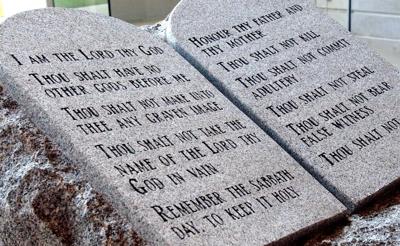


NEW ORLEANS – A nonprofit organization dedicated to “secular values” is urging the U.S. Court of Appeals for the Fifth Circuit to find a Louisiana statute requiring public schools to permanently display the Ten Commandments unconstitutional.
The Center for Inquiry, headquartered in Amherst, New York, filed an amicus brief last month with the Fifth Circuit in the case of Roake v. Brumley. The case challenges HB 71, the Louisiana statute passed in 2024.
“CFI files this brief to highlight the constitutional harms imposed by Louisiana House Bill 71 (‘HB 71’) on atheist students and families. The law not only mandates state promotion of a specific religious tradition but also undermines the right of conscience of those who do not subscribe to any religious tradition,” the nonprofit wrote in its brief.
“CFI respectfully urges this Circuit to reaffirm that the First Amendment’s religion clauses protect all Americans – atheists and believers alike – by holding that HB 71 is unconstitutional.”
According to its filing, CFI defends the rights of atheists, agnostics, humanists, and other nontheists to be free from governmental favoritism toward theistic worldviews. It advocates for “robust interpretations” of the establishment and free exercise clauses that protect the rights of nonreligious and religious individuals alike.
“CFI has a longstanding interest in preserving the constitutional principle of church-state separation, particularly in the public education context where government-sponsored religious messaging threatens the liberty and inclusion of nonbelieving students,” it wrote in its brief.
HB 71 was passed by the Louisiana Legislature and signed by Gov. Jeff Landry in June 2024.
The law mandates that by Jan. 1, 2025 all state-funded school classrooms in Louisiana were required to have “a poster or framed document that is at least eleven inches by fourteen inches” with a King James Bible version of the Ten Commandments as the display’s “central focus,” in a “large, easily readable font.”
The display was required to also include a “context statement” explaining the Ten Commandments' role in American education and government.
The law also allows for the display of the Mayflower Compact, the Northwest Ordinance, and the Declaration of Independence.
In June 2024, a group of multi-faith and non-religious Louisiana parents brought a lawsuit on their own behalf and on behalf of their minor children, in Roake v. Brumley.
In November 2024, the law was ruled unconstitutional by the U.S. District Court for the Middle District of Louisiana. At the time, Louisiana Attorney General Elizabeth Murrill said the state would appeal the case to the Fifth Circuit.
A three-judge panel from the Fifth Circuit unanimously upheld the district court’s ruling in June 2025. The state asked the full Fifth Circuit to reconsider.
In October 2025, the Fifth Circuit agreed to hear the case en banc. “En banc” means for all the judges of an appeals court to hear and decide a case together, instead of a typical three-judge panel. This happens for cases deemed to have great importance.
This nullifies the Fifth Circuit’s previous ruling, with the exception of the preliminary injunction from the district court that remains in place.
The full Fifth Circuit is scheduled to hear oral arguments in the case Jan. 20. Each side is given 45 minutes to present arguments, according to the court’s website.
CFI has described the law as “an exclusionary, heavy-handed measure that will make every student who is a member of a minority religion (or no religion at all) feel like an outsider in their own school.”
The nonprofit, in its brief, argues HB 71 “runs afoul of history and tradition to promote a distorted, non-secular history that alienates atheist students.”
“Forcing students to accept a distorted narrative that the history of their state and nation is rooted in religious tenets undermines intellectual integrity and inflicts harm on students with diverging beliefs,” CFI argues. “For atheist children, this state-sanctioned messaging communicates, falsely, that their worldview is incompatible with foundational community values.
“The Establishment Clause was designed precisely to prevent this kind of governmental imposition of religious orthodoxy, ensuring that public education remains a neutral space where students of all faiths – and of none – can learn without coercion or doctrinal pressure.”