
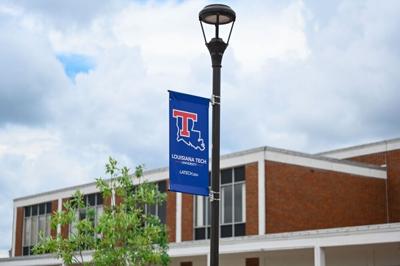


Louisiana Tech campus in Ruston.
ALEXANDRIA, La. – A Louisiana woman is suing Louisiana Tech University and its board for discrimination, alleging she was denied approved accommodations and a victim of retaliation.
Plaintiff Emily Madeline Miller, a Rapides Parish resident, filed her lawsuit February 2 in U.S. District Court for the Western District of Louisiana, Alexandria Division.
The named defendants are Louisiana Tech University, in Ruston, and the Board of Supervisors for the University of Louisiana System, or ULS. The board supervises, controls, operates, manages, and controls public institutions within the ULS, including LTU.
Miller, who was enrolled as a graduate student in LTU’s Speech-Language Pathology, or SLP, program during the 2025 winter quarter, has documented disabilities and was granted accommodations by LTU’s Testing and Disability Services, or TDS. Such accommodations include extended testing time and testing in a reduced-distraction environment.
In her 12-page filing, Miller contends the university violated the Americans with Disabilities Act by not following her accommodations. The ADA is a civil rights law that prohibits discrimination based on disability in various areas of life, including education, employment, and transportation.
“By denying Plaintiff approved accommodations, subjecting her to harsher testing conditions, and retaliating against her for asserting rights, Defendants excluded her from participation in and denied her the benefits of educational programs ‘by reason of’ her disability,” the complaint states.
“Despite TDS approval after submission of medical records to prove her disability, LTU faculty repeatedly denied and/or interfered with her accommodations.”
For instance, she alleges that she requested testing accommodations during a course taken with Professor Daphne Washington, and set up testing parameters and approval through TDS.
However, Washington allegedly refused to allow the use of the TDS testing center for testing and instead provided only a distraction free testing room – a room inside Robinson Hall “similar to a closet,” she alleges.
“No extended testing time was permitted,” Miller’s complaint states.
Miller claims she was told accommodations were a “gracious exception,” and not a right.
In addition, she alleges faculty retaliated against her after she complained to administrators and TDS, and she was “reprimanded” for contacting the dean.
For example, Miller alleges she was subjected to “belittling” comments such as, “If you were my employee, I would have fired you.”
She contends in her filing that grading of remediation assignments was arbitrary – contrary to her syllabus and prior assurances – and that they were applied to her overall course grade instead of the specific exam. Doing so, she alleges, further reduced her average and inability to pass the course.
Miller also alleges faculty made changes to an exam, making it more difficult – and did so on purpose, for retaliation.
“These denials delayed Plaintiff’s graduation, excluded her from participating in comprehensive exams, and caused out of pocket damages, mental anguish, humiliation, economic and financial hardship,” her complaint states.
“The SLP Handbook and University policy guarantee equal access for students with disabilities. Defendants’ acts directly contravened these written policies.”
She seeks injunctive relief, requiring LTU to: correct her SPCH 527 grade; recognize her passing score as satisfying comprehensive requirements; and confer her Master’s degree.
She also seeks compensatory damages for lost job and educational opportunities, economic damages for tuition and other out-of-pocket costs, and attorney’s fees.
The Vasquez Law Office in New Orleans is representing Miller in the action.