
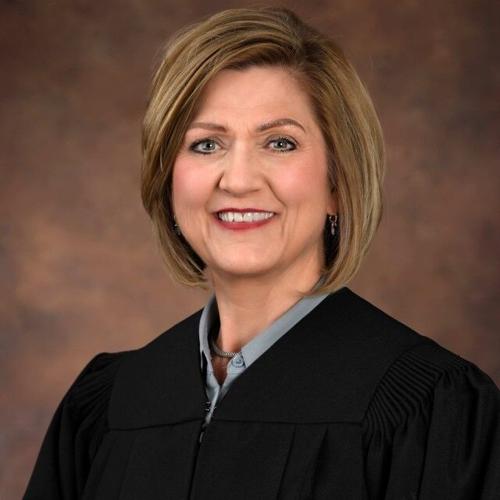



Illinois Supreme Court Justice Mary K. O’Brien
SPRINGFIELD - The Illinois Supreme Court has said a lower court wrongly blocked embattled developers from obtaining the state permit they need to run a proposed high-voltage power line project intended to move wind-generated electricity more than 200 miles across southern Illinois.
On Jan. 23, the state high court handed the win to Grain Belt Express (GBX) and its parent company, Invenergy, in their bid to overturn the ruling from the Illinois Fifth District Appellate Court and restore the permit awarded to the GBX project by the Illinois Commerce Commission.
In the 6-0 ruling, the Illinois Supreme Court said the appeals court erred in declaring the ICC had wrongly awarded the permit without properly determining if GBX had the capability to finance and complete the project.
In the decision, which was authored by Justice Mary K. O'Brien, the state Supreme Court said it believed there was "substantial evidence supporting that ICC's finding that GBX 'is capable of financing the project without significant adverse financial consequences' to it or its customers..."
But the court further declared that neither the courts nor the ICC need to obtain such "proof of ... current and present financial capability" before awarding the permit, known as a certificate of public convenience and necessity, or CPCN.
"Instead, evidence of the industry’s method of financing the construction of large-scale energy projects, along with unrefuted evidence that such projects do not generate revenue until regulatory permits are issued and customer contracts are executed, supports the ICC’s decision to issue a CPCN to GBX," O'Brien wrote in the decision.
O'Brien was joined in the ruling by Chief Justice P. Scott Neville and justices Mary Jane Theis, David K. Overstreet, Joy V. Cunningham and Elizabeth M. Rochford.
Justice Lisa Holder White did not participate in the decision.
The Supreme Court's ruling overturns the holdings of a Fifth Appellate District panel, which had determined the ICC had improperly approved the controversial high-voltage power line project without first requiring proof of how GBX would pay for it and profit from it.
GBX had sought the CPCN since 2015 to run its power line project for 207 miles through Pike, Scott, Greene, Macoupin, Montgomery, Christian, Shelby, Cumberland, and Clark counties. The Illinois segment made up a large portion of the proposed 800 mile power line project, intended to run wind-generated electricity from wind farms in Kansas through Missouri and Illinois to a substation in Indiana.
The ICC first granted GBX the CPCN permit in 2018 over the objections of a coalition of opponents, including land owners and the Illinois Farm Bureau.
The opponents then appealed the ICC's decision in court, arguing the ICC had illegally awarded the CPCN to a private company, when, they argued, Illinois law only allowed such permits to be awarded to public, regulated utility.
At that time, the Fifth District appeals court agreed, blocking the permit.
However, in 2021, Illinois Democratic state lawmakers rewrote the law to specifically allow such "qualifying direct current applicants" to secure permits for power line projects, in the name of supporting Democrats' efforts to transition Illinois to rely on so-called "renewable" energy, including power generated by wind and solar installations.
GBX and Invenergy then applied again to the ICC for the permit, which the Commission granted in 2023.
That, in turn, prompted another appeal by opponents of the project. This time, they argued the permit should be blocked because the ICC essentially accepted GBX's and Invenergy's word that they would bring in the money they needed to complete and operate the power line project once they had obtained the needed permits.
In siding again with the objectors, the Fifth District justices said that reasoning essentially amounted to "a classic case of putting the cart before the horse.”
“Grain Belt Express must prove that it has the capacity to finance the project prior to the commission granting any certificate of public convenience and necessity,” Justice Randy Moore wrote in the 2024 Fifth District ruling.
In its new ruling, however, the Illinois Supreme Court said no such proof of financial capability is needed to obtain a CPCN for such high-voltage power line projects.
The justices agreed the new Illinois law creates a distinction between traditional public utilities, with an existing presence in the state and a base of rate paying customers, and power line builders and operators, like GBX, which has no rate payers to help pay for the construction project.
"In the emerging renewables energy industry, infrastructure projects are not financed based on current financial capability but on future revenues that will be generated from customers paying for transmission line capacity," O'Brien noted in the ruling.

Adam Vaught
Therefore, it is enough for the company to assert it will qualify for private financing and government aid after it has secured the regulatory permits needed to build the project.
The decision, however, does not provide the GBX with clear sailing.
Missouri officials, notably including that state's Attorney General Andrew Bailey, led the effort to persuade the U.S. Department of Energy under President Donald Trump to pull the plug on a nearly $5 billion federal loan guarantee for the GBX project, which had been approved under the Biden administration.
Bailey called the GBX project a "massive green energy scam ... to benefit corporate interests at the expense of family farms."
The project is estimated to carry a total price tag of $7 billion.
Bailey has further urged the Missouri counterpart to Illinois' ICC to also reconsider the permit it had awarded to GBX to move ahead with the project in the Show Me State.
In the Illinois litigation, GBX and Invenergy were represented by a prominent group of Illinois attorneys, including Thomas L. Kilbride and Adam R. Vaught, of the firm of Croke Fairchild Duarte & Beres, of Chicago.
Kilbride is a former Democratic Illinois Supreme Court justice.
Vaught is a high profile attorney long associated with the power structure of the Illinois Democratic Party, including a long history of service representing the interests of powerful former Illinois House Speaker Michael J. Madigan. Madigan is currently serving a prison sentence after he was convicted on public corruption charges.
The Farm Bureau has been represented in the litigation by attorney Charles Y. Davis, of the firm of Brown Hay + Stephens, of Springfield.