

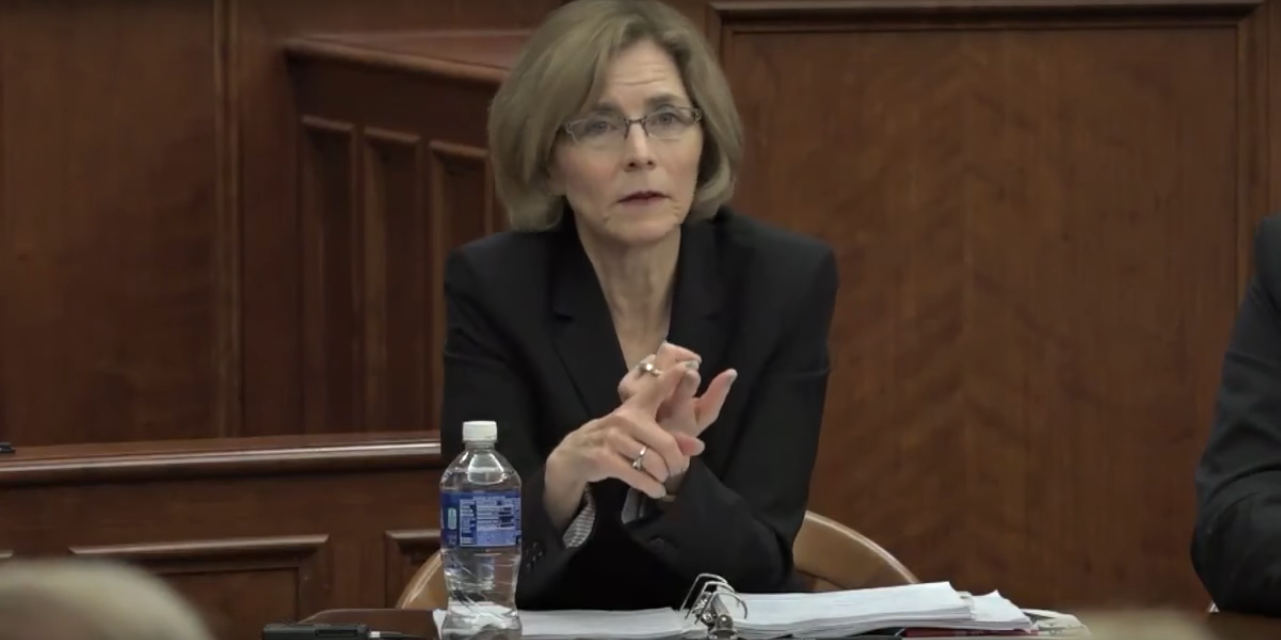
U.S. District Judge Rebecca Pallmeyer
CHICAGO — A federal judge has potentially cleared the way for another trial against pharmaceutical and nutritional supplement maker Mead Johnson & Co. over claims their Enfamil-brand infant formula has harmed some babies.
On May 8, U.S. District Judge Rebecca Pallmeyer denied Mead Johnson's bid to bring a relatively quick end to a key lawsuit amid the thousands of others pending in the sprawling litigation.
The decision sets up a high-stakes trial, with potentially billions of dollars at stake.
Pallmeyer's new ruling marks a potentially significant win for trial lawyers who are seeking huge potential judgments and settlements in lawsuits against Mead Johnson and its frequent co-defendant, Abbott Laboratories. In those lawsuits, the plaintiffs accuse the companies of allegedly selling baby formula, including under the Similac and Enfamil brand names, despite allegedly knowing consumption of their cow's milk-based formulas increases the risk of babies suffering severe injuries or dying from the illness known as necrotizing enterocolitis, or NEC.
NEC is a condition which results in the death of bowel tissue and can lead to severe illness and death in newborns, particularly if they are born premature. NEC carries a fatality rate of around 15-40% in infants suffering from the condition.
The lawsuits have poured into courts by the thousands in state and federal courts throughout the U.S.
Specifically, they typically accuse the companies of allegedly failing to warn the public about the alleged enhanced NEC risks posed by the baby formulas, compared to human breast milk,
While hundreds of lawsuits are pending in Illinois state courts in Madison and St. Clair counties, more than 750 lawsuits have been consolidated before Judge Pallmeyer in Chicago federal district court.
As part of that action, Pallmeyer, in consultation with attorneys for both sides, selected four cases to serve as so-called "bellwether" cases. While pre-trial proceedings would continue to be consolidated for the other 700-plus cases, legal teams had prepared to take those four cases to trial.
To this point, the formula makers had succeeded in winning pre-trial judgments from Pallmeyer that had put the kibosh to trials planned in the first three bellwether cases.
To this point, the Chicago federal judge had sided entirely with formula makers on certain key questions at the heart of the litigation, and had granted their requests for summary judgment.
Mead Johnson had hoped to make it a clean sweep of all four cases.
In the fourth case, Mead Johnson had been sued by plaintiff Alexis Inman, an Indiana woman whose infant son died from NEC after consuming a nutritional regimen including Enfamil formula.
Pallmeyer, however, put an apparent end to those hopes in a decision that represented a reversal, of sorts, from her previous rulings.
In all three of the bellwether cases decided thus far, Pallmeyer agreed that evidence overwhelmingly favored formula makers' position that plaintiffs can't get past the benchmark holding that the benefits of their infant formula products -- feeding newborns who would otherwise starve, for instance, in cases in which their mothers not be able to produce milk to feed their babies -- outweigh the risks of possibly contracting NEC.
In a ruling in October 2025, for instance, Pallmeyer granted judgment in favor of Abbott Labs, saying trial lawyers can't show evidence that an alternative formula made from human milk could be mass produced in large enough amounts to prevent tens of thousands of babies from otherwise starving.
In her new ruling in the case against Mead Johnson, Pallmeyer reiterated her belief that the evidence shows formulas made from human milk don't amount to a viable commercial alternative that could form the basis of a lawsuit against formula makers for producing infant formula's from a cow's milk base.
However, Pallmeyer said, evidence may show that formula makers could have instead produced a different kind of formula, which relies on the compound known as lactose "as the main source of carbohydrates, rather than corny syrup and maltodextrin."
In her decision, Pallmeyer noted some studies had shown such a lactose-based formula could reduce the risk of NEC in piglets.
In her decision, Pallmeyer said communications from scientists employed by Mead Johnson showed the company was at least aware of those studies since at least 2015.
The judge said this means, "Ms. Inman has presented evidence of a possible reformulation of Enfamil Premature that would have reduced the risk of NEC. Triable questions of fact remain regarding the safety, feasibility, and reasonableness of the possible reformulation as an alternative design..."
So, Pallmeyer said, Inman's case against Mead Johnson should proceed to trial to allow a jury to assess those facts and evidence.
The judge has not yet set a date for trial in the case.
Inman is represented by attorney Jose M. Rojas, of the firm of Levin Rojas Camassar & Reck, of Hartford, Connecticut.
Other attorneys representing plaintiffs in the consolidated actions and bellwether cases include attorneys from the firms of Levin Papantonio, of Pensacola, Florida; Johnson Becker, of St. Paul, Minnesota; Lieff Cabraser Heimann & Bernstein, of New York; DiCello Levitt, of Chicago and Birmingham, Alabama; and The Dixon Firm, of San Diego.
Mead Johnson is represented by attorney Paul W. Schmidt and others from the firm of Covington & Burling, of New York and Washington, D.C.