
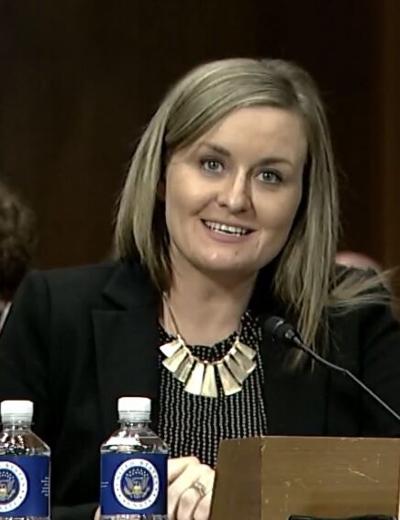


U.S. District Judge Colleen Lawless
SPRINGFIELD — A federal judge has preserved a $6 million jury verdict for the family of a man who died in a 2020 truck crash near a rest stop south of Springfield.
According to court records, John Barnes was driving a box truck around 5:20 a.m. when he hit the back of an R+L Carriers trailer. Barnes’ widow, Barbara Barnes, filed a negligence and vicarious liability action against Greenwood Motor Lines, which does business as R+L, and the driver, Michal Hegger, alleging he re-entered the right lane in front of Barnes and caused the crash. The defendants countered by alleging Barnes was under the influence of a prescription pain killer medication, tramadol, and could otherwise have prevented the collision.
A jury awarded Barnes more than $10 million in damages, but that sum was reduced to a bit more than $6 million based on finding Barnes 40% liable for the incident. The defendants then asked U.S. District Judge Colleen Lawless to revisit the judgment, grant a new trial or change the damages. In an order filed Oct. 30, Lawless denied those requests.
The defendants argued the trial record showed insufficient evidence to support the verdict, saying the traffic laws and regulations Barnes cited didn’t establish “Hegger proximately caused” the crash.
Lawless noted the jury instructions included seven possible ways for panelists to find Hegger could’ve been negligent. She explained trial evidence showed that Hegger was only driving about 18 mph in a 70-mph zone when Barnes’ truck — at roughly 73 mph — hit the trailer. She said Hegger pulled onto the interstate at a spot eight to 11 seconds ahead of Barnes given the box truck’s speed and said “a human factors expert” told jurors Barnes might have had about four seconds before impact to perceive a collision was imminent and “67% of drivers facing this scenario would not have avoided impact.”
The jury also took note of “substantial evidence that Mr. Barnes was himself negligent,” Lawless continued, further bolstering her position the verdict was reasonable and “not against the manifest weight of the evidence.”
Lawless rejected arguments she improperly excluded a challenge to the evidence of a doctor Barnes called on to discuss the postmortem redistribution of tramadol, an opiate that can cause drowsiness, writing “the jury heard the substance” of defense lawyers’ challenge to a degree required to take it into consideration. She also dismissed complaints about a different Barnes witness expressing “emotion and personal feelings” during the defense’s redirect examination, noting the defense didn’t object during the trial and further finding “no unfair prejudice” in what the witness stated about the importance of his trucking classes.
Turning to the financial award, Lawless again said the jury’s decision was “reasonably supported by the facts.” It awarded “$525,000 for loss of benefits, goods and services; $2.5 million for grief, sorrow and mental suffering; and $7 million for loss of society and companionship,” she wrote.
The defendants said rather than the reduced figure of $6 million, Lawless should further limit compensation to $3 million based on a July 2020 bench trial from the Northern District of Illinois, Lane-Murray v. Payton, and “several figures reached by settlements,” Lawless wrote. But the judge said settlement figures aren’t good comparisons for damages awards because they factor the parties’ risk-benefit calculations about letting a dispute proceed to trial.
“Ms. Barnes lost her husband, and her children lost their father,” Lawless wrote. “Ms. Barnes is deaf. In her words, her husband ‘was my ears’ and ‘he would use his voice for me.’ He would help her with everyday tasks and was ‘the glue’ to the family. Though defendants contend the jury’s award for loss of benefits, goods and services lacked economic evidence, it is clear from the record that Mr. Barnes’ support for his family went beyond his mere presence as a husband and father.”
A jury may consider several factors, she concluded, and the award “fell within the flexible range of conclusions that could be supported by the evidence.”
Barnes is represented by Levin & Perconti, of Chicago.
Greenwood is represented by Baker Sterchi Cowden & Rice, of St. Louis.
West Bend Insurance, for Hegger and as a subrogee of Black & Co., is represented by McCabe & Hogan, of Palatine.
