
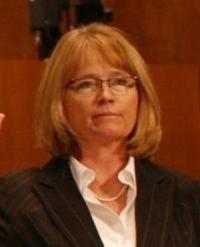


Illinois Central District Court Judge Sue Myerscough
SPRINGFIELD, ILLINOIS - A federal judge in Springfield rejected an effort to restart a trial alleging SuperValu defrauded the government through inflated prescription drug prices.
In March, a jury trial returned a verdict in favor of the supermarket and pharmacy chain that seemingly ended a 14-year-long legal battle over its price-matching system for generic drugs, launched in 2006.
SuperValu at one time was the parent company of such supermarket brands as Jewel-Osco and Albertsons, among others. SuperValu sold those brands in 2013 to Cerberus Capital Management.
Whistleblowers alleged SuperValu violated the False Claims Act by reporting to the government a higher retail price rather than the discounted rates given to customers who showed proof of drugs costing less at competitors.
In an opinion filed Oct. 31, U.S. District Judge Sue Myerscough rejected motions to amend the judgment and grant a new trial while also denying SuperValu’s motion for judgment as a matter of law.
Without detailing the entire procedural history, Myerscough highlighted the August 2019 order granting partial summary judgment to the federal and state government entities challenging whether the matched prices for cash customers were “the usual and customary” amounts that SuperValu should’ve been reporting when filing claims with government health care programs like Medicaid and Medicare Part D.
That ruling prompted appeals to the U.S. Seventh Circuit Court of Appeals and the U.S. Supreme Court on the question of what SuperValu knew when it submitted government claims. The jury in March agreed SuperValu did know its claims were false, but said the government failed to show those claims changed what it actually paid in the context of its own reimbursement rates.
The government plaintiffs asked Myerscough to amend her judgment “establishing the total number of false claims proven at trial and awarding civil penalties for those claims and a new trial on the issue of damages,” she wrote. They claimed they were entitled to civil penalties regardless of their ability to prove cause and further claimed the jury’s decision to not award damages to the government resulted from a series of allegedly erroneous earlier opinions and rulings.
Myerscough asserted her jury “instructions regarding the element of causation, and the corresponding verdict form, correctly stated Seventh Circuit law by explaining the need to prove a false statement, knowledge the statement was false, the influence of the statement on government action and a link between the statement and a government loss.
“Whether the claims were false or fraudulent is not for you to decide,” Myerscough said she told jurors.
While noting other federal appellate circuit courts operate under a framework of liability for civil penalties outside of causation — even without damages — she said the Seventh Circuit hasn’t adopted a distinction “between liability for the purpose of civil penalties versus liability for the purpose of actual damages,” further establishing the validity of her jury instructions.
The jury needed to find for the government “on both of the two outstanding elements of liability under the False Claims Act — knowledge (scienter) and causation — before the jury would be asked to determine the number of false claims and corresponding damages for which (SuperValu) should be held liable,” she wrote. “While relators may wish that the Seventh Circuit had resolved the question of whether there are ‘two sorts of liability’ under the False Claims Act — one for the purpose of civil penalties only and another for treble damages — prior to trial in this matter, it has not.”
She further denied a request for a new trial, explaining “the jury was not confused or misled as to” prior rulings regarding whether the reimbursement claims SuperValu submitted were false. The government, Myerscough said, wanted jurors to be told courts had already determined those claims to be false, “but that is exactly what this court did” by saying the issue wasn’t before the jury, she said, adding a request to define “usual and customary” or detailing the price match programs “were more specific and technical and, therefore less clear, that then plain instruction” she delivered.
Myerscough also noted the jury agreed with the government that SuperValu, by a preponderance of evidence, “knowingly presented, or caused to be presented, false or fraudulent claims for payment to federal programs,” undercutting the argument the instructions caused prejudice. She also rejected concerns over testimony presented at trial, saying it went to the issue of if SuperValu knew its claims were false when submitted and noting the information “was not presented in isolation.”
SuperValu asked Myerscough to overrule the jury regarding its knowledge of the claims being false, but she said there was enough evidence to support the verdict, which “included emails from the executive team at SuperValu that characterized its approach to price matching as ‘stealthy.’ SuperValu executives acknowledged that treating the price matching as ‘routine’ would ‘affect the integrity of our U&C (i.e., usual and customary) price – a slippery slope, as true U&C price is a claim submission requirement for all Medicaid and private commercial Managed Care and (pharmacy benefit manager) agreements.’ Further evidence included reminders sent to SuperValu from pharmacy benefits managers that usual and customary prices must include "all applicable discounts,’ including competitor’s matched price.’ ”
Myerscough said she would rule on SuperValu’s motion regarding costs in a separate order.
SuperValu is represented in the action by attorneys Enu Mainigi, Craig Singer, Jennifer Wicht, A. Joshua Podoll, Annie Showalter and Kimberly Broecker, of the firm of Williams & Connolly, of Washington, D.C.
Plaintiffs/relators in the case are represented by a number of attorneys, including: Timothy Keller and others with the firms of Aschemann Keller LLC, of Marion, Illinois; Helmer Martins Tate & Garrett Co., of Cincinnatti, Ohio; the Law Office of Glenn Grossenbacher, of Hot Springs Village, Arkansas; Goode Casseb Jones Riklin Choate & Watson, of San Antonio, Texas; Idell PLLC, of Austin, Texas; and Murphy & Murphy LLC, of Marion, Illinois.