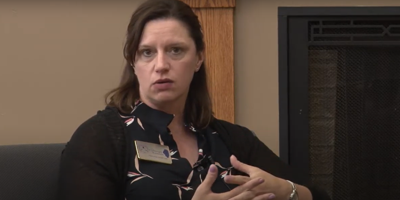



Lake County Circuit Clerk Erin Weinstein
CHICAGO - A federal judge has agreed to preserve a jury’s verdict ordering the Lake County Circuit Clerk’s Office to pay more than $2.5 million to three workers who say they were fired for supporting a Republican opponent of current Clerk Erin Weinstein.
U.S. District Judge Andrea Wood filed an opinion Dec. 18 denying Weinstein’s request for a new trial on a dispute that dates back to the summer of 2016 when Michelle Higgins, Tiffany Deram and Joshua Smothers said they campaigned for Republican incumbent Keith Brin. The workers sued in October 2017, claiming Weinstein fired them shortly after taking office the previous December.
Higgins and Deram were department chiefs, having joined the office in 1985 and 1998, respectively. Smothers was a supervisor, having joined in 2007. They alleged the new clerk fired them about an hour after being sworn into office, telling them to collect their belongings and leave the office due to their poor job performance and an office restructuring. After Wood denied Weinstein’s motion to dismiss the case in September 2021, a jury ruled in favor of the workers.
After the verdict, Weinstein and her office petitioned Wood to grant her own judgment as a matter of law and also asked her to vacate the jury’s award of lost wages and pension benefits and grant a new trial.
Wood said the request for a fresh judgment was based in Weinstein’s insistence Higgins and Deram worked in positions where political loyalty can be considered a job qualification. She said the U.S. Seventh Circuit Court of Appeals “has recognized numerous positions” as being exempt from the general rule of First Amendment protections for politically-based terminations of government workers. Determining which positions qualify, she explained, requires focus on the power of an office, not what a particular employee does while holding the job.
“Since there is no job description for the department chief position at issue here, the court relies on the parties’ trial testimony about how the job was performed,” Wood wrote. “Contrary to defendants’ assertions, there was sufficient evidence for a jury to find” Higgins and Deram did not hold positions exempt from First Amendment protections, “particularly as Weinstein bore the burden of proof.”
Wood reviewed trial testimony, focusing on how Deram and Higgins executed their duties under Brin and his Chief Deputy Jeanne Polydoris. She acknowledged evidence each worker “exercised meaningful discretion in their managerial roles” but also said a rational jury could determine such discretion was professional, not political, noting “even Weinstein conceded that department chiefs in her administration do not create policy.”
One key aspect of assessing which positions can require political loyalty is whether the job offers access to “confidential, politically sensitive thoughts” of an elected official, but Wood noted the workers reported to Polydoris, not directly to Brin, and neither ever met alone with the clerk.
Turning to damages, Wood said Weinstein and her office failed to offer a “persuasive reason for the court to find that a judgment against Weinstein in her individual capacity for lost wages and benefits would expend itself on the state treasury, interfere with public administration, or compel the state to act.” She further explained the judgment doesn’t conflict with 11th Amendment protections for government entities.
Wood further said there was no error in allowing the workers to offer their own testimony regarding the present value of lost pension benefits. She noted Deram and Smothers used uncontested Illinois Municipal Retirement Fund data along with standard, widely available formulas, while Weinstein and her office failed to suggest an expert witness would’ve used alternate methodology.
Weinstein argued she drastically cut the salaries for department chiefs in order to hire a third, but Wood explained the jury wasn’t forced to credit that explanation nor were the fired workers required to calculate their own lost wages based on the people who currently had their old jobs. She also said the jury could’ve reasoned “Weinstein’s decision to reduce the salary of the department chief position was related to her decision to unlawfully terminate Higgins and Deram.”
Wood did agree to dismiss a claim for injunctive relief against the clerk’s office because Higgins and Deram were no longer seeking reinstatement or front pay, while the jury didn’t award front pay to Smothers. The plaintiffs also agreed those claims should be dismissed.
Finally, Wood rejected a request for a new trial based on a purported error during jury selection. Weinstein claimed Wood wrongly denied two of her “for cause” challenges, saying that forced her to use peremptory challenges in order to strike two jurors she found biased against elected officials. She also claims the workers were allowed to bring “for cause” challenge on a similarly situated juror.
The key factor, Wood said, is whether the jury that actually heard the case was functionally impartial. Although a 2013 Seventh Circuit opinion, Jiminez v. Chicago, does allow for a new trial regardless of jury impartiality if there is “an exceptionally confused jury-selection process,” Wood said, there was no such confusion in the present case. Wood also reviewed the cases of two dismissed panelists and found no reason to restart the proceedings.
Chicago attorney Paul Vickrey, of Vitale, Vickrey, Niro, Solon & Gassey, represented the workers along with attorneys Patrick Solon and Dylan Brown.
Erin Petrolis and Phillip Rehani, of the Illinois Attorney General’s Office, represented Weinstein's office.