
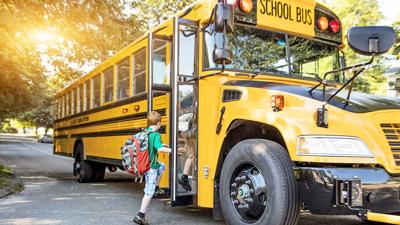


Young children get on a school bus.
SPRINGFIELD — Public school districts in Illinois aren't required by state law to transport private schooled students by bus to their schools, unless their normal bus routes already travel to or very near their schools, the Illinois Supreme Court has ruled.
However, a group of dissenting justices on the state high court said the ruling effectively voids a state law that school districts have long understood to require more than that and which thousands of Illinois families have relied upon annually to safely get their children to school safely, creating an "absurd" result in which the law requires school districts to take nonpublic school students to school, but also does not.
In the decision delivered June 25, the state high court ruled 4-3 against families whose children attend school at Sister Thea Bowman Catholic Elementary School in East St. Louis.
The plaintiffs, Chandres Johnson and Antonio Brown, had sued East St. Louis School District 189 in 2022, asserting District 189 had violated state law when it refused to provide school bus service to Bowman students.
The families sought a court order declaring the Illinois School Code requires public school districts to provide free transportation to private school students and ordering District 189 to resume the service.
They pointed to a longstanding state law that states school districts are required to provide such free bus transportation to nonpublic school students who live within the district boundaries and attend a school located within the district boundaries, but who live more than 1.5 miles from their school.
The plaintiffs noted lawmakers said the law was enacted to promote the safety of children traveling to and from school.
However, in response, District 189 argued it would no longer provide the service to Bowman, because it needed to redesign its public school bus routes to account for a shortage of drivers. The new routes would no longer allow the district's buses to stop at Bowman, the district said.
District 189 argued the law shouldn't be read to require public school districts to pick up students at or near their homes and deliver them to their school, if those destinations are not along their regular routes.
A St. Clair County Circuit Court judge sided with the district.
However, on appeal, the Illinois Fifth District Appellate Court sided with the parents, ruling the law, known as Section 29-4, requires public schools to transport private schooled students "the same as it does the public school children attending the schools within its district."
District 189 then appealed to the Illinois Supreme Court.
There, the majority sided with the school district.
The majority opinion was authored by Justice Mary Kay O'Brien, joined by Chief Justice P. Scott Neville and justices Lisa Holder White and Sanjay Tailor.
Justice Joy V. Cunningham authored a dissenting opinion. Justices David K. Overstreet and Elizabeth Rochford concurred in the dissent.
In the majority opinion, O'Brien said Section 29-4 doesn't require school districts to alter their bus routes to accommodate private schooled students. Rather, it only requires schools to pick up and drop off students at the locations along their regular routes that are closest to the private schools and the students' homes.
O'Brien said the majority recognizes that this may result in students being dropped off far from their schools or potentially going nowhere near their schools.
In that case, she said, parents must figure out for themselves how to best transport their children to school.
"We are mindful that in some communities the regular routes of the public school transportation system might not offer a realistic means of school transportation," O'Brien wrote. "For example, the point on the regular route that is nearest or most easily accessible to the child’s school may be a significant distance. In that case, parents of nonpublic schoolchildren are left to find other means of school transportation.
"... Just as section 29-4 does not require the public school district to provide transportation to nonpublic schoolchildren on days public schools are not in session, section 29-4 does not command a local district to modify its regular bus routes to accommodate transporting nonpublic schoolchildren to and from their place of learning."
In dissent, however, Cunningham said the majority's reasoning produces an "absurd" result.
Cunningham said the majority ruling means the courts have interpreted the law to mean lawmakers intended to require public schools to transport nonpublic school students, while also not requiring them to do so if it a public school district deems it an inconvenience.
The decision, she said, effectively nullifies the law, while also potentially exposing the state to new lawsuits over the constitutionality of such a contradictory and potentially discriminatory law.
And, Cunningham said, the decision forces parents to make difficult choices concerning how to send their children to school.
"No parent is going to put a child—especially an elementary schoolchild—on a bus that does not take the child to the school the child is attending," Cunningham wrote. "It would be both pointless and completely irresponsible to do so. As construed by the majority, the bus transportation service required by section 29-4 would never be used.
"The majority has thus rendered section 29-4 completely inoperative and, indeed, has effectively repealed the statute."
Cunningham urged state lawmakers to revise the law to undo the majority's ruling.
"The majority now effectively eliminates this long-standing program and tells thousands of schoolchildren that they no longer have a safe and reliable means of getting to school," Cunningham wrote. "The majority’s construction of section 29-4 is both misguided and unfortunate."