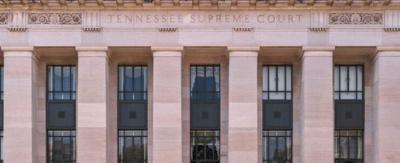



Tennessee Supreme Court
KNOXVILLE, Tenn. – Allowing profit-driven companies to enter the practice of law won’t help Tennesseans, lawyers are telling the state Supreme Court, and would only serve to further monetize the personal-injury market.
The question of whether non-lawyers should own law firms is one of many posed last year by the Tennessee Supreme Court as it considers ways to give residents in rural areas more “access to justice.” But the legal issues facing those people – estate planning, divorce, landlord-tenant disputes, etc. – aren’t money-makers and wouldn’t be helped by so-called alternative business structures (ABS) currently permitted in states like Arizona and Utah, according to much of the feedback.
Only those with valuable legal claims like personal injuries that can be grouped into mass torts would be served by funding from non-lawyers, John Harris of Schulman, LeRoy & Bennett in Nashville wrote to the court.
“If anything, there is a tremendous risk of reducing access to justice among the most affected populations,” he said. “Private-equity investment has led to widespread closures of rural hospitals in favor of consolidation in metropolitan areas.
“The same economic incentives would predict similar outcomes in the legal profession, as investors seek scale, efficiency, and higher margins, often at the expense of rural and low-profit communities. The poor would find it even more challenging to obtain cost-effective legal representation as investors chase the most profitable cases, not the least profitable ones.”
Numbers from a court fight in California show what types of cases some firms prefer. The mass tort firm Wisner Baum took advantage of Arizona allowing non-lawyer ownership to establish Eleos Law there. Wisner Baum litigates the cases while Eleos Law, whose ownership is 46% non-lawyer, focuses on client services and other matters.
Among Eleos’ workload are 9,400 cases over Zantac and 8,450 over alleged contamination of baby food. It is funded by 5% of the attorneys fees recovered by Wisner Baum.
“The American legal profession is at its best when it stands with those it represents in the pursuit of justice,” said Stef Zielezienski, Executive Vice President and Chief Legal Officer at American Property Casualty Insurance Association.
“Investor-owned law firms are a mockery of that ideal. Subordinating justice to shareholder profit would drive up costs for everyday Americans while further eroding public trust in the law itself.”
Some came forward to support ABS entities. There are more than 150 ABSs in Arizona but far less in Utah, where a personal injury lawyer on the state Supreme Court’s ad hoc committee on regulatory reform says the ABS program has spurred legal innovation.
Tyler Brown encouraged Tennessee to implement the program to encourage even more investment in legal tech nationwide, while arguing the rules in place for lawyers don’t serve the public. And consumers have not been damaged in Utah, as “it turns out that non-lawyers are at least as ethical as lawyers,” he said.
Reporting in the Arizona Republic, however, showed the focus of those participating in Arizona is personal injury cases. Rather than simply operating as call and referral centers, changes made earlier this year to the program require ABSs to actually provide legal services.
This came in response to complaints that clients had felt “scammed.” The Republic reported loopholes, lack of oversight and financial conflicts of interest plagued the program, and that half of the state’s ABSs do business in other states.
Also legal in D.C., ABSs have been outright rejected in other states like California, which forbids lawyers there from sharing fees with out-of-state ABSs. That complicated Wisner Baum’s relationship with Eleos Law, leading the firm to challenge California’s rules in federal court. Judge Dolly Gee refused to block the measure, AB 931.
Elsewhere, the Florida Supreme Court late last year amended rules to clarify that “only a person legally qualified to render legal services in Florida may” direct legal services. South Carolina’s Ethics Advisory Committee this year issued an opinion prohibiting state lawyers from working with ABSs, and Illinois, Maryland, New York and Texas have similarly turned down the idea of ABSs.
In Tennessee, legislators have passed a bill that would regulate companies that invest in lawsuits, paying some of the costs of bringing them while taking a chunk of what is recovered. As for ABSs, the Memphis Bar Association has a “profound concern” that non-lawyers would not be bound by the rules of professional responsibility, worrying the public could be misled by firms “professing legal expertise without the accountability of bar licensure.”
The Knoxville Bar Association said it was unclear how ABSs would help residents in “legal deserts” increase access to justice, as profits would not likely follow.
“They are not focused on tackling the access to justice divide,” the KBA said. “Examples of existing ABS entities include wealth-management firms, accounting firms, litigation-finance companies, hedge funds, private-equity firms, other financial institutions and alternative legal-service providers that offer customers the ability to create legal documents without hiring a lawyer.”
The bar associations for Cocke, Grainger, Jefferson and Sevier counties said its members are concerned ABSs would divert money from locally owned firms to outside investors and corporations with no connection to Tennessee communities.
“Reports out of Arizona are not particularly flattering,” the Chattanooga Bar Association said. “Consumer complaints seem to have increased with complaints of lack of supervision and oversight and conflicts of interest.”