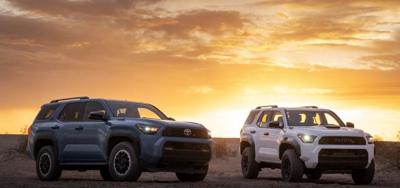



Two Toyota 4Runners
PHOENIX - Toyota isn’t liable for a head-on crash when a sleeping driver crossed the centerline in his 4Runner, the Arizona Supreme Court ruled, in a decision clearing up confusion among appellate courts about the legal proof required in products liability cases.
Shawn and Tanya Maywald were on State Route 77 when the driver of a 2019 Toyota 4Runner fell asleep, drifted across the centerline and collided with their vehicle. The Maywalds sued Toyota, claiming the 4Runner was defective because it didn’t have a lane departure warning system. Toyota didn’t offer LDW on the 4Runner in 2019.
A trial court dismissed the case but the Arizona Court of Appeals, Division One, reversed, ruling that a jury should decide whether Toyota was negligent for designing the 2019 4Runner without LDW. Toyota appealed and the Arizona Supreme Court reversed in a July 7 opinion by Justice James P. Beene.
Saying it was time to clear up a series of appeals court decisions that had “muddied” the understanding of product liability, the Supreme Court ruled plaintiffs must prove both that a product was defective when it left the factory and unreasonably dangerous. The Toyota 4Runner was neither, the court said, since it was perfectly capable of driving in a straight line and the absence of alternative safety technology doesn’t make a product unreasonably dangerous.
“There is an expectation that safety devices will guard against injury by accidents,” the court ruled. “But there is no expectation that a vehicle will prevent human error in careless driving.”
Decades ago, Arizona adopted strict product liability with a two-part test requiring plaintiffs to prove the product was defective as designed and that it was unreasonably dangerous and caused the plaintiff’s injuries.
“In the years that followed, however, appellate decisions muddied that framework,” the high court said, making the two tests interchangeable proof of whether a manufacturer was liable.
The First Division Court of Appeals, in an opinion by Judge Brian Y. Furuya, improperly ruled a jury could use a risk/benefit approach to decide whether Toyota could have incorporated LDW in the 2019 4Runner and its absence caused the accident, the Supreme Court said.
California has taken a more liberal approach in such cases, the court said. But Arizona law requires the plaintiff not only to prove a product was defective, but that it was unreasonably dangerous, either because an ordinary consumer couldn’t anticipate hidden risks of using it or those risks outweigh the benefits.
“Although LDW technology may enhance vehicle safety, it does not eliminate the driver’s fundamental responsibility to maintain control of the vehicle,” the Supreme Court said. “Nor can it reasonably be disputed that an ordinary driver understands the obligation to stay awake and remain within the proper lane of travel.”
In a concurrence to the First Division’s decision, Judge James B. Morse said the court correctly applied district precedent but that emerging self-driving technologies “introduces novel and unforeseeable challenges for manufacturers and litigants.”
Plaintiffs may soon argue human-operated cars themselves are unreasonably risky, he wrote, even if drivers prefer not to purchase them. And lawsuits over autonomous driving technology might drive up the cost of such systems, slowing the adoption of life-saving technology.
“Our current case law could place us on the path to increasing the cost of ADAS technology dramatically or a situation in which manufacturing a human-operated car is, in itself, a tort,” Judge Morse wrote. “I hesitate to follow that path and, therefore, only concur in the result.”
G. Lynn Shumway and Ghelfi Law represented Maywald, Bowman & Brooke represented Toyota, and Snell & Wilmer submitted an amicus brief for The Product Liability Advisory Council.