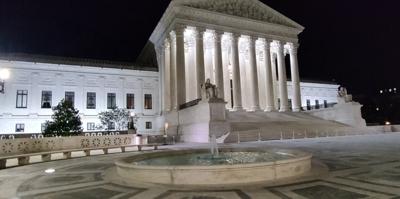



U.S. Supreme Court
Climate litigation is a crusade funded by rich celebrities and well-heeled nonprofits without any concern for the costs it will impose on workers and minorities, panelists said in a conference about an upcoming U.S. Supreme Court case that may decide the future of lawsuits over global warming.
“It’s rich people’s cliques,” said Jennifer Hernandez, a partner with Holland & Knight who focuses on environmental law. “Think middle school.”
Environmental groups shifted from campaigns to clean up the water and air to suing oil companies over global warming partly because it was a natural sell to Hollywood stars looking for a popular cause, Hernandez said. But the effects of these lawsuits will primarily hurt working-class people by restricting mobility and driving up the cost of energy, she added.
California estimates households earning less than $100,000 a year – disproportionately members of racial and ethnic minority groups -- will see a $5.3 billion hit to their income by 2045 under its carbon-neutrality plan, while wealthier households see their income rise by the same amount.
“It’s a tort system that pays no attention at all to civil rights,” Hernandez said at the event organized by Meet The Future, a Washington, D.C., news organization.
The Supreme Court has agreed to hear a lawsuit by the City of Boulder, Colo., against Suncor and ExxonMobil this fall to decide whether such cases are preempted by federal law. The stakes are huge, since states and municipalities around the nation have dozens of similar lawsuits seeking hundreds of billions of dollars in damages they blame on the sale of fossil fuels.
Private lawyers working on contingency fees hoping for jackpot verdicts or settlements scored contracts with local officials and crafted their complaints in a way that kept them out of federal court – a strategy already affirmed by the U.S. Supreme Court when it rejected the defendants’ arguments that they belonged there.
Instead, various state court judges have been and are currently asked to toss the cases at the motion-to-dismiss stage. The lawsuits say the public would not have purchased as many fossil-fuel products as it did had Big Oil not lied about their harms, but despite state-law claims like public nuisance and violations of consumer protection laws, some judges have decided the cases are really about regulating emissions – the job of federal officials.
Cases have been tossed in Pennsylvania, South Carolina, New York, Delaware and New Jersey. And in Maryland, multiple judges dismissed lawsuits and were affirmed by the state Supreme Court in a ruling that said climate litigation of this type “cannot be seriously contemplated.” But Colorado’s and Hawaii’s supreme courts have denied those same motions to dismiss, creating confusion for oil companies.
The goal of the lawsuits is to raise the cost of oil and gas and “drive it out of the marketplace,” said former U.S. Attorney General William Barr, now in private practice. “The first victory that they get here that is finally established by the judicial system will become a template and trigger more and more of these cases.”
The Supreme Court should decide a single state or city can’t impose such costs on the rest of the country, let alone other nations, said Phil Goldberg, a partner with Shook, Hardy & Bacon and co-chair of the firm’s Public Policy Practice Group. Basic principles of federalism prohibit one state from enforcing its laws against another. While the Supreme Court appeared to leave open some room for climate litigation in its 2011 AEP v. Connecticut decision, the court also said states must apply the law of the place where the pollution originates.
“Here the source law is every state, every country,” Goldberg said. “That’s why this can’t be a matter of state law.”
Goldberg called climate litigation “message lawsuits” that don’t attempt to address the underlying policy questions of how to regulate energy emissions when the largest polluter by far is the nation of China. The lawsuits are attractive to some government officials because they come pre-funded by outside groups and offer the potential for billions of dollars in revenue, he said. Those officials “can tell all these people in other states and other countries `What you’re doing is wrong, and you need to pay us,’” he said.
The environmental movement did such a good job of cleaning up the atmosphere that by the 1990s activists were looking for a new cause, said Hernandez, who spent more than 20 years on the board of the California League of Conservation Voters.
“But it’s not good to have a bunch of relatively educated, relatively affluent people with nothing to do,” she said. “Climate change supercharged the passion, and it became `We have to just change the way we live.’” The problem with using the courts to achieve that goal is it imposes huge costs on citizens who have no political recourse against it, she said.
“If ever there was a major federal question, if ever there was a major question doctrine, this is it,” she said.