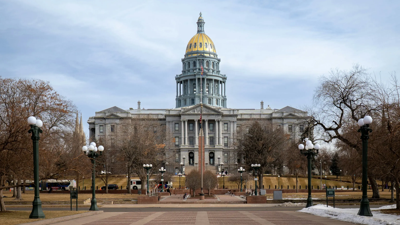


The Colorado State Capitol stands in Denver.
DENVER – Colorado lawmakers have overwhelmingly rejected the idea that law firms can be owned by non-attorneys, recently passing a bill that prevents lawyers from sharing fees with those entities.
They’re called alternative business structures, and they’re legal in Arizona and Utah. But they won’t be in Colorado if Democrat Gov. Jared Polis signs HB26-1421, which passed the Senate 33-2 and the House 53-11 last week. Both chambers have Democratic majorities.
“We are trying to make sure that when you hire a lawyer, that that lawyer works for you and not an investor, not a private equity firm that bought into a law practice. For you,” bill sponsor Javier Mabrey told the House on May 1.
Concerns came that it wasn’t the place of legislators to regulate the legal profession, but Sen. Lisa Frizell, a Republican, said the Colorado Trial Lawyers Association had tried to get the state Supreme Court to weigh in, but it declined to do so.
“I also want to recognize that we regulate businesses here. The legislature regulates businesses. The Supreme Court regulates the practice of law – what individual attorneys do, that is regulated through actions on somebody’s license, sanctions,” Mabrey said.
“They’re regulated by being registered with the Bar as attorneys. People who are not attorneys, who are investing in the legal space, will not be regulated by the Supreme Court. We need to make sure that there’s an avenue to regulate these business structures, and I believe that that is appropriate.”
Proponents say non-lawyer ownership would increase access to justice for citizens in rural areas who have few law firms to choose from, but critics recently told the Tennessee Supreme Court that unless those cases would provide significant returns on investment, nothing would be done to help with routine legal issues.
That state is exploring opening itself to ABSs while others are shutting them out. Also legal in D.C., ABSs have been outright rejected in other states like California, which forbids lawyers there from sharing fees with out-of-state ABSs.
Elsewhere, the Florida Supreme Court late last year amended rules to clarify that “only a person legally qualified to render legal services in Florida may” direct legal services. South Carolina’s Ethics Advisory Committee this year issued an opinion prohibiting state lawyers from working with ABSs, and Maryland, New York and Texas have similarly turned down the idea of ABSs. Illinois is considering a measure similar to Colorado’s.
Numbers from a court fight in California show what types of cases some firms prefer. The mass tort firm Wisner Baum took advantage of Arizona allowing non-lawyer ownership to establish Eleos Law there. Wisner Baum litigates the cases while Eleos Law, whose ownership is 46% non-lawyer, focuses on client services and other matters.
Among Eleos’ workload are 9,400 cases over Zantac and 8,450 over alleged contamination of baby food. It is funded by 5% of the attorneys fees recovered by Wisner Baum.
ABSs are opposed by business entities and plaintiffs lawyers – groups that rarely agree on any civil justice issue. While lawyers are hoping to maintain the integrity of their practice, and possibly keep clients from hiring ABSs instead, the business world worries that ABSs would increase litigation.
“HB 1421 addresses a growing challenge in our legal system by reinforcing a simple but critical principle that legal decisions should be made by attorneys, not outside investors,” Colorado Chamber CEO Loren Furman said.
“As private equity continues to find ways to enter the legal market, it is important to ensure that those decisions remain focused on the best interest of Coloradans rather than profit.”
There are more than 150 ABSs in Arizona but far less in Utah, and reporting in the Arizona Republic showed the focus of those participating in Arizona is personal injury cases.
Rather than simply operating as call and referral centers, changes made earlier this year to the program require ABSs to actually provide legal services.
This came in response to complaints that clients had felt “scammed.” The Republic reported loopholes, lack of oversight and financial conflicts of interest plagued the program, and that half of the state’s ABSs do business in other states.