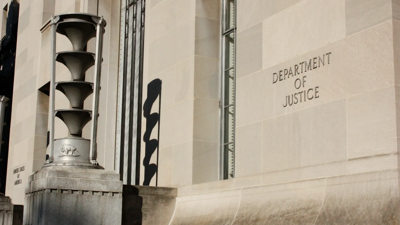


The Department of Justice building in Washington, D.C.
GREENBELT, Md. - The Justice Department is challenging the constitutionality of a Maryland county ordinance that prohibits the carrying of firearms throughout a significant portion of the county.
The DOJ’s Aug. 3 complaint filed in federal court in Maryland claims that Montgomery County Expedited Bill 23-26 runs afoul of the Second Amendment’s guarantee of the right to keep and bear arms.
Dubbed the “Restrictions on Ghost Guns Near Minors and Carrying of Firearms in or Near Places of Public Assembly,” the ordinance bans the carrying of firearms in a long list of places where residents and visitors to Montgomery County gather. The list includes parks, places of worship, schools, libraries and recreational and exhibition facilities, and it doesn’t matter whether those places are publicly or privately owned.
But the restriction goes even further. In addition to banning firearms in places of public assembly, the law also prohibits anyone from carrying within 100 yards of these areas.
According to the DOJ, these “Exclusion Zones” cover a vast area of Montgomery County, making it difficult for law-abiding gun owners to comply with the ordinance. By way of example, the complaint notes that Montgomery County boasts 605 houses of worship, 693 public parks, and 42 public recreation centers.
“Not surprisingly, this comprehensive ban on firearms prevents citizens from possessing firearms as a practical matter throughout most of the public (and many private) spaces in Montgomery County as they go about their daily lives,” the DOJ alleged.
What’s more, this ban applies to people with a valid permit to carry a firearm and even if the property owner consents.
In written testimony opposing Bill 23-26, Mark Pennak, President of Maryland Shall Issue, Inc., illustrated the burden placed on lawful firearm owners: “[T]he 100-yard zones for each of these places often encompass ordinary places of commerce and associated public sidewalks,” Pennak noted. These include grocery stores and other retail outlets, banks and medical facilities, all of which are private places at which firearm owners would expect to be able to lawfully carry. “People do not ‘assemble’ in these locations,” Pennak said.
“Banning carry within these areas ‘burdens permit holders, including the many who reside outside the County but drive within it, with the choice of significant travel restrictions or regularly yielding their benefits as permit holders,’” Pennak concluded.
Karan Singh, who also submitted testimony opposing the bill, pointed out how a carry ban like Bill 23-26 disproportionately affects minorities within Montgomery County. “Black and Brown residents are disproportionately concentrated in high-density mid- and down-county regions (i.e., more area parks, schools, churches),” Singh testified. “By blanketing places within 100 yards of public assemblies with strict criminal penalties, you turn dense minority neighborhoods into legal minefields for local permit holders.”
Bill 23-26 added to firearm restrictions in Montgomery County that had previously been the subject of a Maryland Supreme Court decision handed down in April. The Maryland high court considered arguments by a Maryland firearms dealer and several gun owners that Maryland laws and its constitution preempt the authority of Maryland counties to regulate the carrying of firearms.
Relevant to the DOJ’s lawsuit, the Supreme Court struck down provisions of the prior law because they “included within the definition of a place of public assembly the following locations: hospital, community health center, long-term facility, childcare facility, government building (as defined), and gathering of individuals without regard to the place in which they are gathering,” the unanimous court held.
The decision was not based on Second Amendment arguments, though, and ultimately the Court ruled that Maryland law “authorizes local regulation of firearms… with respect to minors and within 100 yards of or in a park, church, school, public building, and other place of public assembly.”
Last June, the U.S. Supreme Court confronted a Hawaii statute that imposed similar restrictions and struck it down on Second Amendment grounds. “This law,” Justice Samuel Alito wrote about the Hawaii carry ban, “departs sharply from the standard common-law rule on access to private property held open to the public… When these permit holders leave home in the morning, not only must they take care to avoid all the territory where the possession of a gun is prohibited outright, but they may also be barred from entering many places that people routinely visit in the course of their daily routines,” which “hobbles what the Second Amendment protects: the right of Americans to carry arms for self-defense as they go about their daily lives,” Alito stated.
Montgomery County’s Ordinance suffers from the same defect, the DOJ argues in its motion to preliminarily enjoin the law, which was filed with its complaint. “As a practical matter,” Justice stated, “the enormous scope of the Exclusion Zone makes it almost impossible for a citizen to walk through town to shop, to dine, or engage in any other common activity of daily life without likely entering the Exclusion Zone multiple times in a single trip and thereby becoming a criminal without ever intending to do so (or even knowing that he has done so).”
“The Second Amendment does not allow local governments to ban law-abiding citizens from carrying firearms in public places as they go about their daily lives,” said Assistant Attorney General Harmeet K. Dhillon of the Justice Department’s Civil Rights Division. “Montgomery County makes it almost impossible for a law-abiding citizen with a valid carry license to walk down the street and avoid these exclusion zones.”