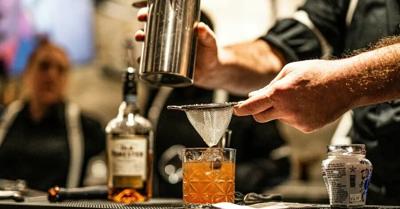



A bartender strains a cocktail into a glass.
SALT LAKE CITY – A Utah law that allows bars and restaurants caught in car-wreck lawsuits to recover some of the money they owe from allegedly intoxicated drivers doesn’t apply when they choose to settle, the state Supreme Court has ruled.
Language in the Dramshop Act that allows bars to seek contribution after “an award is made” prevents the efforts of RMB Inc. and Shaman Inc., the court wrote July 23. Their settlements were not awards, and they only could have recovered from driver Corbin Celotto if a judgment or verdict was entered against them.
The bars had already lost their arguments in the trial court and the Court of Appeals, which wrote Celotto had gone through “an evening of barhopping and consuming a lot of alcohol.” The Supreme Court’s ruling leaves other establishments in the state to wonder if it’s worth risking a giant verdict against them if it means they can seek compensation from allegedly at-fault drivers.
“When read in context, the term ‘award’ is not ambiguous and does not include voluntary settlements,” Justice Jill Pohlman wrote. “That is because a settlement is not an award made against a party.”
Celotto and five bars were sued in a lawsuit alleging he was intoxicated while speeding on the wrong side of a road. A collision caused allegedly severe injuries to another driver, plus medical expenses, and though two of the bars were dismissed from the case, three of them chose to settle for a combined $1 million.
RMB and Shaman then asserted cross-claims against Celotto under the Dramshop Act, but he fended off those claims by pointing at the statute. The bars argued taking “award” to only mean a court-imposed judgment went against common law principles and policy concerns.
The Court of Appeals provided an explanation on the wider context of the law beyond the word “award,” the Supreme Court said. The bars argued common law doesn’t limit contribution actions like theirs but failed to explain further, it added.
“Without these foundational showings, we cannot conclude that the Court of Appeals’ interpretation of the contribution provision displaces any particular common law principle in contravention of legislative intent,” Pohlman wrote.
The bars also argued the legislature could not have possibly meant to limit contribution actions to court awards because the majority of cases settle. Not so, the Supreme Court said.
“Here, the Act presents a unique framework under which the legislature has imposed a form of strict liability for injury and damage on distributors of alcoholic products,” Pohlman wrote.
“Under this framework, a legislator reasonably could have intended to allow for contribution only where an award is forced upon a party and not where a party voluntarily settles a claim.”