
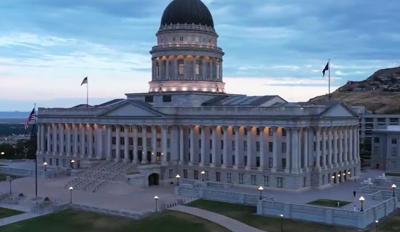


Utah State Capitol
SALT LAKE CITY – Legal reform has passed in Utah with a rare combination of support from both industry groups and injury lawyers.
The bill allows companies in court to defend themselves when their conduct was authorized by a governmental entity, like a permit to perform drilling or mining operations. Speaking on behalf of the Utah Mining Association, president Brian Somers noted the importance of coal in heating Americans during the cold end to winter and said the bill would make it harder for activists to push “novel environmental litigation.”
Even the state’s plaintiff lawyer group – the Utah Association for Justice – had no objection to lawmakers passing the legislation after “thoughtful discussion” with its sponsor, Rep. Colin Jack, resulted in a finished bill that addressed the group’s access-to-justice concerns.
Jack also consulted with the Attorney General’s Office on H.B. 330, which passed the House with a 65-0 vote in February and the Senate 17-7, with an amendment approved by the House 50-15 on Feb. 26. Gov. Spencer Cox signed it into law last week.
Mark Behrens of Shook, Hardy & Bacon, who testified on behalf of the U.S. Chamber Institute for Legal Reform, said he is not aware of any state with a similar law.
“First of all, it is not a license to injure people or protect wrongdoers in anyway,” Behrens testified Feb. 2 in the House Judiciary Committee.
“What the bill does is provide an important carrot-and-stick approach. It says that if the government mandates the law, if the experts who are in charge of public health and safety in the environment set standards, and you follow them, that you can rely on those standards and not be second-guessed later in a lawsuit.”
Rachel Sykes, the vice president of the Utah Association for Justice, testified at that hearing in opposition to the bill, claiming it was giving a pass to bad actors who can point at regulatory checklists that they followed. She pointed at nursing-home litigation and car-wreck cases when the at-fault driver has a government-issued license.
“I think this is going to address every single civil lawsuit in the state of Utah because it is so broad,” she said.
Those concerns were addressed in the final version of the bill, which states that “lawful authorization to engage in an activity does not eliminate a duty to exercise reasonable care.”
Two weeks after the House Judiciary hearing, the Utah Association for Justice testified in support at a Senate Economic Development and Workforce Services Committee.