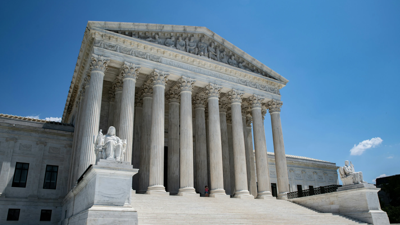


The U.S. Supreme Court stands in Washington.
WASHINGTON – The U.S. Supreme Court now has the opening arguments in a closely watched case that seeks to punish the fossil-fuel industry for climate change, with Suncor Energy and Exxon warning the justices against letting it proceed.
The Colorado Supreme Court denied their motion to dismiss the lawsuit brought by Boulder, which is one of dozens of cases in the country brought by government officials against oil companies. The Supreme Court’s review will impact litigation against other companies like Chevron and BP.
Defendants and critics say those who have filed lawsuits have overstepped their authority and that emissions must be regulated by the federal government. Though Colorado’s and Hawaii’s supreme courts have let the cases proceed, the Maryland Supreme Court ruled the other way, finding they “cannot be seriously contemplated.”
In their brief to the Supreme Court, Suncor and Exxon call Boulder’s case “an audacious attempt to use state tort law to address the effects of global climate change…” Officials who have teamed with private lawyers hoping for a large payday kept their lawsuits out of federal court by alleging violations of state consumer protection laws and public nuisance.
“The requested damages in any one case could reach into the billions,” attorneys for the companies wrote. “And if claims such as Boulder’s are allowed to proceed, every political jurisdiction in the Nation could bring a similar suit against any subset of the world’s fossil-fuel producers (with the defendants carefully selected, as here, to keep the suit in state court).”
Suncor and Exxon argue Boulder’s claims fail because they seek relief for alleged harms occurring outside of America, which interferes with the federal government’s diplomatic efforts that “balance the need to address climate change on the international level with other competing foreign and domestic interests.”
State judges in Pennsylvania, South Carolina, New York, Maryland, Delaware and New Jersey threw cases out as improper attempts to regulate emissions. A federal judge dismissed a case in Puerto Rico, while federal judges in New York and California had tossed cases before the U.S. Supreme Court found they had belonged in state court.
Alabama Attorney General Steve Marshall led a group of 26 states that said Boulder is trying to “assert a power with no analogue in our Nation’s history and no place in our federalism.”
Republicans in Congress also filed a brief, complaining the Colorado Supreme Court’s ruling created a patchwork of state and local regulations for a market that is supposed to be overseen by federal authorities.
And the Trump administration, which has issued an executive order forbidding any new cases and is battling the attorneys general of Michigan and Hawaii in court, submitted its thoughts last year, saying Boulder is attempting to impose new rules that would go far beyond the borders of Colorado.
As Exxon and Suncor argued, “Only the federal government has the power, capability, and institutional expertise to effectuate meaningful, long-lasting change across the United States and the world on the issue of global climate change.
“Our Nation’s climate policy should not be left in the hands of six jurors in Boulder, Colorado. The Colorado Supreme Court’s decision to allow Boulder’s claims to proceed should be reversed.”