
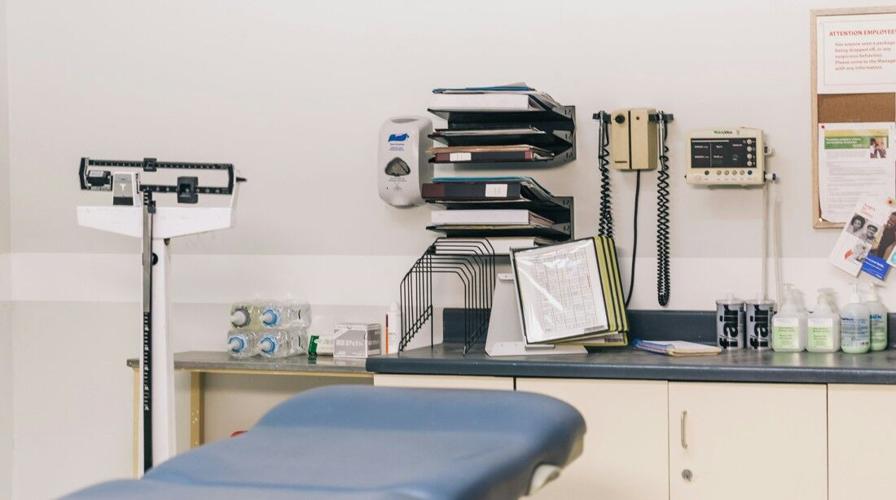



Interior view of an empty doctor's office exam room
Editor’s note: This is the third article in a four-part series on the fight to expose who and what are fueling Georgia’s lucrative market for car-wreck lawsuits. Part one, “Hush Money,” can be read here. Part two, “Money Machine,” is here, and part four, “Juror Furor,” is here.
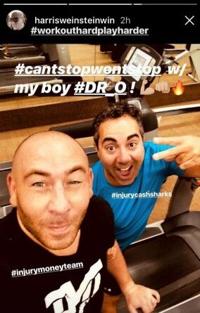
The Instagram post shows Georgia personal-injury attorney Harris Weinstein, aka “The Georgia Pitbull,” smiling with Dr. Amin Oskouei, owner of Ortho Sport & Spine, a nationwide chain of medical clinics. Over them is the text “#cantstopwontstop w/my boy #Dr_O!” Dr. Oskouei has the label #cashmoneysharks and Weinstein is #injurymoneyteam.
It’s no accident money is a repeated theme in this picture. Plaintiffs lawyers in the state send their clients to doctors like Dr. Oskouei, and doctors like Dr. Oskouei help them win big in court. It’s a volume business (as described in part two of this series) and by outward appearances at least, Dr. Oskouei has done very well. So well, in fact, insurers are starting to question how he’s made so many friends, though it’s unclear Weinstein’s firm and Oskouei have ever done business together.
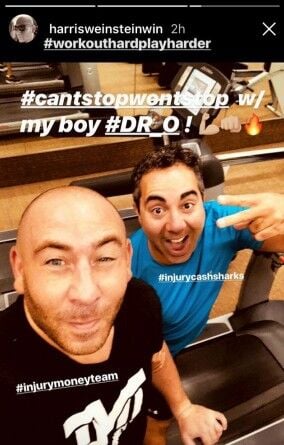
Insurers used this photo of injury lawyer Harris Weinstein, left, and Dr. Amin Oskouei to question the doctor’s ties to the trial bar
“The fact that Ortho Sport’s owner and founder has a close enough relationship with an Atlanta plaintiff’s lawyer to be characterized in a public social media posting as ‘my boy #Dr_O’ as well as an #injurycashshark and apparent member of the #injurymoneyteam gives rise to reasonable questions about just how much business Ortho Sport is doing with personal injury law firms generally…” lawyers for an insurer wrote in one key case.
An anesthesiologist by training, Dr. Oskouei now owns a chain of more than 60 orthopedic clinics across Georgia and 11 other states. He reportedly paid $46 million for Billy Joel’s former home in Miami in 2024, races Ferraris and owns a Falcon 50EX jet. Corporate records show he owns a profusion of other businesses, including Supersafe Insurance, Superspeed Motorsports, Athena Funding and Aysium Yacht Ventures.
He also seems to be well connected in the world of accident litigation, where plaintiffs blame somebody else for their injuries. To win in court, attorneys need a medical expert to explain that a client’s injury was caused in an accident. In exchange, lawyers send clinics like Ortho Sport a steady stream of patients, often under contracts with outside funding companies that pay the doctors two to three times what they would earn from insurance. Sometimes the doctors keep that financial interest and await a payday from a settlement or verdict.
In one Georgia lawsuit, plaintiff Larry Snipes testified he called Morgan & Morgan right after his accident and the big national injury firm “lined up everything for me within that week,” including treatment that Ortho billed at $19,000. In another case, documents obtained in discovery showed Morgan & Morgan sent 752 referrals to a competing orthopedic clinic, Barbour Orthopedics, from 2020 to 2022.
“A lot of these injured individuals actually have their own insurance,” said Travis Ginest, general counsel at the Owner-Operator Independent Drivers Association, which represents truckers and provides insurance. “Their attorneys advise them not to use it and go to this doctor instead.”
Doctors who treat accident plaintiffs say these arrangements are the only way poor accident victims can receive care without paying cash up front. But insurance companies argue they need to see financial relationships among doctors, lawyers and funders to make sure the plaintiff’s medical expert doesn’t have a financial interest in the outcome of a lawsuit.
Barbour revealed it billed $230 million to patients referred by lawyers over three years in a recent lawsuit, and other orthopedic, imaging and physical therapy providers have similar reliance on traffic lawsuits for their business. Documents obtained through discovery show law firms discuss patient care with their client’s doctors and sometimes even appear to approve or disapprove certain treatments.
Emails between Barbour and Witherite Law Group show Barbour’s director of legal affairs sending the estimated cost for a recommended surgery to Witherite, and a law firm employee emailing back, “you may proceed.” Another document shows a physical therapy provider routinely charges 20% more for patients coded “High Risk/MVAL.” High Risk doesn’t refer to medical risk, but the financial risk of MVAL cases, or motor vehicle accident medical lien patients.
Before a lawsuit against Coca-Cola abruptly settled, Ortho was ordered to turn over marketing materials aimed at plaintiffs lawyers, plus reveal parties, sporting events, vacations and gifts, if there were any. Cases over this type of communication have reached the Georgia Court of Appeals a few times now, with judges ordering companies like Ortho and Omni Healthcare to turn over information. If doctors have a financial interest in testifying that a car wreck or slip-and-fall caused injury, it needs to be disclosed, the court has said.
“(E)vidence that the plaintiff’s counsel had a close relationship with and history of making referrals to the plaintiff’s treating physician can be relevant to show the bias of that physician,” the court wrote last year.
The imaginary friend
In case after case, Ortho has claimed the records insurers are seeking are held by independent “case manager” firms that manage communications between lawyers and Ortho. One Georgia judge described these firms as “a shell game,” however, since they seem to close whenever they are ordered to turn over documents. Who owns them is a mystery, although most were set up by an attorney named Yasha Heidari, who also represents Ortho.
Heidari didn’t respond to requests for comment. In court, he has said he doesn’t know who owns the companies he was paid to set up. Neither does the chief executive, Matt Stubblefield, who has run a string of these case managers out of the same offices, with most of the same employees.
A January hearing over $123,000 in sanctions insurance attorney Zach Matthews is seeking against Ortho for evading discovery resembled a comedy routine as Stubblefield acknowledged he’d run firms named Falcon Marketing, Medernix, Maranex, Premier Medical Consultants and Marketing Management Solutions out of the same offices but insisted they were separate companies.
Stubblefield claimed not to know who owned the firms he ran, or even who hired him and paid the lawyer representing him in court that day. He said he was hired by “Diego Garcia” (also the name of an island in the Indian Ocean) but couldn’t say what this person looked like or how to reach him.
Finally Judge Eric W. Norris looked up Premier Medical Consultants, the firm Stubblefield said he was running currently, and informed him Georgia corporate records showed it had been dissolved in 2024.
“Are you aware of that?” the judge asked. “You are the CEO.”
“Of? Which company, your honor?” Stubblefield responded.
“Premier Medical Consultants, LLC.”
“No, I was not aware of that,” Stubblefield said.
Later, the judge said: “You know, to work in a line of business as the main person and not know who the principals are or things of that nature… you know, I didn’t fall off the turnip truck.”
Friends and enemies
The fight for that information has become particularly acrimonious between Dr. Oskouei and Zach Matthews, an insurance defense attorney who has won several court orders against Ortho for information requiring it to turn over how much it charges lawsuit patients and how many of those patients come from law firms.
Dr. Oskouei, in turn, is suing Matthews for slander for allegedly saying “Dr. Oskouei is performing illegal surgeries”, is “a fraud,” and is a “back ally (sic) doctor” - allegations Matthews denies.
Some judges are out of the friend zone too. In addition to scrutiny from Norris, a recent Court of Appeals ruling orders one of Stubblefield’s firms – Falcon Marketing – to produce information on Ortho’s referral arrangements with personal-injury attorneys. Those connections “can be relevant to show the bias of a treating physician,” it said.
Defendants checked LinkedIn profiles of Falcon and Ortho employees, plus social media posts and deposition testimony, to allege Ortho created Falcon to market the provider’s services to attorneys. It’s part of a growing blitz on the entire referral and care machine that has been frustrated when plaintiffs voluntarily dismiss their cases, as detailed in part 1 of this series.
In addition to trying to reveal what is said between lawyers and medical care companies, insurers also want the details of patient charges because they believe some clinics are performing unnecessary procedures and accepting cash payments that are a fraction of the bills presented in court.
"If a doctor routinely accepts 30% of a bill as payment, you can show it to the jury,” said Joe Kessing, a consultant who spent decades managing personal-injury claims for a major insurer. “But you have to prove it."
Dr. Oskouei and Ortho didn’t respond to requests for comment through attorney Heidari, although in court filings Heidari has stated Ortho’s doctors are on salary and have “absolutely NO financial interest in the patient’s case.”
The close relationship between Ortho and plaintiff lawyers was revealed, however, when a judge unsealed the complex settlement that a patient named Glenda Ochoa signed after Ortho sued her over $18,000 in unpaid medical bills. Instead of Ochoa paying Ortho, Ortho paid Ochoa $100,000 in exchange for her dismissing the accident lawsuit she had filed against a trucking company. The check was issued by Heidari’s law firm.
Ochoa’s lawyers had to obtain a conflict waiver to negotiate the deal, since they did so much business with Ortho and by dismissing her suit, Ochoa was potentially ending the sanctions action against Ortho.
Judge Norris expressed amazement at the transaction.
“I just have this matter where a third party has settled a -- brought suit against their patient and then paid their patient $100,000 for them to drop a suit for which she claims that she has a meritorious claim,” the judge said. “So there is a part of me that goes maybe I'm just going to sit back and watch the movie unfold for a little while before I make some final decisions.”