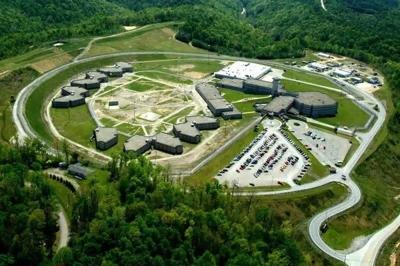



Mount Olive Correctional Center in Fayette County, W.Va.
CHARLESTON – A Mount Olive inmate claims a former prison industries supervisor of running a scheme to steal state‑purchased materials and force prisoners to build projects for his personal home while top officials allegedly looked the other way.
Elby F. Lilly filed his complaint July 16 in Kanawha Circuit Court against the West Virginia Division of Corrections and Rehabilitation, the West Virginia Department of Homeland Security, the State of West Virginia, former Mount Olive Superintendent of Industries Daniel L. Tincher, Mount Olive Superintendent John Frame, Mount Olive Chief Investigating Officer Jonathan Young, Co-Superintendent of Industries Chad Taylor and 10 unnamed officials.
Located in Fayette County, Mount Olive Correctional Complex is the state’s only maximum-security prison. It can house about 1,000 inmates.
In the 23-page complaint, Lilly says Tincher used his authority over prison work assignments to coerce Lilly into placing fraudulent supply orders and fabricating trailers, gates, cabinets and other building components that were then delivered to Tincher’s private residence.
Lilly, who has been incarcerated at Mount Olive since about 2010, says he worked in the prison’s plate shop for four to five years and that Tincher direct him “to place fraudulent supply and tool orders through the West Virginia Correctional Industries purchasing system for Tincher’s personal benefit” and to “fabricate residential building components using state-owned materials and state-owned equipment.”
The complaint says Lilly complied “under duress, in a coercive custodial setting” where Tincher allegedly controlled his job, housing placement, disciplinary exposure and the incentives that affect parole and good‑time credit.
According to the filing, Lilly kept contemporaneous handwritten lists of the items he ordered, which allegedly included framing lumber, OSB, sheetrock, kitchen cabinets, a double‑bowl sink, appliances, ceiling fans, recessed lights, paint, power tools, welding tables and scaffolding – supplies the suit describes as “consistent with residential construction rather than with plate-shop operational needs.”
Under Tincher’s direction, Lilly says he built items including a dual‑axle trailer from leftover metal, a 10‑by‑4‑foot gate with fabricated hinges, a fence extension “so (Tincher) can keep his dog from jumping the fence,” a steel‑case door, a transfer box wired into Tincher’s electrical panel and cabinets for a structure at Tincher’s residence, all using state materials and equipment. Lilly also says about 400 feet of 10‑gauge wire was ordered through Correctional Industries “for the stated purpose of allowing Tincher ‘to run power from his house to his building.’”
Lilly says that while the Constitution allows involuntary labor “as a punishment for crime,” it “does not authorize a state officer’s extraction of an incarcerated person’s labor and craft output for the officer’s personal benefit under threat of correctional consequence.”
He also says Tincher obtained Lilly’s labor through “abuse of legal process” and a coercive scheme designed to make Lilly believe he would suffer “serious harm”—including adverse housing, disciplinary action, loss of his work assignment and negative effects on parole and good‑time credit—if he refused to comply.
Lilly claims Tincher “used his authority over Mr. Lilly’s work assignment, privileges, and institutional record to compel Mr. Lilly to devote his labor and skill to the production of goods for Tincher’s private benefit … and without compensation of any kind to Mr. Lilly.”
The complaint says Tincher used his official state credentials to place at least some of the orders directly, noting two 2025 Lowe’s Pro quotes generated under his state email address and phone number and listing his affiliation as the Department of Homeland Security’s Division of Administrative Services, with item lists that allegedly included high‑end tools, electrical supplies, door hardware and other construction materials.
When Lilly tried to report the alleged misconduct, he says prison and state officials failed to act and instead left him under Tincher’s control. Roughly 18 months before Feb. 16, 2026, Lilly says he reported Tincher’s conduct to Young and that both Frame and someone known as “Major Tony” also were informed.
About a year after the initial report, the complaint states, Frame spoke directly with Lilly and acknowledged the report but “took no substantive action.” When Lilly followed up on Sept. 11, 2025, to note that nothing had been done, Frame’s response was simply that “it takes time.”
“No meaningful investigation was thereafter opened or, if opened, disclosed to Mr. Lilly,” the complaint states, adding that Lilly remained assigned to the plate shop and subject to Tincher’s authority while the “scheme continued.”
Lilly also suggests any purported internal probes as shams.
“Any purported ‘investigation’ performed by defendants State of West Virginia, Department of Homeland Security, or Department of Corrections and Rehabilitation were, in fact, performed only as a means to cover up the wrongdoing alleged herein, protect those within power within the State of West Virginia, with zero interest of uncovering embezzlement or holding wrongdoers accountable,” the complaint states.
The complaint also claims an investigator identified as Dustin Boggs saw items believed to have originated from the Mount Olive plate shop or other state‑purchased materials in plain view at Tincher’s residence. Those photographs are attached to the filing.
Lilly files a First Amendment retaliation claim against Frame, Young and Taylor, saying his reports of “misuse of a public office, the misappropriation of state funds, and the corruption of a correctional-industries program” were constitutionally protected speech and that officials responded with adverse actions including refusing to remove him from Tincher’s supervision and allegedly taking negative steps affecting his housing, work record and parole status.
The complaint also invokes West Virginia’s Whistle-Blower Law, arguing that Lilly’s plate‑shop labor for a public body should qualify him as an “employee” entitled to protection when he reports “wrongdoing or waste” such as “substantial abuse, misuse, or loss of state funds and resources” and violations of statutes and ethics codes.
“Defendant State of West Virginia’s inaction in the face of rampant embezzlement wreaks of coverup, corruption and failure to prosecute criminal wrongdoing,” the complaint states.
The complaint also accuses Tincher, Frame, Young, Taylor and others of civil conspiracy, saying they “knowingly acted in concert and pursuant to a common plan and agreement to conceal Defendant Tincher’s misuse of state resources, abuse of official authority, and exploitation of inmate labor for his personal benefit.”
He also accuses the WVDCR and officials of negligent supervision and retention for allegedly failing to investigate credible inmate reports that a prison employee was misusing his position “to extract compelled labor and to misappropriate state resources for private benefit.”
Lilly seeks reinstatement to a work assignment outside any defendant’s supervisory authority, along with compensatory damages, punitive damages, attorney fees and costs under the whistleblower statute. He also seeks injunctive relief and expungement of what he characterizes as retaliatory entries in his institutional record
He is being represented by Stephen P. New, Emilee B. Wooldridge and Morgan E. Wilkes of Stephen New & Associates in Beckley as well as by Timothy Lupardus of The Lupardus Law Firm in Pineville and by Zachary Whitten of The Whitten Law Office in Pineville. The case has been assigned to Circuit Judge Stephanie Abraham.
Kanawha Circuit Court case number 26-C-836