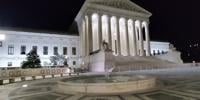



Robert C. Murphy Courts of Appeal Building in Annapolis, Md.
ANNAPOLIS, Md. - A statute that limits the tort liability of local governments does not apply to Maryland’s general employment discrimination law, though it may affect county anti-discrimination codes.
On July 13, the Maryland Supreme Court issued an opinion on the effect that the damages cap in the Local Government Tort Claims Act has on employment discrimination claims filed by local government employees under the Maryland Fair Employment Practices Act and the anti-discrimination ordinance of Prince George’s County.
The plaintiff, Joseph Watts, worked as a correctional officer for Prince George’s County and filed suit under the MFEPA and the Prince George’s County law, claiming that the county discriminated against him after he had his left foot amputated as a result of an infection. Watts complained about return-to-work requirements that the county imposed on him, and when he was eventually fired, he claimed the county retaliated against him.
After a jury trial, Watts was awarded $1.7 million in damages, which included compensation for back pay, future losses, other compensatory damages and retaliation.
But Maryland’s Local Government Tort Claims Act, or LGTA, caps damages for tortious acts or omissions of its employees at $400,000 per claim. A plaintiff also can be awarded up to $800,000 for all claims arising from the same occurrence.
Notably, where the employer has more than 500 employees, the MFEPA has a statutory cap of $300,000 for compensatory damages, though back pay is excluded from that cap and punitive damages are possible in certain situations.
The trial court capped Watts’ recovery at the LGTCA limit of $400,000. The Court of Appeals flipped that ruling and decided that the LGTCA does not apply to either the MFEPA or the County’s ordinance.
The Court split the difference and ruled that Watts is “entitled to a judgment in whichever amount is higher: (a) his MFEPA claims after application of the limitations provision of that statutory scheme; or (b) his [County ordinance] claim after application of the LGTCA damages cap.”
The LGTCA’s damages cap arose from a “concern about the costs of lawsuits for local governments without insurance, finding it ‘obvious’ that local governments ‘must have some form of liability coverage in an era when suits involving civil rights’ and other issues were commonplace,” Chief Justice Matthew Fader wrote in an opinion joined by five of his colleagues.
According to Fader, a paper prepared for the General Assembly by the Governor’s office found that from 1980 to 1985, lawsuits filed against municipalities increased 500% and sought total damages of $106 million.
Limiting liability was not the only purpose of the LGTCA, however, the majority found. In addition to its cap on tort claims, the LGTCA also prevents local governments from asserting sovereign immunity for torts committed by their employees.
The next logical question, then, is whether Watts’ statutory claims for employment discrimination and retaliation are considered “torts” under the LGTCA. The Court found they can be.
A “statutory employment discrimination claim is not only akin to the common law tort claim of wrongful discharge but has displaced that cause of action where the statute applies,” Fader reasoned.
Had the Court stopped there, the LGTCA cap would apply to both of Watts’ claims.
“The LGTCA is a general statute containing a general mechanism to limit the otherwise uncapped liability of local governments for tortious acts or omissions,” Fader wrote. “Where the General Assembly has provided for a different balance in enacting statutory schemes that authorize private causes of action against local governments, the LGTCA does not apply.”
That’s exactly what the General Assembly did, in the Court’s view, when it passed its general employment discrimination law. The MFEPA states that an “employment discrimination claim brought against any” local government, “is subject to the same ‘rules, procedures, powers, rights, and remedies… as those that apply in a discrimination case in which a private person is the respondent,’” Fader found.
Section 20-1202 of the State Government Article, which creates a state cause of action for violations of the anti-discrimination codes of Prince George’s, Montgomery and Howard counties, is different in the court’s view. “Where state statutory claims sound in tort and it is not apparent that the General Assembly has made a decision concerning how to treat claims against local governments, the LGTCA may apply,” the majority opined.
Of course, both statutes provided Watts with a pathway to recovery for damages from the County’s alleged discrimination and retaliation. The only question left for the trial court on remand is which one provides more – the MFEPA with its own damages cap or the County’s anti-discrimination ordinance with the LGTCA’s cap.
Justice Shirley Watts filed her own opinion arguing that the LGTCA cap does not apply to either the MFEPA or the County ordinance claim.