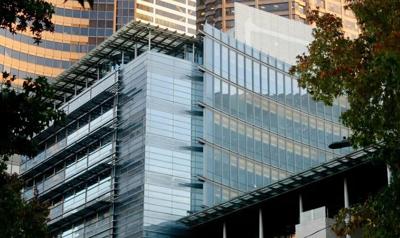


The glass exterior of Seattle City Hall rises above the street, Oct. 16, 2026.
SEATTLE - A Washington appeals court has allowed a property owner to proceed with a lawsuit claiming the value of a once-profitable downtown apartment complex was destroyed by a series of Seattle ordinances that force landlords to accept criminals and virtually anyone else an existing tenant invites into their unit.
The Seattle ordinances, intended to increase the availability of low-income housing, had the opposite effect in the case of the Addison, a 254-unit apartment building that GRE Downtowner invested more than $39 million in under a federal affordable-housing program. Once nearly full and profitable, the building is now half-empty and only half the tenants who remain are paying rent, GRE Downtowner said.
By allowing GRE Downtowner’s suit to proceed, the Washington Court of Appeals has opened a line of attack for landlords who argue excessive regulations have effectively stripped them of their property. So-called “inverse condemnation” suits seek compensation under the Takings Clause of the U.S. Constitution, which prohibits the government from seizing property for public use without payment.
GRE Downtowner sued the city in 2024, claiming the city had forced it “to accept as tenants dangerous criminals who often refuse to pay the rent they agreed upon,” whom they couldn’t evict. A trial court dismissed the case, citing numerous court decisions over the years upholding regulations including rent-control and historic preservation measures that diminish the value of a property. The Court of Appeals reversed that decision in an Oct. 26 opinion by Judge David S. Mann that held the company can sue for a regulatory taking.
GRE Downtowner has successfully argued, for purposes of defeating the city’s motion to dismiss, “that its reasonable investment-backed expectations were ruined,” the court said.
GRE Downtowner paid $12.5 million for the Addison in 2012 Seattle and invested another $26.5 million to qualify for a federal tax credit. The complex was fully renovated by 2015 and through 2018 was collecting more than 90 percent of its total potential rental income under low-income housing regulations.
That changed starting in 2018, when the Seattle City Council passed a series of ordinances council members said would increase the city’s stock of affordable housing. The Fair Chance Housing Ordinance, passed in 2018, prevented landlords from excluding or evicting tenants based on their criminal history.
In 2019 the council passed the Roommate Ordinance, which extended occupancy rights to a tenant’s immediate family, an additional “roommate” not in the tenant’s family, and that person’s immediate family. Under that ordinance, if the tenant leaves, the “roommate” is automatically put on the lease.
The City Council followed those measures up with a ban on evictions between Dec. 1 and March 1, an outright eviction moratorium in from 2020 to 2022 due to the Covid-19 pandemic, and finally an ordinance establishing a 180-day notice period before raising rent. Under that ordinance, if the landlord proposes a rent increase of 10 percent or more and the tenant moves out, the landlord must pay the former tenant three months’ rent at the new rate.
The result of all these regulations is the Addison went from earning money to losing millions, making it “functionally valueless,” the appeals court said. Losses totaled $5.8 million over five years. Since the federal affordability restrictions run for another 23 years, the owners are trapped with a property they cannot sell, the court said.
The city cited a 1992 case where the U.S. Supreme Court upheld a California rent-control ordinance that effectively forced mobile-home park owners to allow tenants to remain on their property at below-market rents. In that decision, however, the Supreme Court said property owners could have a case if the government forced them to accept third parties that weren’t on the lease.
More recently, the Supreme Court overturned a California regulation requiring fruit growers to allow labor organizers on their property. “Rather than restraining the growers’ use of their own property, the regulation appropriates for the enjoyment of third parties the owners’ right to exclude,” the Supreme Court said int hat decision.
The appeals court seized upon that language to rule that GRE Downtowner has provided sufficient evidence to show it is being forced to accept virtually anyone an existing tenant invites into their apartment as a permanent resident.
“GRE Downtowner is required to accept uninvited, non-tenant third parties, including their former spouses, domestic partners, and dating partners,” the court said. “Those requirements go beyond the quotidian regulation of `the economic relations of landlords and tenants,’ which does not effect a per se regulatory taking.”