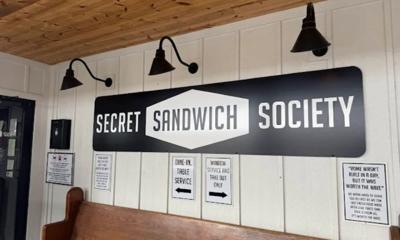


Secret Sandwich Society’s original Fayetteville location
CHARLESTON – A West Virginia investor has sued the operators of Richmond’s Secret Sandwich Society restaurant, alleging they diverted approximately $2 million or more from the business while withholding payments owed to minority owners.
Sami Ghareeb of Nitro filed the lawsuit October 21 in U.S. District Court for the Southern District of West Virginia. The complaint names Society Hospitality LLC, the company that operates the Richmond restaurant, Michael and Nicole Sloane and three affiliated companies. It alleges breach of contract, fraud, breach of fiduciary duty and violations of the federal Racketeer Influenced and Corrupt Organizations Act, among other claims.
The case concerns the Richmond restaurant, not the original Fayetteville restaurant. It adds an investor’s allegations to an already contentious legal dispute between the Richmond operators and the brand’s founders, David and Tashia Bailey.
Ghareeb says he owns 6.75% of Society Hospitality, making him its largest minority investor. According to the complaint, he and other preferred investors have received no distributions since August 2022, when the Sloanes acquired control of the business through TLT Group LLC.
“By contrast,” the complaint alleges, the defendants have extracted “approximately, and likely in well in excess of, Two Million Dollars” through transactions characterized as distributions or, more recently, loans.
The restaurant’s ownership structure gives TLT Group a 70% stake and minority investors the remaining 30%, according to the complaint. The Sloanes own TLT Development Partners LLC, which holds half of TLT Group. Blue Fire Capital LLC, another Sloane-owned company, also is named as a defendant.
Ghareeb says Society Hospitality’s operating agreement requires available net cash flow to be distributed in a specific order: first, a 10% annual priority return to preferred investors on their unreturned capital; second, repayment of those investors’ capital contributions; and finally, distributions to all members according to their ownership percentages. The offering materials make the priority payments contingent on available net cash flow after expenses, debt payments and other specified needs.
The complaint alleges the Sloanes bypassed those requirements by taking money for themselves and affiliated companies while paying preferred investors nothing. It also accuses them of using company credit cards for unreimbursed personal expenses and routinely withdrawing substantial amounts of cash from the restaurant.
For 2023, the complaint cites approximately $3.18 million in gross receipts and $213,181 in purported net distributions to TLT Group that ultimately benefited the Sloanes. Ghareeb’s tax statement for that year allocated $2,300 in ordinary business income to him but reported no distributions, according to the filing.
The complaint lists approximately $3.5 million in gross receipts for 2024 and nearly $1.94 million in income on a 2025 profit-and-loss statement. It says a 2025 balance sheet carried an $825,180.47 “TLT Group LLC Note Receivable,” which Ghareeb alleges represented distributions improperly recast as a loan to conceal the diversion of money.
Ghareeb alleges that in 2026 the defendants attempted to reclassify distributions taken during 2024, 2025 and 2026 as loans to Blue Fire or TLT Group.
The federal racketeering claim centers on annual tax documents and accompanying communications allegedly mailed to Ghareeb and other West Virginia investors. Ghareeb contends those mailings concealed payments to the controlling owners while creating the impression that the business lacked cash available for distributions.
The complaint identifies mailings in 2023 through 2026 involving tax documents for the preceding years as alleged acts of mail fraud supporting the civil RICO claim. It seeks triple damages and attorney fees under the federal law.
Ghareeb also requests compensatory and punitive damages, repayment of improper distributions, a full accounting of the company’s finances and an injunction requiring compliance with its distribution obligations. He alleges his losses exceed $75,000 and requests a jury trial.
The Baileys opened the original Secret Sandwich Society in Fayetteville in 2010 and the Richmond restaurant in 2016. They later sold their controlling interest in the Richmond operation while retaining ownership of the brand. The Fayetteville restaurant had been sold separately to an employee, according to earlier reporting.
Ghareeb’s complaint expressly excludes the Baileys from its accusations, saying they paid minority owners the amounts owed before selling their 70% interest in 2022.
The Baileys and Sloanes subsequently became embroiled in separate Virginia litigation over the sale and the Richmond restaurant’s licensing agreement. The Baileys accused the operators of failing to pay required royalties, withholding sales information and violating brand requirements, including by using an unauthorized hamburger bun.
The Sloanes disputed those allegations and accused the Baileys of trying to force them out of the business and collecting excessive royalties. Both sides denied the other’s allegations. Those responses concerned the earlier disputes, not Ghareeb’s new lawsuit.
The Richmond restaurant also was briefly closed by Virginia tax officials in October 2025 over $119,419.14 in unpaid taxes, according to media reports.
In another development, Graze (the Baileys’ brand company) agreed to pay a $9,000 penalty and $1,000 in investigative costs to resolve Virginia regulators’ allegations that the Richmond transaction violated state franchise-registration and disclosure requirements. Graze attorney J. David Fenwick said the company did not consider the transaction a franchise sale and settled rather than incur further litigation costs, according to media reports.
Ghareeb is represented in the federal case by Fenwick and Robert S. Pruett of Goodwin & Goodwin in Charleston.
U.S. District Court for the Southern District of West Virginia case number 2:26-cv-00676