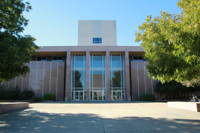



The entrance to Six Flags America, now closed
GREENBELT, Md. – Six Flags America must face a lawsuit brought by a Maryland veterinary school student who says she was kicked out of the now-closed park in Woodmore for bringing her service animal.
Federal judge Paula Xinis on Aug. 13 denied several requests in Ceonni Dunn’s lawsuit, filed last year against the theme-park company and the International Board of Credentialing and Continuing Education Standards.
Her lawsuit says in June 2024, she was ejected from Six Flags America because she brought a panic attack alert dog. Six Flags asked Xinis to either send the case to arbitration, group it in with another case in California or dismiss the case.
Unfortunately for the company, the arbitration provision in its customer agreements includes a section stipulating that “Six Flags may revise the Terms in its discretion.”
“Plainly,” Xinis wrote, “only Six Flags retains the power to change terms at will and without notice. Further, because Six Flags may later change any promise it had made at the time the customer accepted the agreement, including the terms of the arbitration provision, the ‘promises’ are illusory and lack valid consideration.
“Thus, the parties never formed a valid agreement to arbitrate.”
The company requires disabled customers to apply with IBCCES before visiting the park to bring a service animal. The application must be completed more than 48 hours before visiting Six Flags and requires applicant to disclose their disability, their doctor's name and supporting medical documentation.
Six Flags staff can also deny or revoke a reasonable disability accommodation based upon their belief as to whether a person is in fact disabled, the suit says. But those staff members aren’t trained well enough on disability policies, and this led to Dunn being told to leave the park, she says.
Dunn has formally been diagnosed with severe generalized anxiety disorder that features "debilitating" panic attacks. Her lawsuit says non-discriminatory accommodation programs are used by companies like Disney, which evaluates accommodation requests in-person, immediately and without documentary support.
Six Flags' process results in the issuance of an IBCCES Attraction Access Card (IAC). The complaint says there is no review process if an IAC is denied and calls the program “solely a public relations gesture.”
Six Flags is accused of violations of the Americans with Disabilities Act in a 2023 class action still pending in a California federal court. Though the case makes similar arguments about the unfairness of the IBCCES process, Xinis found enough differences to reject the company’s request to fold Dunn’s into it.
The California case seeks to represent a nationwide group of customers, while Dunn’s is “uniquely local in scope,” Xinis ruled. Dunn can receive no injunctive relief under the ADA because the park in Bowie is no longer in operation, and Dunn pursues claims for violation of Prince George’s County law prohibiting public-accommodations discrimination and two common law claims.
“The County Code, moreover, provides for money damages and other related ‘redress of injury,’ not available under the ADA,” Xinis wrote.