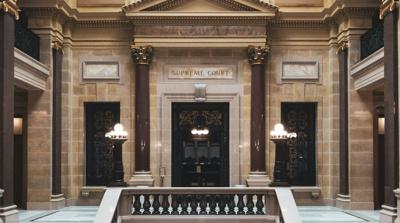



The entrance to the Wisconsin Supreme Court chamber inside the State Capitol in Madison
MADISON, Wis. - “If an attorney makes a false statement of fact or law, she may be sanctioned for violating the rules of professional conduct for attorneys. Unfortunately, supreme court justices can deceive the People of Wisconsin with impunity.”
That’s how Wisconsin Supreme Court Justice Rebecca Grassl Bradley described the court’s decision to allow Attorney General Josh Kaul to deposit and credit uncommitted settlement funds into a discretionary budget account controlled by the AG instead of the general treasury fund controlled by the legislature.
The court’s July 10 decision, authored by Justice Rebecca Frank Dallet, is the latest development in the history of fights between the Republican-controlled legislature and the Democratic attorney general on who gets to control settlement money paid to the state as a result of enforcement actions brought by the AG.
The court’s liberal majority sided with the AG and ruled that he complied with the state’s budget law when he deposited the money into the general fund, even if he also earmarked it to a DOJ discretionary fund placing the funds beyond the reach of the legislature. But in Bradley’s dissenting opinion, the money received from those enforcement actions “fall under the default rule for crediting moneys to the general purpose revenues of the general fund,” which would allow the legislature to control the funds.
The AG’s practice of tagging these funds for his discretionary use led to the central dispute between Bradley and the rest of the court, namely, how to treat these settlement funds? Are they general purpose revenues that the legislature can control through the budgeting and appropriations process? Or are they program revenues, allowing the AG to direct the funds for his own use?
This fight over what to do with settlement funds goes back roughly 20 years and arises from the practice of state attorneys general to band together to bring large, multi-state antitrust and consumer protection lawsuits. Many of these suits are resolved through “consent decrees,” settlement agreements voluntarily entered into by defendants with state AGs and endorsed by a court.
These decrees usually require the payment of money damages, some of which may be directed to a specific use like paying restitution to victims or for attorneys’ fees. Increasingly, however, large portions of settlements have allowed the AG to use his discretion on which accounts to credit the funds to.
“For decades,” Bradley wrote, “Wisconsin attorneys general have siphoned tens of millions of dollars belonging to the People from large multistate consumer protection and antitrust settlements, to various budget appropriations controlled by the Department of Justice.”
Specifically, the AG would direct these settlement funds to a DOJ budget account titled, “Attorney General – Discretionary” rather than depositing and crediting them to the general treasury fund.
The only problem: “The legislature… never made an appropriation for an ‘Attorney General — Discretionary’ account in” the Wisconsin statute, according to Bradley, who was appointed to the Court in 2015 by Republican Governor Scott Walker.
In 2017, the legislature tried to get control of the situation. It started by amending the budget statute to require the AG to submit a proposed plan for any funds it wants to expend from the DOJ account. “The attorney general evaded that requirement,” according to Bradley, so lawmakers sought to make their intent clearer by amending the law to require the attorney general to “deposit all settlement funds into the general fund,” which would place the funds under the control of the legislature.
And to reinforce their point, the legislature capped the DOJ account to the amount appropriated in the state’s budget and then clawed back any unencumbered funds that had already been credited to that program.
In response, the AG declared there were no unencumbered funds in the account and moved the money to a non-budgetary account. At issue was about $33 million, though, according to Bradley, the amount at stake is much larger than the balance at any particular time. “Because the attorney general has siphoned settlement funds and spent them out of DOJ accounts for decades, the record does not reflect the scope of revenues the attorney general amassed over time,” Bradley declared.
So determined was the AG not to have oversight of the claimed funds that he refused to provide a complete accounting of all the funds during discovery, arguing the burden of doing so outweighed the usefulness to the case - a position that surprised Bradley. “It is also not clear how an agency flush with tens of millions of dollars in extra cash is unable to keep track of it,” she noted.
The effect of the court’s ruling is that those uncommitted settlement funds are not available for use by the legislature but rather for use by the AG as if the legislature had appropriated that money to him, presumably for future litigation, a result Bradley found unacceptable and beyond the authority of the AG.
“It is the province of the attorney general to enforce the People’s laws… Once an enforcement action concludes, however, the attorney general’s job is done,” Bradley wrote. “Under the law, the attorney general must give the People their money back.”
After expensive state elections in recent years gave liberals a majority on the court, Bradley has been an outspoken critic of the decisions it has reached on issues like abortion and voting rights.
“Electing justices who fancy themselves super legislators, however, comes at a steep price,” she wrote in the abortion case. “The People of Wisconsin have surrendered self-governance to four liberal lawyers.”