
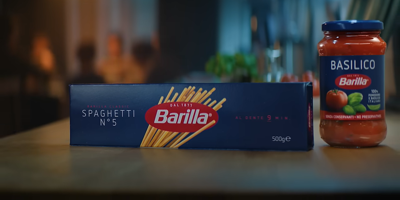


Barilla pasta and sauce, from Barilla television advertisement.
OAKLAND — A federal judge in California has drained a lawsuit alleging Barilla pasta isn’t sufficiently Italian.
Matthew Sinatro and Jessica Prost are the lead plaintiffs in a class action false advertising complaint centered on the phrase “Italy’s #1 Brand of Pasta” for food made in the U.S. from non-Italian ingredients.
U.S. Magistrate Judge Ajay Krishnan granted Barilla’s motion for summary judgment in a Sept. 30 opinion, finding the class couldn’t rely on a consumer survey from one of its expert witnesses.
Although Barilla also moved to decertify a class of California shoppers and strike other witness opinions, Krishnan said the summary judgment ruling negated remaining issues.
Krishnan said the defendant, Barilla America, is a subsidiary of Barilla Group, which remains a family-owned business tied to its 1877 founding by Pietro Barilla in Parma, Italy. Barilla Group started making pasta in Iowa in 1999 and New York in 2007, using global wheat supplies.
Barilla America, headquartered in Northbrook, Illinois, sold 54 pasta varieties in the U.S. when the class period opened in June 2018. Each box, at the time, had the challenged phrase on the front “with three teardrops of color — green, white and red — positioned on either side,” Krishnan wrote. Side labels said: “Made in the U.S.A. with U.S.A. and imported ingredients.”
Sinatro and Prost initially sued in June 2022.
They are represented in the action by attorneys from the Clarkson Law Firm, of Malibu.
That October, Krishnan dismissed a request for injunctive relief while allowed the other claims to survive: violations of the Unfair Competition Law, the False Advertising Law, the Consumer Legal Remedies Act along with breach of warranty and unjust enrichment. He certified the class of California buyers in May 2024, which involved dismissing any nationwide claims.
Summary judgment, Krishnan explained, came down to a consumer perception survey from expert witness J. Michael Dennis. In that survey, 57% of respondents said the statement “Italy’s #1 Brand of Pasta” does communicate the ingredients come from Italy. A separate survey “found a 9.9% price premium associated” with the phrase, he wrote.
Dennis gave survey takers only three possible responses, an affirmative, a negative and uncertain. Krishnan said that makes the question improperly biased because “it steers them to that very meaning and gives them no opportunity to indicate other meanings,” while also failing “to capture the possibility that respondents understand the Challenged Representation to have multiple meanings.”
A Barilla survey included five possible interpretations while allowing respondents to indicate “Yes/No/Don’t Know” on each phrase: “The product’s ingredients are sourced from Italy; the brand is the largest selling pasta in Italy; the brand is the best known pasta in Italy; the brand is the most popular pasta brand in Italy; and the brand is the oldest producer of pasta in Italy.” There also was a window to type in any unlisted interpretation.
“Survey respondents who answered Dennis’ question affirmatively might have never made an association with Italian ingredient sourcing had the survey not fed it to them,” Krishnan wrote. “And respondents who normally would think the statement means something else entirely may have abandoned that opinion upon intuiting from the survey itself what they should take the Challenged Representation to mean. A ‘don’t know /not sure’ option does not negate such effects, because the question by its design elicits them before respondents even go to choose an answer.”
With the class unable to use the survey, Krishnan continued, it had no evidence the phrase convinced reasonable consumers the pasta was made with Italian ingredients. That the named plaintiffs inferred that meaning isn’t sufficient to survive a summary judgment request.
“To the extent that the words ‘Italy’s #1 Brand of Pasta’ make a claim about brand — namely, that Barilla is the foremost brand of pasta in Italy — those words, on this record, are true,” Krishnan wrote. “Undisputed record evidence establishes that Barilla has leading market share in Italy, and that it is the most popular pasta brand in Italy. Accordingly, the court finds the challenged representation’s brand-related meaning — which, incidentally, strikes the court as the most plausible meaning — to be accurate.”
Krishnan agreed the phrase is ambiguous, bolstering Barilla’s position it didn’t assert the meaning Sinatro and Prost inferred. He noted more than 80% who responded to Barilla’s survey took the phrase to reference brand popularity while only 30% drew a message about ingredient sourcing and said “even plaintiffs concede that the challenged representation has that non-deceptive meaning.” He further said the side labels make it clear to reasonable shoppers the pasta wasn’t made in Italy with Italian ingredients.
After granting summary judgment on the state law claims, Krishnan also explained why the common law claims failed: the phrase makes no explicit guarantees that could sustain a warranty breach claim and unjust enrichment cannot stand on its own.
