
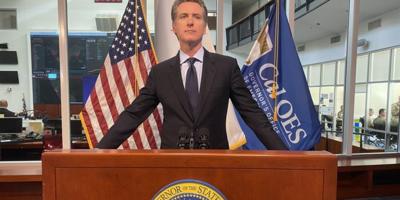


California Gov. Gavin Newsom
SAN FRANCISCO — California can't punish employers with the threat of lawsuits or crackdowns if they express ownership's political or religious opinions at workplace meetings, a federal appeals panel has ruled.
On Oct. 29, a three-judge panel of the U.S. Ninth Circuit Court of Appeals sided with business advocacy groups, upholding a lower court's block on the California state law docketed as Senate Bill 399.
While California Democrats dubbed the law the "Worker Freedom From Employer Intimidation Act," employers and groups advocating for them said the law actually represented a move by state lawmakers to trample the First Amendment free speech rights of employers and business owners.
In the Oct. 29 decision, the three Ninth Circuit judges – which included a mix of Democratic and Republican appointees – agreed the law likely amounts to unconstitutional speech restrictions imposed by California Democratic state lawmakers and Gov. Gavin Newsom.
The court fight began in 2024, shortly after California enacted SB 399.
The law specifically "prohibits employers from 'subject[ing], or threaten[ing] to subject, an employee to discharge, discrimination, retaliation, or any other adverse action' for refusing to attend meetings or receive communications from the employer where the purpose is to 'communicate the employer’s opinion about religious or political matters.'”
SB399 specifically empowers employees who believe their employers have violated the law to sue their employers directly for allegedly violating their rights under SB399.
Even if they don't sue, the law still empowers the California state Labor Commissioner to investigate claims against businesses and launch enforcement actions against employers.
Under the law, employers accused of violating SB399 could get socked with penalties worth as much as $500 per employee for each alleged violation. This could potentially subject employers to thousands or even millions of dollars in potential penalties, when multiplied across entire workforces, depending on the nature of the alleged violations.
Supporters of the law said it is needed to end so-called "captive meetings" and allow employees the freedom to avoid hearing their employers' views.
Such legislation has been strongly backed by labor unions, which are some of the largest campaign donors to Democrats nationwide.
Similar laws have also been approved in recent years in other Democrat-dominated states or in Rust Belt states in which unions, at least, hold considerable political sway, including Illinois, New York, Washington, Oregon, New Jersey, Minnesota, Wisconsin and at least four others.
Lawsuits have swiftly followed challenging the similar "captive meeting" bans in many of those other states and remain pending throughout the country. The lawsuits similarly have alleged the state laws violate the First Amendment and the federal National Labor Relations Act.
Opponents of such laws have claimed the laws in California and elsewhere are an unconstitutional assault upon the speech rights of employers and a sop to labor unions, in particular, who they say are seeking to monopolize the attention of workers and muzzle efforts by employers to thwart unionization of their workplaces.
In the lawsuits, the plaintiffs assert the threats of potentially costly legal fights and investigations have the effect of "chilling and prohibiting employer speech" and interfering with the employers' ability to communicate with their workers.
In California federal court, judges have agreed that the Golden State version of the law, at least, violates the First Amendment.
A Sacramento federal judge, U.S. District Judge Daniel J. Calabretta, entered an injunction blocking California from enforcing SB 399.
Calabretta was appointed to the court by former President Joe Biden.
California Attorney General Rob Bonta appealed that decision.
But at the Ninth Circuit, judges upheld the injunction and said they believe the business groups would be likely to succeed in proving the law was unconstitutional overreach by the state.
The Oct. 29 ruling was authored by Ninth Circuit Judge Richard Tallman, an appointee of former President Bill Clinton. Circuit Judges Richard Paez and Mark J. Bennett concurred.
Paez was appointed by Clinton, and Bennett was appointed during the first term of President Donald Trump.
In the decision, Tallman and his colleagues said they believed the law clearly would chill the free speech rights of employers to express their opinions on political or religious matters to their employees.
Specifically, they faulted the law's threats of potentially costly and punishing lawsuits or state investigations and penalties against employers who may take "adverse action" against employees who refuse to attend workplace meetings at which employers express their own political or religious opinions.
"Because employers are forbidden from taking adverse action only if they communicate certain messages at the underlying meeting, the law inevitably singles out employers based on their expressive activity," Tallman wrote.
Further, they said, California's legal reasoning in support of the law unconstitutionally stretches onto private employers restrictions on "captive meetings" that should only apply to governments.
The judges noted California could only cite to cases allowing restrictions on speech on public transit, in health care facilities and in schools, "which referred to commuters, patients, and students as captive audiences."
While California asserted employees should also be treated as "captive because they are economically dependent on their employer and risk losing their job ... should they refuse to listen to their employer's speech," the judges said "California's argument goes too far."
The cases, they said, simply don't show what California claims, namely, that states can ban employers from speaking on certain subjects to their employees in their own workplaces.
"... An audience’s degree of 'captivity' is relevant when the government, acting as a proprietor, excludes certain kinds of speech from nonpublic forums or when evaluating the reasonableness of content-neutral time, place, and manner restrictions imposed by the government acting as a regulator," Tallman wrote.
"No federal appellate court, including the Supreme Court, has relied on a 'captive audience' theory to identify a compelling interest sufficient to support a content-based restriction on nongovernmental speech in a nongovernmental forum."
The judges ruled solely on the argument that SB 399 likely violates the First Amendment. The judges did not rule on whether the law also should be blocked by the federal NLRA.
Plaintiffs in the action included the Western Growers Association, the California Chamber of Commerce and the California Restaurant Association.
They are represented by attorneys Lonnie D. Giamela and Todd A. Lyon, of the firm of Fisher & Phillips, of Los Angeles and Portland, Oregon.
They were supported in the action by the U.S. Chamber of Commerce, which was represented by attorneys from the firm of Morgan Lewis & Bockius, of Washington, D.C.
