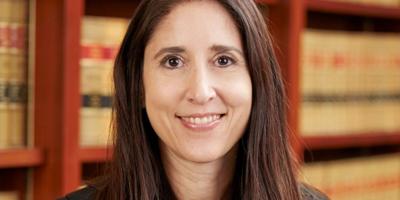


California Supreme Court Chief Justice Patricia Guerrero
SACRAMENTO — The California Supreme Court has ruled, for the first time, that some litigants who cannot afford a court reporter are entitled to electronic recordings of proceedings.
Chief Justice Patricia Guerrero wrote the unanimous opinion, filed Aug. 10. For this case, the vacancy on the court was filled by Cynthia Lie, a justice of the California Sixth Appellate District.
The opinion opened with a quote from the court’s 2018 decision, Jameson v. Desta, regarding the presumption of trial court judgments as correct and the burden of an appealing party “to demonstrate, on the basis of the record presented,” an error justifying reversal.
Family Violence Appellate Project and Bay Area Legal Aid, agencies that provide legal representation to people who are low income or indigent, have sued Los Angeles, Santa Clara, Contra Costa and San Diego county courts and alleged they fall short of Jameson obligations.
“Many courts throughout California do not employ sufficient court reporters to comply with their obligations under Jameson, such that an indigent litigant who requests an official court reporter often appears in court and finds that no official court reporter is present,” Guerrero wrote. “The indigent litigant must either accept a continuance of the scheduled proceeding or consent to go forward without the means to create an official verbatim record. Both options are unpalatable.”
Again quoting Jameson, the court noted that “Prior to the drastic cuts in judicial budgets over the last decade, superior courts in California generally made official court reporters routinely available for civil trials. As a result of budget reductions, however, many, but not all, of the superior courts throughout the state have adopted new policies limiting the availability of official court reporters to only a narrow category of civil cases, which generally do not include ordinary contract, personal injury, or professional negligence cases.”
FVAP and BayLegal pointed to a November 2024 report from the California Access to Justice Commission citing more than 1 million hearings and trials in the prior year without a superior court providing means to create an official transcript. They also cited a January 2023 Los Angeles County Superior Court general order about the limited availability of official reporters and said Santa Clara County “family law departments largely stopped providing official court reporters in the middle of 2020.”
The court said despite Jameson, many indigent litigants must choose between accepting a continuance of proceedings to a time when a reporter might be available or going forward without any official record. A BayLegal lawyer said many people who initially agree to a continuance or two ultimately decide to just go ahead without a reporter.
“In response to this systemic inability to comply with Jameson, several courts have issued general orders authorizing the use of electronic recording equipment to create an official verbatim record in certain situations when a court reporter is unavailable,” Guerrero wrote, spotlighting a Los Angeles County program that started in September 2024, followed by Santa Clara in November and Contra Costa in December, but not San Diego.
Also requests from FVAP and BayLegal asking the Supreme Court to order a state law prohibiting electronic recording “materially impairs the inherent power of the courts,” Guerrero wrote. The court asked the four named counties to show why the agencies were wrong to request a policy of requiring electronic recordings whenever a reporter was unavailable.
With numerous support briefs filed, the court asked Attorney General Rob Bonta for input. He sided with the agencies’ due process argument for “proceedings involving a low-income litigant, at least where a court reporter is unavailable and electronic recording equipment is already installed,” Guerrero wrote.
But professional associations, including a court reporter union, called for dismissal by disputing the factual record regarding why courts haven’t been hiring enough reporters and challenging the reliability and accuracy of electronic records. They said reporter supply will increase with licensing reciprocity agreements and certification of voice writers, who can be trained more quickly than shorthand stenographers. One San Diego County court reporter testified to being unaware of a recent instance "where the Court has been unable to accommodate a litigant’s timely submitted request for a court reporter under Jameson.”
The state Supreme Court agreed county superior courts don’t have the discretion to decline a request to comply with a request for an official verbatim record when a litigant demonstrates the inability to pay for a private reporter. It detailed the history of the English common law tradition of a court’s power “to facilitate meaningful access to justice for indigent litigants” and how state law has codified that condition for the modern age, including its own decisions addressing concerns beyond typical “court fees and costs,” such as posting bonds as security for damages or the shared cost of arbitration fees, much of which was rolled into Jameson.
“Although this court has never held that a civil litigant has a right to an official verbatim record of trial court proceedings, the general availability of such a record is presupposed under California law,” Guerrero wrote.
But the court agreed the policies at the heart of the agencies’ challenge “placed new burdens on indigent litigants.” And although state law does provide for alternative procedures for when an official record is incomplete or unavailable, which “are by no means a facially inadequate method for creating an adequate record for purposes of appeal,” approaches like “settled statements suffer from well-known shortcomings that preclude their use as a systematic substitute for an official verbatim record of trial court proceedings.”
After explaining “equality has not been achieved” in the years since Jameson, Guerrero continued, the court noted the superior courts didn’t contest the agencies’ statements about access, but rather chose to “emphasize the severity of the problem.”
While a portion of state law limits court usage of electronic recording to “civil, misdemeanor and infraction cases,” the court noted that section “is silent regarding its application to indigent litigants who otherwise have no means to obtain an official verbatim record. Thus, like other mandatory statutes that ‘do not themselves contain an exception for needy litigants,’ courts may imply an exception” if doing so preserves meaningful access.
“Even if the Legislature had attempted to curtail the inherent power of the courts in this respect, we would have serious doubts that such an effort would be permissible under the California Constitution,” Guerrero wrote. “We need not in this proceeding investigate the various causes of the courts’ inability to comply with Jameson or assign blame for the unfortunate circumstances in which indigent litigants find themselves. It is sufficient to recognize that, whatever the cause, courts are frequently unable to provide indigent litigants with the means to obtain an official verbatim record. Courts must provide a remedy.”
The court rejected the urging from support briefs to “exhaustively define unavailability” of court reporters in this context and said the question distills to whether access to justice is inhibited when available recording technology isn’t used. Finding that to be the case, and determining superior courts don’t have discretion and must imply an exception to when electronic recordings are permitted, the court said the limits must be lifted.
The agencies were represented by attorneys with the firm of Covington & Burling and the Community Legal Aid SoCal and Bay Area Legal Aid organizations.
The county superior courts were represented by the firm of Wilson Sonsini Goodrich & Rosati.