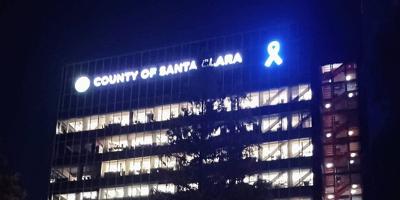


Santa Clara County Government Center, San Jose, California
SAN JOSE — Federal spending cuts can justify an "emergency declaration" that triggers a special election to ask voters to raise hundreds of millions of dollars in local taxes, a California state appeals court has ruled.
On Sept. 23, a three-justice panel of the California Sixth District Court of Appeals ruled that Santa Clara County did not violate state election law by asking voters to raise sales taxes in 2025.
In the ruling, the justices specifically upheld the passage of the referendum, known as Measure A, and turned aside a challenge from opponents who claimed Measure A was illegal.
The Santa Clara County Board of Supervisors had placed the referendum on the ballot for the November 2025 special election. That election had been called statewide by the California state legislature to ask voters to sign off on new mid-decade congressional maps drawn by Democrats, ostensibly to push back on attempts by lawmakers in Texas and other states to redraw their states' maps to benefit Republicans in the 2026 election.
The California Democrat-drawn maps secured voter approval.
However, at the same time, the Santa Clara County Board moved to take advantage of the special election by seeking approval of Measure A.
Under Measure A, the county asked voters to approve a sales tax increase of 5/8 cents to be in place for five years.
The county board said the sales tax increase was needed to raise $330 million per year to support county services and avoid "service cuts" which the county board said would result from the passage of the 2025 federal budget. That budget included reductions from the previous years in spending on Medicaid and other welfare programs, such as the program known as the Supplemental Nutrition Assistance Program (SNAP), also known as "food stamps."
The county asserted it would lose "more than $1 billion" in funding from the federal spending cuts.
Under California law, however, the county would have been generally forbidden from taking Measure A to the voters in the special election. Instead, election law reserves such referendums for general elections. The next general election would have been in 2026.
However, the law provides an exception, allowing governments to advance ballot measures to voters in a special election by declaring an "emergency."
In this case, the Santa Clara County Board did just that, declaring the federal spending cuts amounted to an "emergency" requiring immediate action and a special election in November 2025.
The ballot question included politically-tinged references to "President Trump and Congress," as well, and asserted the measure was needed to ensure the creation of a funding pool that "cannot be taken by the federal government..."
The measure ultimately was approved by voters.
However, it was challenged in court by opponents who asserted the "emergency" declaration was illegal, invalid and illusory.
The challengers asserted the "emergency" didn't meet any established legal criteria for an emergency.
They asserted, for instance, that the "emergency" was "self-created," as it was merely the result of the county's unwillingness to curtail spending in any way in response to decreased funding, including abiding by legal requirements to restrict illegal immigrants from receiving county aid.
They further argued the ballot language was biased and intended to mislead voters into voting yes.
A Santa Clara County Superior Court judge, however, refused to overturn the referendum. And on appeal, the justices backed that ruling.
The appellate decision was authored by Sixth District Justice Allison M. Danner. Justices Mary J. Greenwood and Adrienne M. Grover concurred.
In the ruling, the justices said the county board was entitled to define its situation as a "fiscal emergency," as they wished, and to decide they could not wait until 2026 to address any revenue shortfalls.
"... We recognize the reasonableness of the conclusions drawn therefrom and defer to the Board’s legislative assessment of the magnitude and urgency of the circumstances," the justices wrote.
And the justices said the challengers' assertions concerning the county's own role in creating its "emergency" amounted to mere policy disagreements over the county's response to the federal cuts and could not serve as basis to question whether the emergency declaration was legal or justified.
The appeals panel allowed the vote on Measure A to stand and will allow the tax increase to move forward.
Challengers were represented in the action by attorney Jason Bezis, of Lafayette.