
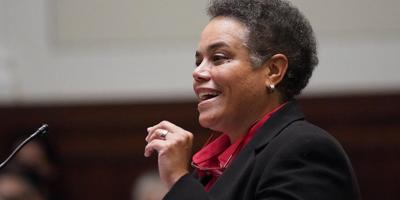



California Supreme Court Justice Kelli Evans
SACRAMENTO — A unanimous California Supreme Court ruling revived state-court lawsuits against a school district, finding the sexual abuse and assault litigation can proceed despite the plaintiffs bringing similar actions against the same school district in federal court.
The underlying litigation involves seven unnamed plaintiffs, all identified as John or Jane Doe, who sued Marysville Joint Unified School District and a counselor they accused of committing sexual assault at Kynoch Elementary School between 1993 and 2001.
Marysville is located about 40 miles north of Sacramento.
According to court records, the plaintiffs twice filed and voluntarily dismissed nearly identical complaints in a state court, then a federal court, then again filed a complaint in Ventura County Superior Court.
After a venue transfer, the school district asked Yuba County Superior Court Judge Debra Givens to dismiss the most recent complaint, invoking what federal courts call the “two-dismissal rule” wherein a plaintiff can voluntarily dismiss a claim without a court order, and can do so without prejudice. But if the same plaintiff later dismisses a state or federal lawsuit based on the same claim, the dismissal notice equates to a ruling on the merits, under the rule.
In November 2021, Judge Givens agreed with the claim preclusion argument, after which a California Third District Appellate Court panel affirmed on a split decision in 2023, finding it had to follow the federal rule.
However, the state Supreme Court reversed that ruling, holding the preclusion affects only an attempt to refile the same claim in a federal court and doesn’t apply when a plaintiff initiates an identical lawsuit in California state court.
Justice Kelli Evans wrote the unanimous opinion, filed July 2. For this case, the vacancy on the court was filled by Justice Lamar Baker, who serves on California's Second District Court of Appeals.
“The underlying facts are not relevant to the issues on appeal,” Evans wrote, saying the court’s only question was “the preclusive effect” of commencing and dismissing other lawsuits and noting the U.S. Supreme Court hasn’t “addressed the question of what law governs the claim-preclusive effect of a judgment disposing of both federal law and supplemental state law claims.”
However, Evans continued, the California court agreed with the Doe plaintiffs in the relevance of the 2001 U.S. Supreme Court ruling, Semtek International v. Lockheed Martin. Evans noted that although that case dealt with involuntary dismissals, it nonetheless “rejected the premise that any judgment denominated ‘on the merits’ is necessarily a judgment entitled to claim-preclusive effect.’ ”
The California court said the Semtek ruling established “adjudication upon the merits” doesn’t have the meaning in the relevant federal court rule that the school district defendants insisted in their arguments. Evans reviewed the court’s ruling and reasons, and noted the ultimate holding that dismissing a federal lawsuit because of statutory limitations in California didn’t preclude plaintiffs from trying to sue in Maryland. Specifically, the court found “no conceivable federal interest in giving that time bar more effect in other courts than the California courts themselves would impose.”
Evans said the school district argued and the appellate court reasoned Semtek concluded that when there is jurisdiction diversity, state law dictates if dismissal of a federal claim would block state litigation. But the California justices determined the Semtek court’s holding, and the underlying interpretation of the federal court rule, “does not depend on the source of the federal court’s subject matter jurisdiction. Indeed, it would be highly unusual for the interpretation of a federal rule to depend on such a thing.”
Because the appellate court misread Semtek, Evans wrote, the remainder of its reasoning was flawed. And the school district likewise failed in its attempt to further refine the appellate decision. The California Supreme Court then examined whether there might be another reason the voluntary dismissal of federal claims would inhibit a state lawsuit, but found none.
“Both the California and federal rules of claim preclusion point to this conclusion,” Evans wrote. “Although the standards differ in certain respects, they both require a final judgment on the merits. In California, a voluntary dismissal without prejudice is not a judgment on the merits, and therefore, has no claim-preclusive effect upon a later suit.”
Evans further noted the district couldn’t “identify any other basis for giving Does’ voluntary dismissal claim-preclusive effect” and just because some adjudications can have the effect it argued, there isn’t evidence the dismissal in this case meets that standard.
“Even if we were to assume that the federal dismissal has some preclusive effect under federal law, a question we need not decide here, we do not think it would be so broad as to preclude the refiling of state law claims in state court,” Evans wrote. “The two-dismissal rule implicates federal interests insofar as it limits a plaintiff’s ability to repeatedly bring and dismiss the same claims in federal court to the detriment of the defendant and the court’s docket. But there is ‘no conceivable federal interest’ in the application of a federal procedural rule to state law claims raised in state courts.”
Representing the plaintiffs are Manly, Stewart & Finaldi and Esner, Chang, Boyer & Murphy.
Leah Spero, of UC Law San Francisco, filed a support brief on behalf of the plaintiffs.
The school district is represented by Spinelli, Donald & Nott; Horvitz & Levy; and McCormick Barstow Sheppard Wayte & Carruth.

