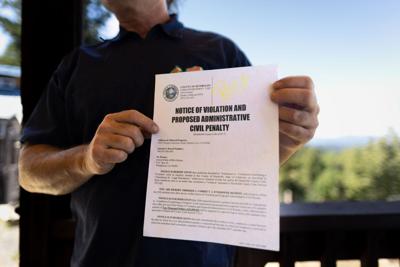


A Eureka, California area landowner holds a notice of penalties for alleged violation of Humboldt County ordinances governing marijuana cultivation.
EUREKA, CALIFORNIA — Humboldt County has agreed to shelve its controversial practice of using drones to search for illegal marijuana crops, under a settlement with a group of county property owners who claimed in court that they were subjected to millions of dollars in unconstitutional fines and limits on their availability to improve their land.
The settlement was inked on Aug. 19 and announced in Northern California federal court on Aug. 23.
The plaintiffs were represented in the action by attorneys from the Arlington, Virginia-based constitutional rights legal advocacy group, Institute for Justice.
In a statement concerning the settlement, Institute for Justice attorney Jared McClain said: “Humboldt County spent years fining people more than their homes’ value for things they never did, and then delayed their day in court for years until the pressure to sign a settlement agreement became too much to resist.
“Today that unconstitutional money-making machine is dismantled."
The deal marks the likely conclusion of a court fight that began in 2022, when a collection of Humboldt County property owners enlisted the help of the Institute for Justice on a lawsuit filed in San Francisco federal court.
The landowners, who live in the forests around Eureka, allege officials in the far northern California region accused them of illegally growing marijuana without sufficient evidence.
In their lawsuit, they assert the county rolled out its code-enforcement policy after California legalized recreational marijuana. By creating an abatement program, the county can cite landowners for nuisances or for violating permitting rules and, if the county alleges a connection to improper marijuana cultivation, “the daily fines automatically jump from a few hundred dollars to between $6,000 and $10,000 per violation, regardless of whether the violations pose any harm to the community.”
Primary evidence the county uses to write citations, according to the complaint, are satellite images of otherwise “harmless things like greenhouses” with no probable cause or further investigation. That can generate a $10,000 fine for the greenhouse, another $10,000 fine for unpermitted marijuana cultivation and a $10,000 daily fine alleging the landowner built the greenhouse after grading without a permit.
Plaintiffs in the action include Humboldt County landowners Blu Graham, Rhonda Olson, and married couple Corrine Morgan Thomas and Doug Thomas.
Federal Magistrate Judge Robert Illman, of the Northern District of California in Eureka-McKinleyville, dismissed the claim on the grounds the plaintiffs had yet to pay a fine, depriving of them of standing, while also saying the timing wasn’t right for either their Eighth Amendment claim or constitutional challenges to the relevant county codes.
However, the landowners appealed the case to the U.S. Ninth Circuit Court of Appeals.
There, a three-judge panel sided with the landowners in early 2025, agreeing Humboldt County's drone surveillance program and the penalties it generated ran afoul of the prohibition on excessive fines in the Eighth Amendment to the U.S. Constitution.
On appeal, the Ninth Circuit judges said it was clear that “lesser penalties could accomplish the same health and safety goals, and the county offers no reason to infer otherwise.”
“There are clear and concrete injuries stemming from the imposition of the penalties,” the panel wrote.
Following the win in appeals court reviving the lawsuit, the parties ultimately entered into talks to end the litigation.
Under the settlement, Humboldt County agreed to:
Erase every outstanding fine against the plaintiffs and withdraw all active notices, fines and fees;
Retract all of the allegedly false allegations against the plaintiffs that were published online or in local newspapers;
Provide a warning before issuing any future fines, giving owners 30 days to respond;
Provide specific notice of violations, with proof of actual marijuana cultivation to back up any charges;
Provide hearings within 60 days, with fines only allowed after a case is decided against a landowner; and
No longer holding building or development permits over alleged cultivation.
The federal court will retain supervision of the settlement for three years.
And the county agreed to pay the plaintiffs to cover court costs and attorney fees.
Following the settlement announcement, the Institute for Justice said the settlement sends a "simple message."
"The Constitution does not permit government to fine first and ask questions years later," the Institute said.
In the statement, McClain added: "Our clients get their lives back, the county has agreed to repeal and replace its bad procedures, and every homeowner in the West now has a federal appellate decision holding that crushing fines and endless delay are real constitutional violations that can be challenged in court immediately.
"That win reaches far beyond Humboldt and will ensure that no one else has to wait years just to have their day in court.”