
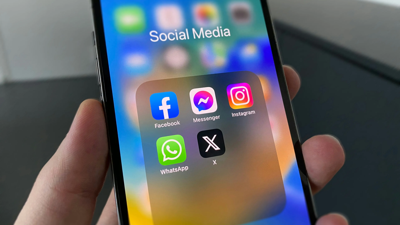



Social media apps are displayed on a smartphone screen.
SAN FRANCISCO — Facebook- and Instagram-parent company Meta can't pull the plug quickly on thousands of so-called "social media addiction" lawsuits pending in northern California federal court, after an appeals court rejected Meta's claims that a federal law that makes it hard to sue social media companies doesn't give them absolute immunity from being sued over content on their sites.
On Aug. 10, a three-judge panel of the U.S. Ninth Circuit Court of Appeals dismissed Meta's appeal after an Oakland federal judge had declined to pull the plug on all of the claims in the thousands of lawsuits in federal court.
In the ruling, however, Ninth Circuit Judge Jacqueline Nguyen and her colleagues specifically knocked down Meta's claims that federal law completely immunizes them and other social media companies from being sued for allegedly intentionally designing their products and platforms to addict young people, allegedly causing or fueling a raft of individual and societal harms, while boosting the profits of the social media platform operators.
Rather, the appeals panel said the provision of federal law at issue, known as Section 230 of the federal Telecommunications Act, only gives Meta and its fellow social media companies a powerful tool to use to fight the lawsuits in court, or at least limit some of the multi-billion dollar damages that may ultimately be at stake.
Nguyen was joined in the opinion by Ninth Circuit Judge Mark J. Bennett and U.S. District Judge Kiyo A. Matsumoto, of the Eastern District of New York, who was sitting on the panel by special designation.
The decision comes as the latest step in a sprawling legal fight that have embroiled social media companies for more than four years.
Since early 2022, thousands of lawsuits have poured into state and federal courts across the country, filed by individuals, families, school districts, state governments and more.
Defendants in the actions include Meta, Google and a host of other big tech and social media platform operators, including the owners of the TikTok and SnapChat platforms.
The lawsuits claimed social media operators should be held responsible for allegedly creating a mental and behavioral health crisis among American children and teens, encouraging young people to engage in potentially harmful behaviors, while increasing dysfunction, anxiety, depression and other psychological and emotional disorders and maladies.
And all of the lawsuits are seeking at least millions of dollars each from the companies for the alleged harm their products have caused.
In recent years, trial lawyers, government officials, left-wing activists and others have publicly discussed an overall grand strategy behind the litigation effort, as they seek to replicate the legal and regulatory campaign that produced strong new government regulatory powers and which wrung billions of dollars out of tobacco companies over the societal harms of cigarette smoking in decades past.
More than 3,000 of the lawsuits against social media companies have been consolidated in federal court in Oakland before U.S. District Judge Yvonne Gonzalez Rogers. Many other lawsuits, however, have remained pending in state court.
In New Mexico and other states, for instance, claims under state law have avoided being transferred into federal court and have advanced to trial.
From the beginning, social media companies have argued the lawsuits should be disallowed because they say Section 230 should be read to shield them from being sued over such claims at all.
Section 230 generally immunizes internet service providers and social media platforms from being held legally liable for content posted online by others using their platforms.
The social media companies have attempted to argue that Section 230 should also prevent them from being sued for alleged harms caused by people consuming and interacting with content posted on their platforms.
To this point, courts have largely disagreed, ruling in several cases that those protections don't necessarily apply to claims that the social media companies allegedly designed their products to amplify the alleged harmful products and feed more of it to young users, in particular, to generate "compulsive use" of social media.
And while no federal lawsuits have yet advanced to trial, the claims have already generated verdicts worth many millions of dollars.
In New Mexico, a jury ruled against the social media companies for allegedly failing to warn users about the risks of addiction, depression or other mental or emotional harms which can allegedly be caused by social media use by young people. That verdict has resulted in damages worth a combined $942 million.
In Los Angeles County court, a jury awarded the family of a single young person $6 million over her alleged mental illness allegedly caused by social media use.
However, trial lawyers and their allies have indicated those awards are only the beginning of their pursuit of ultimate payouts worth potentially hundreds of billions of dollars, as well as potentially new laws and rule empowering government officials to regulate and limit social media in America.
With the stakes high, Meta attempted to move quickly to secure an order from the Ninth Circuit bringing the lawsuits to a potentially much quicker and less costly end under Section 230.
In Oakland federal court, Judge Nguyen agreed that Section 230 should produce strong skepticism among judges over many of the claims advanced in the social media addiction lawsuits.
But the judge refused to dismiss the lawsuits entirely.
While appellate procedures typically wouldn't allow Meta to appeal the judge's decision at this relatively early stage in the litigation, Meta appealed to the Ninth Circuit, nonetheless.
On appeal, the Ninth Circuit panel agreed that it lacked jurisdiction to hear Meta's appeal at this point and dismissed the petition — but not before explicitly agreeing with Judge Nguyen that Section 230 doesn't grant social media companies statutory immunity from the legal claims.
They noted that while Section 230 provides protections for social media operators from lawsuits over content posted on their site by others, it doesn't necessarily shield them from lawsuits over "the creation of content."
And they said Congress did not include language in Section 230 to explicitly immunize social media companies against lawsuits.
Rather, courts are left to determine if a legal claim is allowable under Section 230 or not.
"... We hold that Section 230 provides a defense to liability, not immunity from suit, and an order denying this defense can be effectively reviewed on appeal from a final judgment," Nguyen and her colleagues wrote.
The ruling means the thousands of consolidated cases before Judge Nguyen can continue to proceed.
Meta is represented by attorneys from the firms of Davis Polk & Wardwell, of New York, and Covington & Burling, of Washington, D.C.