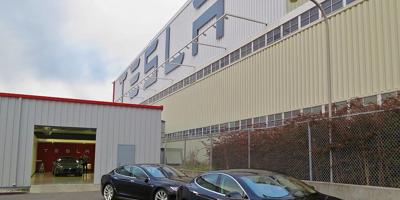


Tesla factory, Fremont, California
SAN FRANCISCO — A state appeals panel has agreed certain vehicle operators should be allowed to bring wage dispute lawsuits, finding they are exempt from the Federal Arbitration Act based on their role in interstate commerce, even if the vehicles they drive never make it onto a public street with them behind the wheel, much less cross state lines.
At issue are people who work as “yard hostlers,” specifically those on the Tesla payroll tasked with moving 53-foot trailers full of auto parts shipped to the factory from other states around factory grounds.
Kenneth Doss, seeking to lead a class action against his former employer, convinced Alameda County Superior Court Judge Michael Markman that, although hostlers only work on Tesla property, they are nonetheless “transportation workers” exempt from compulsory arbitration.
Tesla challenged that ruling before the California First District Appellate Court, which filed its opinion on the matter June 11. Justice Carin Fujisaki wrote the opinion, joined by Justices Victor Rodriguez and Therese Stewart.
Doss worked for Tesla in Fremont from 2017 through 2021. In response to his allegations the company violated the Labor Code and Unfair Competition Law, Tesla pointed to the arbitration provision in his employment offer letter and also argued hostlers don’t have a role in sending goods across state or national borders.
“The flow of commerce does not stop at the loading dock door,” Markman wrote. “The final step over the threshold — actually receiving the product — that has traveled from elsewhere is still part of the flow of commerce.”
The panel noted Section 1 of the FAA doesn’t apply to contracts for “seamen, railroad employees or any other class of workers engaged in foreign or interstate commerce,” then explained it agreed with Markman that hostlers fall under that umbrella.
“Doss played a direct and necessary role in the completion of interstate commercial transactions,” Fujisaki wrote. “While the record here does not indicate that Doss physically unloaded the trailers, he performed preparatory work necessary to that end by moving the trailers from the part of the factory grounds where they were temporarily parked to the warehouse where they could be safely and efficiently unloaded.”
The panel said it’s significant the trailers that hostlers move remain packed after arriving from out of state and the contents aren’t removed until after hostlers are done. A 2022 U.S. Supreme Court opinion, Southwest Airlines v. Saxon, established that the act of unloading a vehicle constitutes interstate commerce activity for Section 1 purposes, which Fujisaki wrote means “the necessary preparatory work of Tesla’s yard hostlers to facilitate that unloading likewise fits the bill.”
Fujisaki further explained the panel’s distinction between “the completion of an interstate delivery by truck and trailer from, for instance, the hand delivery of a package to a residence,” noting the trailers containing car parts were “instrumentalities of interstate commerce” and also explaining “there was no temporary cessation of interstate movement at a remote warehouse. The very trailers that traveled across state lines are essentially handed off to Tesla’s yard hostlers to facilitate completion of the delivery and receipt of the goods contained therein.”
However, the panel did say Judge Markman erred by ruling a state Labor Code section negated the entire arbitration agreement, finding it didn’t have that power over “Doss’ causes of action for overtime violations, meal and rest break violations and wage statement violations, as those are not actions for collection of due and unpaid wages within the scope of the statute.”
In an unpublished portion of the opinion, the panel said Tesla failed to show Markman wrongly ruled a class waiver provision was invalid. It noted Doss showed evidence the amount of money individuals could hope to secure through litigation was modest — about $25,000 — and said the judge could reasonably infer Doss or class members might encounter obstacles through arbitration that wouldn’t present through litigation.
Tesla further argued Markham should’ve severed the class waiver clause and enforced the rest of the arbitration agreement. The panel agreed on the presence of legal error in that determination.
“The class waiver was the only provision the trial court expressly found to be substantively unconscionable, even though Doss’ arguments on substantive unconscionability pertained to several other provisions in the arbitration agreement,” Fujisaki wrote. Although it found some of Doss’ claims should go to arbitration, the panel said severing the class waiver “would appear to require no augmentation or reformation other than limiting the two offending provisions so as to permit class arbitration.”
However, it continued, “Doss challenged several other provisions in the arbitration agreement as substantively unconscionable,” and Markman made no ruling on those issues. “Assuming for the sake of argument that these provisions are substantively unconscionable, the court could potentially refuse to enforce the entire arbitration agreement as permeated by unconscionability.”
Because of those factors, the panel remanded those issues so Markman could decide “whether the arbitration agreement is subject to an unconscionability defense based on” Doss’ arguments.
Tesla is represented by Morgan, Lewis & Bockius.
Doss is represented by Thierman Buck and The Markham Law Firm.