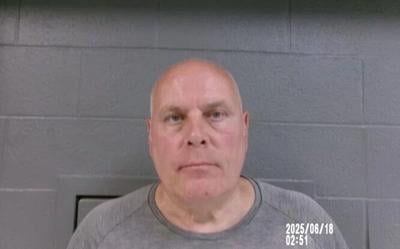



Clark Sinclair
GRAFTON – A former Taylor County sheriff and school board president has filed a civil lawsuit accusing leaders of a Grafton Masonic lodge of engineering a malicious prosecution that led to his arrest.
Clark Sinclair filed his 35‑page complaint June 14 in Taylor Circuit Court against Grafton Masonic Lodge No. 15, the Most Worshipful Grand Lodge of Ancient, Free and Accepted Masons of the State of West Virginia and five lodge members (Christopher A. McIntosh, Dale W. Zinn, John C. Snyder II, Delbert J. Carpenter and Terry M. Gabbert) as defendants.
Sinclair’s lawsuit comes just months after a Taylor County jury acquitted him of grand larceny and a lesser petit larceny charge stemming from a June 2024 dispute over a decades‑old Mosler marble‑top safe and other lodge property.
According to Sinclair’s complaint, the criminal case never should have been brought. He says lodge leaders “gravely damaged” the reputation he built over decades in law enforcement, education and fraternal life.
Sinclair had long served in leadership roles at Grafton Lodge No. 15, including Worshipful Master and, most recently, Secretary, performing many of his secretarial duties from a home office with the lodge’s knowledge. Items such as a Royal typewriter, the lodge’s Masonic seal, postage stamps and a lodge computer were kept at his residence for that purpose, the filing states.
As Sinclair was transitioning out of the Secretary’s office after an election, the complaint says lodge officers never provided a formal turnover procedure, property inventory or deadlines for returning items. On June 23, 2024, Sinclair removed a single item from the lodge building – the Mosler safe – which he claims had been given to him by a prior lodge secretary, the late Bill Sinsel, and which he planned to refurbish and donate in Sinsel’s name after placing a replacement safe at the lodge.
Sinclair removed the safe “openly, in daylight” in front of his wife and son, according to the complaint. The filing says McIntosh, lodge treasurer, and trustee Snyder saw the safe being loaded but did not approach Sinclair or ask questions. Instead, the complaint alleges, McIntosh followed Sinclair’s trailer to his home, photographed the vehicle and trailer from the street, and sent those images to law enforcement while claiming Sinclair was stealing lodge property.
Before calling 911, McIntosh allegedly phoned Worshipful Master Zinn, trustee Carpenter and trustee Terry MGabbert, all of whom are accused of assenting to or urging criminal charges rather than attempting an internal resolution.
The complaint says photographs taken inside Sinclair’s lodge office weeks earlier – after lodge officers entered without his knowledge in April 2024 – were preserved “as a record in anticipation that Mr. Sinclair would not be re‑elected” and later used against him during the criminal investigation.
Sinclair accuses lodge officials of overstating the value of the safe and other items to meet the $1,000 threshold for felony grand larceny under West Virginia law. Sinclair alleges lodge representatives told investigators the safe was worth about $1,500, even though its true value was “a fraction” of that amount, and that they later folded in the value of a typewriter, seal and rolls of postage stamps – some of which Sinclair says he voluntarily turned over during a search – to reach the felony level.
Sinclair also claims McIntosh and Carpenter made inflammatory and false statements to law enforcement, including that Sinclair had a “history” of similar conduct and might possess classified FBI materials taken when he left that agency, and that he had left the Taylor County Sheriff’s Office “a mess” more than two decades earlier.
Carpenter, the complaint notes, did not live in Taylor County during Sinclair’s tenure as sheriff. The suit claims those statements were meant to portray Sinclair as dishonest and to lend urgency and credibility to the theft allegations.
According to the filing, officers went to Sinclair’s home after McIntosh’s report and found the safe in Sinclair’s garage. Sinclair allegedly admitted them into the house, acknowledged he had taken the safe, opened it and consented to its return, which required a commercial tow truck because of its weight. Despite some officers initially recognizing the dispute as a civil ownership issue, Sinclair says they seized the safe as evidence because the lodge had reported it as stolen.
Investigators later obtained a search warrant for other lodge‑related items, but the complaint says Sinclair again cooperated, guiding officers through his home and voluntarily surrendering the postage stamps and the Masonic seal, which had not been listed on the warrant and had not been reported missing at the outset.
The criminal case went to trial last August, and a Taylor County jury acquitted Sinclair of all counts after about two days of testimony from lodge members and law enforcement officers.
The lawsuit also says Sinclair spent about 49 days incarcerated as a result of the charges and alleged bond violations. During that period, his pre‑existing lymphedema allegedly worsened to the point that he experienced severe swelling, needed repeated medical care and at times could not dress himself or stand without help, including during his trial. His attorneys say he also suffered severe anxiety, stress and a worsening speech impediment that sometimes made him difficult for even family members to understand.
Sinclair claims the prosecution and publicity caused “significant public exposure and media coverage” that harmed his name and standing in the community he had served as sheriff, Board of Education member and board president. The complaint alleges the ordeal destroyed relationships he had built within the Masonic fraternity and in Taylor County civic life.
Sinclair also faults how the Grafton lodge and its parent body handled the dispute internally. He alleges Zinn refused to circulate his written explanation and claim of ownership to members and instead had him served with a trespass warning that barred him from the lodge building even though no suspension or expulsion had been imposed under Masonic procedures.
On the day of a special lodge meeting about his status, Sinclair says he called Grafton police to ask whether the trespass order was still in effect and, receiving no clear answer, texted lodge leaders that he feared arrest if he appeared – a message he says drew no reply as the meeting proceeded in his absence. The complaint also contends the Grand Lodge was formally notified in a June 6, 2025, letter requesting an investigation but failed to intervene or require corrective action despite its supervisory authority over subordinate lodges.
Sinclair accuses the defendants of malicious prosecution, abuse of process, defamation, false light invasion of privacy, intentional infliction of emotional distress and two negligence claims directed at the Grafton lodge and the Grand Lodge.
He says the defendants acted with “actual malice” and reckless indifference to his rights, and seeks compensatory damages for reputational, physical, emotional and economic harm, as well as punitive damages, attorney fees and other relief.
Sinclair, who unsuccessfully ran for the school board this spring, is being represented by Dayton C. Meadows V of Meadows Law in Morgantown.
Taylor Circuit Court case number 26-C-37