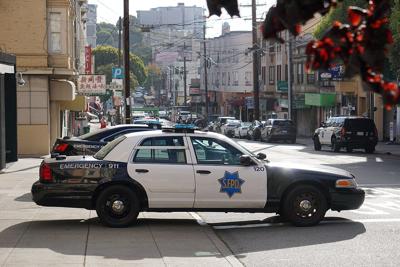


San Francisco Police vehicles
SAN FRANCISCO — A federal appeals panel has agreed qualified immunity is not available to San Francisco police officers facing accusations of framing a murder suspect.
The legal question centers on the April 2022 exoneration of Joaquin Ciria, who spent 32 years in prison before the San Francisco District Attorney’s Innocence Commission issued a unanimous finding he was “factually innocent” despite being convicted of a 1990 murder. During his malicious prosecution lawsuit, U.S. District Judge Kandis Westmore issued a ruling on qualified immunity which then proceeded to the U.S. Ninth Circuit Court of Appeals.
Judge Richard Paez wrote the 2-1 opinion, joined by Judge Mary Schroeder and filed June 5; Judge Eric Miller dissented.
Paez said the Innocence Commission found that George Varela, “the star witness at Ciria’s criminal trial and an accomplice to the actual shooter,” falsely named Ciria as the gunman. Ciria further alleged Varela, then 18, did so only after two SFPD inspectors, James Crowley and Arthur Gerrans, threatened to charge him with murder unless he implicated Ciria.
The November 2022 lawsuit, which also named SFPD Officer Nicolas Rubino, claims the detectives “deliberately elicited Varela’s statement naming Ciria through abusive and threatening tactics,” according to Paez, and that once they had a statement and Varela’s murder charge, never investigated Ciria’s alibi or sought to corroborate Varela’s statement. He said the police conduct amounted to deliberate indifference to or reckless disregard of fabricated evidence.
Judge Westmore initially limited Ciria’s recovery on state law claims to legal injuries incurred before his arraignment. She granted limited summary judgment to the government defendants and said Rubino and the city and its police department didn’t need to stand trial on the federal law claims. While Crowley and Gerrans won summary judgment on a claim related to failing to disclose “exculpatory evidence of rewards and incentives provided” during criminal proceedings, Paez wrote, she said they couldn’t invoke qualified immunity for claims of evidence fabrication and malicious prosecution.
According to the majority, Westmore held a reasonable jury could find that when officers interviewed Varela they “went beyond explaining to a witness the advantages of telling the truth” and threatened an 18-year-old who already had a juvenile record and didn’t feel free to leave, then explained exactly what information he needed to win protection from an adult murder charge and serve as a witness against Ciria. Varela responded with “Hey, whatever you said,” and confirmed he was talking with inspectors to be seen as a witness and not a suspect.
The only question on appeal, Paez explained, is whether a reasonable jury could use those facts to determine the detectives fabricated evidence and, if so, whether they would’ve known at the time that their conduct violated Ciria’s due process rights. He further said the panel lacked jurisdiction to “review purely factual disputes” stemming from the pre-trial record.
“Importantly, Ciria does not merely argue that the inspectors used ‘improper’ techniques or techniques that ‘violated state regulations,’ ” Paez wrote. “Rather, he has presented evidence that the inspectors ‘knew or should have known [their] interview tactics would yield false information. This provides the requisite circumstantial evidence of ‘dishonesty.’ ”
The majority noted the interrogation record shows repeated instances of Varela seeking assurances his compliance would keep him out of trouble, that he struggled to offer actual details about how Cirila was involved with the murder and never received notice of his rights to an attorney or to remain silent. The factual circumstances, Paez wrote, “present a triable question for the jury.”
Although the detectives said their techniques didn’t violate Varela’s Fifth or Fourteenth amendment rights, the majority said the essence of an evidence fabrication claim isn’t one of self-incrimination protections but “whether they used coercive or abusive tactics to elicit a fabricated statement against someone” and further, if they should’ve known they were collecting false information to be used in a criminal trial.
“Given the context of the full investigation and comments Varela made during the interrogation, a reasonable jury could find that the inspectors knew or should have known Varela was not telling the truth but merely adopting the fabricated story they fed him,” Paez wrote, before adding the law was clearly established at the time the inspectors interviewed Varela.
While finding the right in question was almost certainly self-evident, Paez continued that “even if it were not obvious, an array of Supreme Court cases confirm Ciria’s constitutional right not to be charged with deliberately fabricated evidence.” He further said disputes about threats and intimidation, or if officers should’ve known Varela’s statement was false, also are factual issues suitable for a jury trial.
Regarding the malicious prosecution claim, Paez said the evidence record includes “rumor and suspicions not based on objective evidence, an imperfect match to a general physical description, some circumstantial evidence linking the suspect to the crime but no physical evidence, and a failed identification from a key witness,” all of which are insufficient to establish the probability Ciria committed murder and contribute to the officers’ inability to invoke qualified immunity.
In his dissent, Judge Miller said Ciria failed to show his relevant rights were clearly established before the 1990 investigation.
“Notably, the coerciveness of the interrogation was not obvious to Ciria’s lawyer, who had access to the entire transcript of Varela’s interrogation — including all of the exchanges that the court today uses to decide that ‘Varela, scared by the threat of serious criminal liability, was adopting the story defendants fed him’ — but concluded that it would not be helpful to present any of it to the jury at Ciria’s criminal trial,” Miller wrote. “The officers did not use or threaten to use physical force against Varela, and their statements reflected standard interrogation methods. The officers’ observation that someone who drove a shooter to a crime scene might be subject to prosecution either as a principal or an accessory was an accurate statement of the law.”
Paez said Miller’s approach to the question disregards the limits of the appellate panel’s jurisdiction to only the question of what a reasonable jury might conclude based on Judge Westmore’s determinations.
“We decline the dissent’s invitation to weigh the evidence presented by Ciria,” Paez wrote. “That is a task for the jury.”
But Miller insisted he reached his conclusion without revisiting Westmore’s factual determinations, noting specifically her “characterization of the officer’s conduct as ‘feeding [Varela] the story he needed to tell to avoid’ a murder charge is not a factual determination, which we would lack jurisdiction to review,” but a legal conclusion about whether the tactics were coercive.
“I agree that if Valera had been coerced into giving a false statement implicating Ciria, that would violate the Fourteenth Amendment,” Miller wrote. “But whether Valera was coerced into adopting the story fed to him by police depends on the interrogation tactics that preceded Valera’s admission. To prevail, he needs to show that those tactics were unconstitutionally coercive.”
Miller further said “no case law in 1990 would have put the officers on notice that their interrogation tactics would amount to fabrication of evidence in violation of the Due Process Clause.” He also said the malicious prosecution claim should’ve failed because it was “reasonably arguable” probable cause existed to bring the murder charge.
Ciria is represented by The Norton Law Firm, of Oakland.
The government defendants have been represented by the San Francisco City Attorney’s Office.