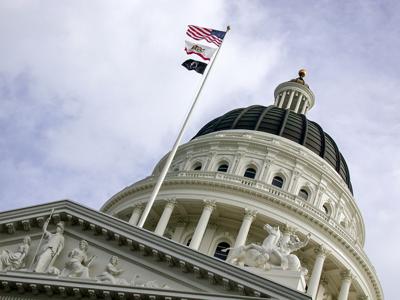


California State Capitol, Sacramento
SACRAMENTO — State legislation proposed by a San Francisco lawmaker seeking to let anti-ICE activists sue immigration officers in California state court could misfire, and instead create a new avenue to file civil lawsuits against state and local police, critics say, warning the measure could “unleash a torrent of new civil liability.”
Senate Bill 747, authored by Democratic state Sen. Scott Wiener, has passed the state Senate and is now under consideration in the Assembly. Wiener said he introduced the measure, called the “No Kings Act,” to give Californians the means to hold federal government officers accountable for the Trump administration’s “unprecedented disregard for civil rights,” including the conduct of U.S. Immigration and Customs Enforcement agents.
According to a summary of the measure by the Senate Judiciary Committee, SB 747 would create a private cause of action against governmental officials who violate a Californian’s constitutional rights, including protected speech, the freedom to peacefully protest and protections against unlawful searches and the use of excessive force.
A right to sue federal officers had been established by the 1971 U.S. Supreme Court case Bivens v. Six Unknown Named Agents, but more recently, the high court has limited so-called Bivens actions, limiting accountability for federal officials’ conduct, according to Wiener’s office.
A 1987 state law, the Tom Bane Civil Rights Act, does offer a litigation path for victims of constitutional violations, but only when officers’ actions include threats, intimidation or coercion. SB 747 provides a more expansive path to bringing lawsuits for monetary damages, according to the senator’s office.
“Californians need a way to stand up to this administration’s unprecedented disregard for their Constitutional rights,” Wiener said in a prepared statement last year. “The Trump administration has used its power to racially profile people and illegally disappear them, to punish political opponents and to cut off funding to universities. … While they take rights away, we will create a new path to justice through a clear legal remedy for willful violations of constitutional rights.”
But numerous California law enforcement associations now oppose SB 747. Attorneys for the Los Angeles Airport Peace Officers Association argue that the measure won’t be enforceable against federal officers but will lead to increased litigation against local and state officers.
“SB 747’s proposed amendment to the Tom Bane Civil Rights Act … will unleash a torrent of new civil liability on the shoulders of California’s peace officers while stripping away critical safeguards, like the specific-intent requirement that has long distinguished the Bane Act from its federal counterpart in 42 U.S.C. Section 1983,” the attorneys said.
The Peace Officers’ Research Association of California also argues that the measure would dramatically increase litigation risks for peace officers.
“(The bill) represents a significant expansion of liability from the current framework, where courts have emphasized that the Bane Act addresses only ‘egregious interferences with constitutional rights’ involving ‘deliberate or spiteful’ conduct,” the association said.
Some legal observers agree that more accountability for the actions of federal officers is needed.
“If a state or local government official violates the Constitution, he or she can be sued under 42 (U.S. Code) section 1983,” Erwin Chemerinsky, dean of Berkeley Law at the University of California, told the Southern California Record in an email. “But there is no federal law allowing such suits against federal officers. That is why it is so important to provide opportunities for such suits.”
Chemerinsky has frequently criticized the Trump administration’s enhanced immigration law enforcement operations. He has also regularly pushed back against assertions that the so-called federal supremacy doctrine, established under the U.S. Constitution, prevents state prosecutors from using state law to sue or criminally prosecute federal law enforcement officers for actions they take that the state finds objectionable.
Chemerinsky added that he did not believe California’s proposed new law would increase the risk of excessive civil litigation or a clogged civil justice system.
“Judges have tools to easily dispose of frivolous litigation,” Chemerinsky said.
Lawsuit reform groups – the Civil Justice Association of California and the California Coalition Against Lawsuit Abuse – declined to comment on the bill.
Supporters of Wiener’s proposal include the Orange County Board of Supervisors and the Inland Coalition for Immigrant Justice.